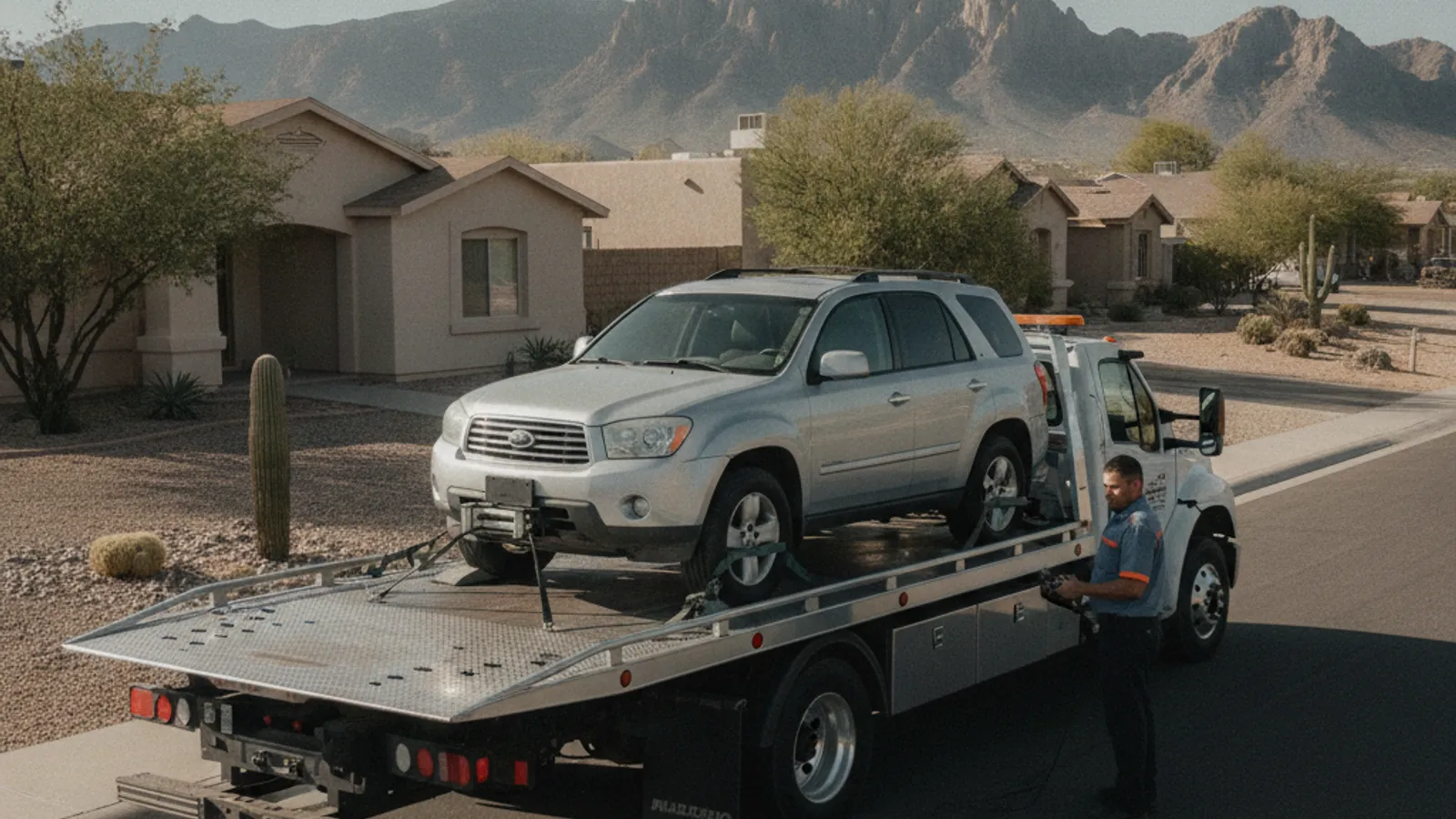
Most passenger cars require either a flatbed or a wheel-lift tow truck. The dispatch choice depends entirely on your vehicle drivetrain and condition. All-wheel-drive SUVs and heavily damaged cars need a flatbed. This keeps all four wheels off the ground. Standard sedans parked in tight spaces usually get a wheel-lift. Knowing the available towing services in El Paso TX ensures the right equipment arrives.
There isn’t one “towing services in El Paso TX” call. Dispatch matches the truck to the vehicle, and getting that match right the first time is the difference between a routine tow and a repair bill nobody expected. This guide walks through every option so you know what to ask for before the phone rings, and what the driver who shows up is actually doing.
The everyday options: flatbed vs. wheel-lift
Most calls sort into one of two methods. Flatbed towing places your entire vehicle on the back of the truck, all four wheels off the pavement. This is the required method for all-wheel-drive and four-wheel-drive vehicles, EVs, and any car with a wheel that won’t turn. Wheel-lift towing lifts just the drive wheels off the ground with a metal yoke, and leaves the other two rolling free for the trip. It hooks up faster and has a smaller footprint, which is why a wheel-lift truck can back into a crowded downtown parking garage or a tight apartment carport that a full-size flatbed can’t reach.
The choice isn’t about which truck looks sturdier. It’s about what’s spinning under your car while it moves. A standard front-wheel-drive sedan rolling on its rear wheels does nothing to the drivetrain. An AWD SUV doing the same thing sends power backward through a transfer case built to run only with the engine turning it, and that can wreck the internals in a few miles. For the full mechanical breakdown of when each method applies, and what happens if the wrong truck shows up, read our flatbed vs. wheel-lift towing guide.
When your vehicle needs a specialty tow
Standard trucks can’t safely move every vehicle. Specialized equipment handles extreme weights, fragile frames, and unique dimensions.
Heavy-duty equipment Box trucks, commercial vans, dump trucks, and buses require heavy-duty towing. These wreckers carry the torque and rated capacity to handle weight a standard wrecker isn’t built to lift. Say a commercial delivery van breaks down on FM 76, the road locals call North Loop Drive. TxDOT lists that stretch as a designated emergency alternative route for I-10 across its roughly 12.5-mile run from Horizon Boulevard to Fabens, which means it has to stay clear for emergency traffic. A heavy wrecker gets the lane open fast instead of leaving a disabled truck blocking a route the county depends on.
Motorcycles and RVs Motorcycles can’t ride on a standard flatbed with car straps. A motorcycle towing service uses soft straps and wheel chocks built for two wheels, so the bike travels without the suspension getting compressed or the frame getting scratched by a yoke or chain. Campers, fifth-wheels, and Class A, B, and C motorhomes need a different kind of underlift entirely, one built for length and a raised slide-out, not just weight. A breakdown during El Paso’s normal July average high of 96.1°F isn’t a wait-it-out situation with a family and a fridge full of food in the rig, so the right RV towing operator dispatches with that urgency in mind.
Exotic cars, classics, and EVs Low-profile sports cars and classics need exotic and classic towing: a load-angle flatbed or a covered trailer that keeps a front splitter or original paint from ever touching a ramp. Electric vehicles are their own category regardless of price point. Every EV, from a Tesla to a Mustang Mach-E to a Rivian, gets Tesla and EV towing, flatbed only, because the drive motors stay mechanically connected to the wheels the same way an AWD transfer case does. The driver puts the car into Transport Mode before it moves, which disengages the parking brake and suspension lockout so nothing fights the tow on the way up the ramp.
How dispatch decides which truck to send
The dispatcher isn’t guessing. They’re matching your answer to a short list of questions to the truck that’s already correct for the job, so the driver who shows up doesn’t need to reassess anything on scene. Have this ready when you call:
- The year, make, and model, or at minimum whether it’s front-wheel, rear-wheel, or all-wheel drive.
- Whether any wheel is flat, locked, missing, or won’t turn.
- Whether the vehicle is lowered, has a body kit, or has visible frame or suspension damage from a collision.
- The exact location, including whether it’s a tight garage, a parking structure, or open shoulder, since clearance affects which truck can physically get to you.
- Whether it’s actually stuck, or just needs a jump, a tire, fuel, or a lockout with no tow at all.
Answering those five things accurately is what gets the right truck rolling on the first call instead of a second dispatch after the wrong one arrives.
Roadside assistance instead of towing
Not every call needs a truck to hook up your car at all. Roadside assistance covers jump starts, tire changes, fuel delivery, and lockouts, the kind of problem that keeps you off the road but doesn’t keep your car from driving once it’s fixed. If your battery dies in a parking lot on the Eastside or you lock your keys in the car outside a Lower Valley shop, a service truck reaches you, handles it on the spot, and you drive away instead of riding in the cab of a tow truck. It’s also usually the faster call, since a jump or a tire change takes minutes on scene compared to a full tow, and it skips the trip to a shop entirely if that’s all your vehicle needed.
Match your vehicle to the right towing service
Use this quick reference to match your situation to the correct dispatch request.
- Standard front-wheel-drive sedan in a tight driveway: Wheel-lift towing
- All-wheel-drive SUV on the highway: Flatbed towing
- Commercial box truck or delivery van: Heavy-duty towing
- Dead battery or flat tire: Roadside assistance
- Harley-Davidson or sport bike: Motorcycle towing
- Class C motorhome or travel trailer: RV towing
Frequently asked questions
Can any tow truck take an AWD car?
No. An all-wheel-drive or four-wheel-drive vehicle has to travel with all four wheels off the pavement, which only a flatbed does. Leaving two wheels rolling on a wheel-lift sends power backward through a transfer case or center differential that expects the engine driving it, and that can damage the drivetrain in a short distance. The operators we dispatch send a flatbed for every AWD or 4WD vehicle without exception.
Does a motorcycle need a special truck?
Yes. A motorcycle doesn’t ride on a car-style flatbed or wheel-lift setup at all. It needs soft-strap tie-downs and wheel chocks designed for two wheels, since standard tow chains or a yoke built for a car’s frame will scratch the bodywork or put uneven stress on the suspension.
Can an RV be towed like a regular car?
No. A Class A, B, or C motorhome, a fifth-wheel, or a loaded travel trailer needs heavy-duty equipment built for length and weight, not the underlift a sedan uses. The size and configuration of the RV determines exactly which class of wrecker the dispatcher sends, so give the make, model, and length when you call.
What if I don’t know which service I need?
That’s normal, and it’s the dispatcher’s job to sort out, not yours. Give them the year, make, and model, or just describe the vehicle and what’s wrong. Mention if it’s lowered, visibly damaged, missing a wheel, or stuck somewhere tight like a parking garage, since any of those details changes which truck comes.
Is there an extra charge for specialty vehicles?
Cost depends on the vehicle, the equipment required, and the distance of the tow, and it varies by situation rather than following one flat number. For the full breakdown of what moves a bill up or down, see our guide on how much a tow costs in El Paso.
When you need reliable towing in El Paso, calling the right truck matters. Call (915) 615-2224 to get connected with a local professional who has the exact equipment your vehicle requires.