A tow truck at your bumper while you are still in the seat is a hard stop for most people. It happens in apartment lots off Horizon Boulevard, in shopping centers along I-10, and on shoulders under the Franklin Mountains. Sitting in the car does not, on its own, settle whether that vehicle can be moved. The verified Texas rules we can cite come from Occupations Code Chapter 2308 and the Texas Department of Licensing and Regulation. A specific occupied-vehicle rule is not on that list, so this page will not treat sitting inside as settled law.
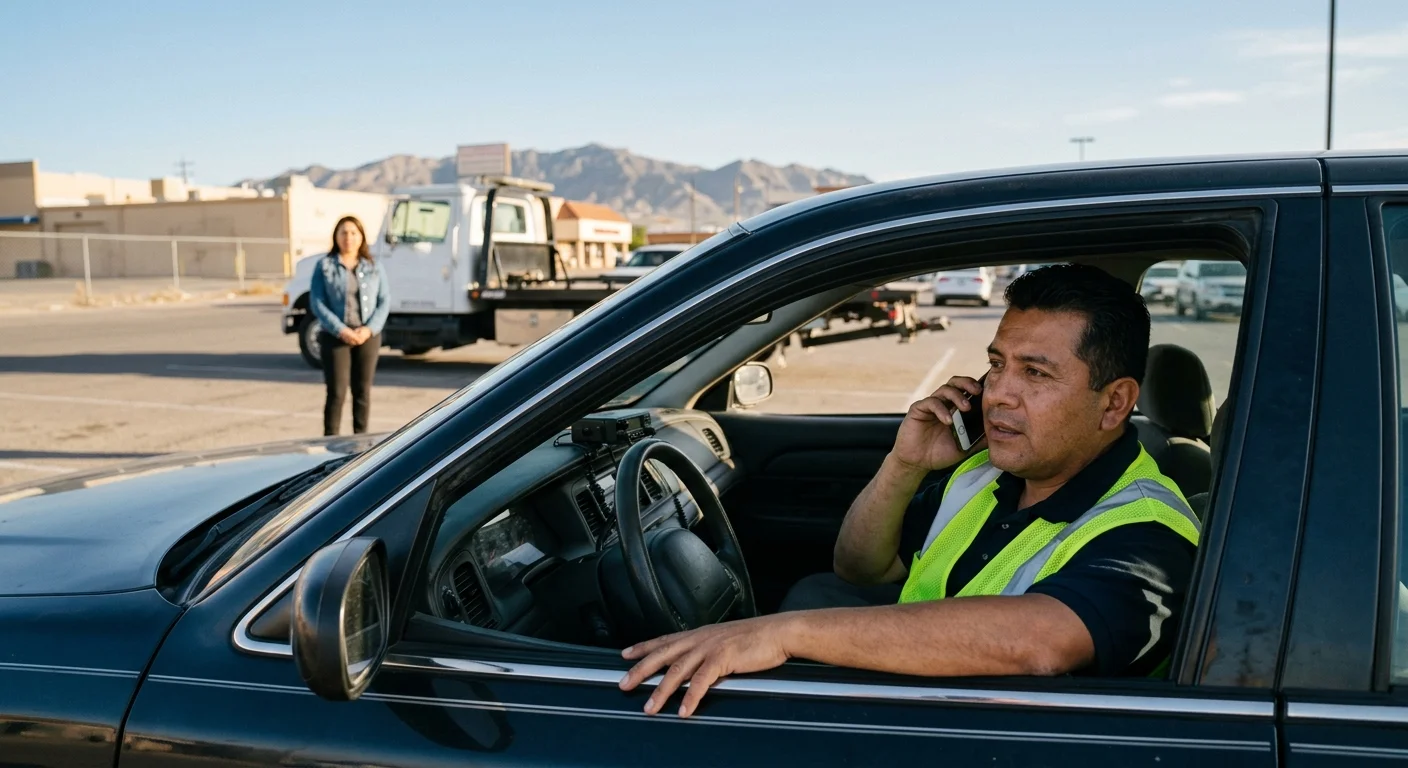
Stay with the car only when it is safe
Stay with the car when leaving it would put you in a live lane. I-10, US 54, and Loop 375 do not pause for a parking fight. Put the hazards on. Stay belted. If you do get out, keep kids on the side away from traffic.
A lot in Central or downtown is a different scene from a two-lane shoulder. The Westside sits under the Franklin Mountains, with tight lots and fast exits back toward I-10. Horizon City and Socorro sit farther out, with more open pavement and less room on the edge of the road. North Loop Drive, the local name for FM 76, runs about 12.5 miles from Horizon Boulevard to Alameda Avenue in Fabens. Most of that corridor is two-lane with 4-foot shoulders, through farmland and houses near Socorro and Clint. Standing in that travel lane to guard a parked car is a bad trade. TxDOT lists FM 76 as an emergency alternative for I-10, so those lanes need to stay clear.
Heat is part of the El Paso decision. The National Weather Service normal July high here is 96.1°F. Summer highs typically run in the mid-to-upper 90s. Sitting in a closed cabin to wait out a truck is a heat risk, especially with children or an older adult. Crack the windows if you stay. Get into shade if you can do it without stepping into traffic.
Do not treat the driver’s seat as a tactic. Do not lock an operator out. Do not grab chains, dollies, or lights. Do not stand in front of the truck. If the scene feels unsafe, call 911. Then call dispatch so the operator we send knows someone is still in the vehicle.
If you asked for a consent tow, staying with the car helps the driver match the right vehicle. If this is a private property towing job you did not request, staying put still does not replace talking to the operator. It also does not replace calling local law enforcement when the dispute is real.
Tell dispatch that someone is still inside
Say it in the first sentence: someone is still inside. Call (915) 615-2224 and lead with that. Occupancy changes how the operator plans the stop. We answer the line and route you to a licensed, insured operator. We do not own trucks, run a yard, or hold a tow license. You contract with the operator who does the work.
Name the exact spot. A lot off Mesa on the Westside is not a stall on Eastlake Drive in Horizon City. Eastlake is how you leave I-10 for the Horizon Boulevard corridor. A shoulder on Loop 375 in the Lower Valley is not a space in Central. Say the city or place: Central, Northeast, Westside, Lower Valley, Horizon City, Socorro, Clint, Fabens, or Sunland Park. Sunland Park sits across the New Mexico line. Do not treat Texas fee caps as the price for a New Mexico tow. Confirm that job with the operator before anyone hooks the car.
Then the vehicle: make, color, plate, and whether it is a car, a troca, or something heavier. Say whether a truck is already on scene, circling, or hooked. Say whether a child, an older adult, or someone who cannot walk far is inside. Say whether you called for help or whether this is a lot tow you did not ask for.
If you need roadside assistance instead of a hook, say that. A jump, a spare, or a lockout is a different job. The operator needs that before they commit equipment.
Keep the phone on. If you move from the driver’s seat to the sidewalk, say so. If police arrive, say so. Dispatch cannot see the lot. The operator cannot guess who is still in the cabin.
Separate a private-property tow from a roadside stop
A private-property tow and a roadside stop are not the same job. Mix them up and you will argue the wrong rule.
Private property means apartment lots, shopping centers, HOA streets, and business lots. Texas Occupations Code § 2308.201 lets cities and counties register trucks that do nonconsent tows, even when the company has no local shop. Operators who do that work over public roads need the matching TDLR license. You can check a name at the TDLR license search.
TDLR’s consumer rules on drop fees are verified, and they matter if you walk up mid-hook. If the vehicle is not fully hooked when you return, the operator must let you retrieve it at no charge. You do not have to prove ownership in that moment. If it is fully hooked and ready to roll, but it has not left the property, you may keep the car by paying a drop fee. Statewide maximums are $135 for vehicles 10,000 pounds or less, $190 for 10,001 to 25,000 pounds, and $244 above 25,000 pounds. Operators must take cash, credit, and debit for that drop fee. Local rules may set a lower cap. An El Paso city cap below the state numbers could not be confirmed from the sources this site uses. Ask the operator for the figure before you pay.
If the truck has already left the lot, you are into a nonconsent tow and storage. Statewide maximum nonconsent towing charges are $272 for vehicles 10,000 pounds or less, $380 for 10,001 to 25,000 pounds, and $489 per unit, with a $978 maximum, for vehicles over 25,000 pounds. Storage is a separate daily charge. Those are legal caps, not a quote from us. The operator sets the price on work you request.
If the fight is over an apartment stall, read what to do when a car is in an El Paso apartment space before you turn it into a standoff. Parking rules, reserved spots, and dumpster access are property issues. Sitting in the car does not rewrite them.
A roadside stop is the job you asked for: a stall, a crash, a winch, a flatbed move. Occupancy is expected. Tell the driver if you cannot get out. On a shoulder, other traffic has a Move Over duty when a permitted tow truck is using proper lights. Drivers must change out of the closest lane, or slow to 20 mph under the limit when that limit is 25 mph or more. That law is about passing drivers. It is not a reason to stand in the lane.
Police can order a tow. City of El Paso impound hours, lot address, and local wrecker rotation are not verified on this site, so we will not invent them. Use the non-emergency police number for a city-ordered tow, and use TDLR for licensing and fee-cap questions.
Do not treat an unverified rule as settled law
Search results will tell you a truck cannot move a car with a person in it. Treat that as a rumor until you hear it from the operator, from police, or from TDLR. Occupations Code Chapter 2308 is the Texas towing chapter we verified. It covers operator licenses, private-property nonconsent work, drop fees, storage, retrieval, and tow hearings. A clear occupied-vehicle ban did not appear in that verified set. So we will not publish “they cannot tow you if you sit there” as law.
We also will not publish the opposite as law. We cannot confirm that an operator may legally drive off with a person still in the cabin. That specific rule could not be confirmed either. The honest line is: ask. Ask the operator on scene. Ask local law enforcement if the scene is a dispute. Read TDLR’s consumer towing page for the rights that are in writing.
Repossession is a different track from a parking tow. A rule on whether a repo agent may take a car with you in it is not in the verified ledger for this site. Do not use the driver’s seat as a plan to stop a lender. Do not fight the truck. If a repo is underway, get clear of the vehicle and take the dispute to the lender and, if needed, the police.
Do not resist a tow. Interfering, grabbing equipment, or blocking the truck can turn a parking problem into a police problem. This page is not going to invent a fine or a charge for that. It is going to tell you to stay calm, document what you can from a safe spot, and use the hearing path if the tow was nonconsent.
Photos help later. Signage, the hook, the lot lines, and the truck’s markings are useful. Keep your distance while you take them. A video argument in a Horizon City lot or a Westside alley does not freeze the job. It just raises the temperature.
Confirm next steps with the operator and local authority
Once the truck is there, the next step depends on how far the hook has gone, not on who is sitting where.
If you returned before a full hookup, TDLR says you can retrieve the car at no charge, with no ownership proof required. Ask for that release in plain words. If the operator refuses, get to a safe spot and call local law enforcement. Then keep the TDLR complaint path in your pocket.
If the car is fully hooked and still on the lot, you are in drop-fee territory. Confirm the amount against the statewide caps above. Pay with cash, credit, or debit. Get a receipt.
If the truck has left, you are retrieving from a vehicle storage facility. Bring photo ID and proof of ownership. TDLR accepts a matching driver’s license, an insurance card, a title, a tax collector’s receipt, a lease or rental agreement, or TDLR forms. You pay towing and storage before the car is released. You do not pay to get ownership papers or personal items out of the car. That access is free, and the facility has to provide it within one hour during the hours TDLR sets.
Storage rates statewide are $20 per day or part of a day for vehicles 25 feet or less, and $35 for longer vehicles, with 2023 adjusted figures of $22.85 and $39.99. A facility cannot charge for multiple days if the car was stored less than 12 hours total. An El Paso city storage figure below those numbers could not be confirmed here. Confirm the yard’s current rate before you pay. Notification can add up to $50, waived if you claim the vehicle within 24 hours. An impoundment fee of up to $20 is allowed only if doors or windows were damaged and documented. Law enforcement or government fees are actual costs only. All other add-ons are prohibited under the TDLR consumer rules we verified.
If the tow was nonconsent, you have a hearing right. File within 14 days, excluding weekends and holidays, after the vehicle was placed at the storage facility or booted. The hearing is on whether probable cause existed. It must be held within 21 calendar days of the request. The court filing fee is $20. A TDLR complaint does not replace that filing. You can do both. Miss the 14-day window and you lose the hearing.
What happens if you do not pay is simpler than the stories online. The facility can hold the car until towing and storage are paid. Auction rules, city lot holds, and police-release steps for El Paso are not verified here, so we will not invent a timeline. Ask the storage facility and, for a city-ordered tow, the agency that authorized it.
For the broader owner-rights picture, including when a truck can take a car you did not summon, read whether a tow truck can take your car in El Paso. That page and this one split the same problem: the other covers consent versus nonconsent. This one covers the occupant still in the seat.
Confirm every dollar with the operator before anyone takes a card. We do not set the operator’s price. We do not promise a flat rate or a written quote. Ask, then decide.
When to call us
If you need a licensed operator for a breakdown, a private-property removal you control, or a car that will not move with people still on board, call us. We will take the occupancy, the location, and the vehicle details, then connect you with an operator who does this work. Call us at (915) 615-2224 and we’ll connect you with an operator who handles this work. Confirm the price and the plan with that operator before the hook.