The pickup still starts. The trailer behind it does not. That is a different job than a car that died on Mesa Street. If you need a grúa para trailer in El Paso, dispatch has to know what sits on the tongue, whether any wheel still turns, and how an operator can reach it.
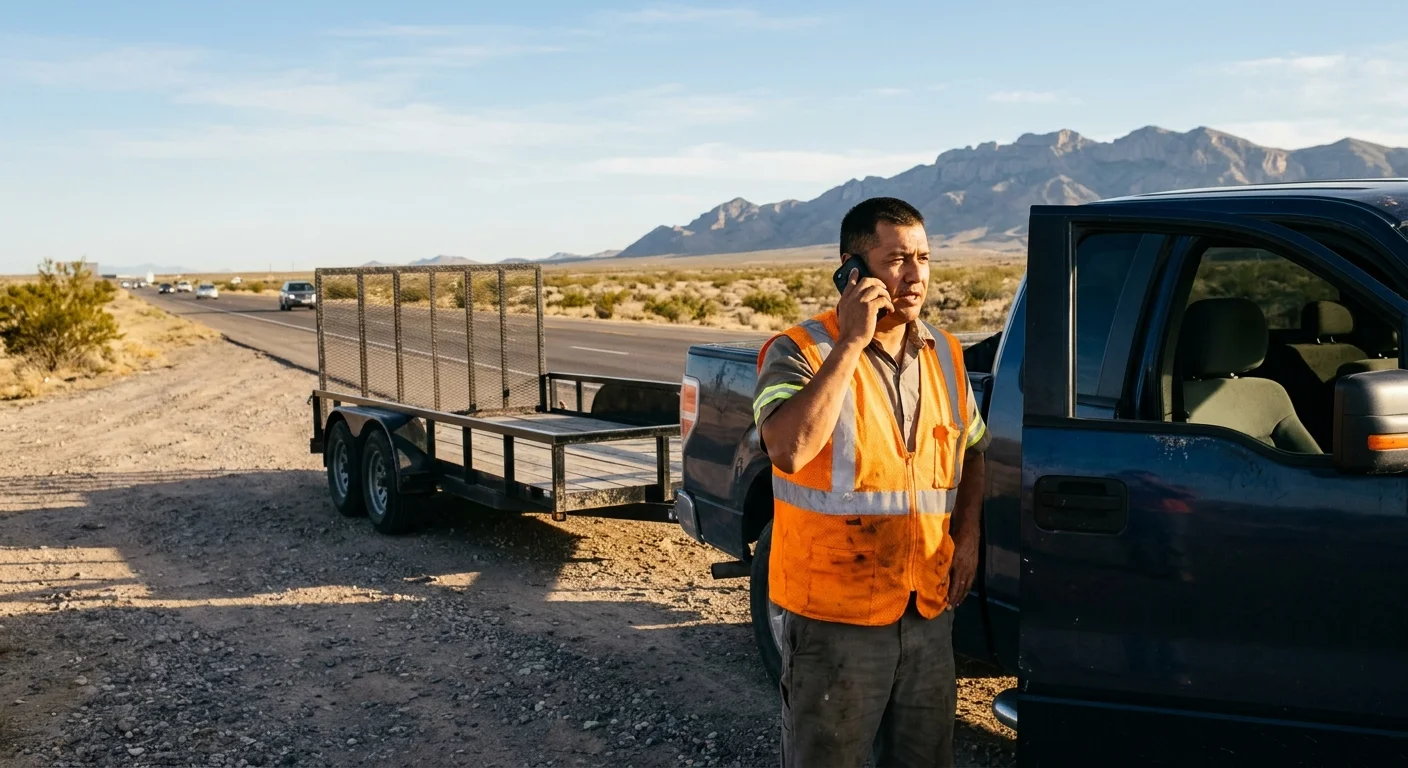
Identify the trailer and what is attached
Start with the kind of trailer. Say cargo, open utility, boat, or bumper-pull travel trailer. A box on two axles with a coupler is its own job. A motorhome is a self-propelled coach. A fifth-wheel uses a hitch in the bed of a pickup. Those recoveries need different notes. We already cover them in fifth-wheel trouble: what tow dispatch needs and motorhome broke down near El Paso.
Then say what is still on it. An empty landscape trailer is one call. The same frame loaded with pavers, a welder, or a riding mower is another. A boat still sitting on the bunks changes how the operator plans the move. We do not guess a weight class on the phone. Read the metal plate on the tongue or the frame. That plate is the rating that matters. If the plate is gone, say so. The operator we send will work from what you can show and from the trailer itself.
Tell us what is coupled to it. A pickup still on the ball is a combined unit until someone separates them. A trailer standing alone in a dirt lot in Socorro is a single piece. Name the hitch you see: a bumper ball, a pintle ring, a lock on the coupler. We do not assign a hitch class for you. If the manual or the plate lists it, read it off.
Give the destination if you have one. A shop on Alameda, a yard off Horizon Boulevard, a house in Horizon City, or a lot in the Lower Valley all change the run. Trailer towing in El Paso is not one corridor. Central, the Westside under the Franklin Mountains, the Northeast, and the farms toward Clint and Fabens sit on different roads. Name the city or the cross street.
If you have a plate number or a VIN, have it ready. If the trailer is a rental, say the company name. You contract with the operator who performs the work. Clear identity on the trailer keeps the pickup from turning into an argument at the destination.
Describe what can still roll or steer
This is the line that decides the truck. “It won’t go” is not enough. Say which wheels still turn by hand. Say which ones are locked, folded under, or missing. A trailer that will not roll cannot be treated like a car that still has two good tires.
Walk around it before you call. Look at both sides of each axle. A utility trailer with one seized hub and one free hub is one problem. A dual-axle cargo box with both drums locked is another. A travel trailer with the tongue jack buried in caliche will not steer even if the tires are fine. A boat trailer with a bunk that dropped can bind the hull against the frame. Describe what you see. Stay off a loaded trailer on a slope. Tell dispatch, and let the operator decide what to release on scene.
People searching grua para trailer often land on crane trucks for sale, or encyclopedia lists of camilla, percha, and horquilla. Those pages talk about cars. They skip a trailer that will not roll. In plain terms, a wheel-lift needs something that can still be picked at the tires or the axle. A flatbed can carry a trailer that cannot roll, if the trailer and the load fit the bed the operator brings. A camión pluma is a boom truck, a lifting crane. A camión grúa is the wrecker that recovers a disabled trailer. They are different machines. We do not pick the body style on the phone. The operator we dispatch confirms the setup after they hear whether the wheels turn. For a longer walk through those two recovery styles on cars, see flatbed vs wheel-lift towing in El Paso.
If the trailer has electric brakes, say whether the plug is still in the pickup. If a breakaway switch has popped, say that too. If a tire is off the rim, say which corner. If you already tried to pull it with a strap from another truck, say so. Bent tongues and twisted axles change the plan. Give the same level of detail you would for a car that cannot steer: which corner, what is touching the ground, and whether the frame is sitting on the drum.
Share pickup access and ground conditions
Where it sits matters as much as what it is. An operator can work a trailer on a wide I-10 shoulder in a different way than one sitting on FM 76. North Loop Drive, the local name for FM 76, is a two-lane rural road for most of its run from Horizon Boulevard to Alameda in Fabens. TxDOT lists it as an emergency alternative for I-10. Shoulders there are about four feet. Farmland and houses sit close to the pavement through Socorro and Clint. Say if you are in a turnout, in a field access, or blocking a lane.
Horizon City traffic usually reaches the commercial strip on Horizon Boulevard, FM 1281, from Eastlake Drive off I-10. A trailer that died in a dirt cul-de-sac there is a different pickup than one on the boulevard. The Westside under the Franklin Mountains funnels onto different exits than the Lower Valley. Loop 375 along the Border Highway is its own corridor. Name the road and the nearest cross street.
Ground in this desert is often caliche, an irrigation lateral, or a soft shoulder. Those surfaces can swallow a jack. In July, El Paso’s normal high is 96.1°F, and summer highs run in the mid-to-upper 90s. Hot asphalt can soften a pad under a tongue jack. Say if the trailer is on concrete, chip seal, dirt, or gravel. Say if a gate, a cattle guard, or a low tree line blocks a wrecker. If you are in an apartment lot or behind a locked industrial gate, have the code ready.
If you are on a highway, stay out of the travel lane when you can do it safely. Texas’s Move Over law applies when a permitted tow truck is stopped with proper lights. Other drivers must change lanes away from that truck, or slow as the statute requires. That is for the people passing you. It is not a promise about when a truck arrives.
Sunland Park sits across the New Mexico line. Anthony does too. If the trailer is on that side, say the state. We connect you with an operator who can work the location. We do not quote a New Mexico price.
Photos help. One of the full trailer from the side, one of the hitch, one of each axle, one of the approach. Dispatch uses them to brief the operator.
Separate the trailer from the tow vehicle
Say whether you want the trailer moved alone, or the pickup and trailer as a pair. If the pickup still runs, you may drive it off once the coupler is clear. If the pickup is also dead, you are describing two units. The operator confirms whether one truck handles both.
Keep the trailer coupled until the operator is on scene and tells you to pull the pin. A tongue that hits the dirt on I-10, or on a two-lane in the Lower Valley, can bind, dump a load, or block a lane. If a coupler lock is on the hitch, have the key in your hand. Safety chains, the wiring pigtail, and a weight-distribution bar all have to come off in an order the operator is willing to use.
If the trailer is a travel trailer with tanks or a propane bottle, say so. The operator on scene will tell you what has to be closed or left alone. If cargo can shift, describe the load. We do not invent a loading method for you.
If someone is waiting in the trailer, get them out before work starts. People do not stay inside a unit that is about to be moved. If the trailer is your only shade on a summer shoulder, say that when you call. The operator still needs a clear, empty box to work.
Take what you cannot replace. This call is usually a consent job you requested. You and the operator settle the destination before they hook up. If a trailer is later held after a nonconsent removal, TDLR sets how you prove ownership at a storage facility. Photo ID plus title, insurance, or another listed proof of ownership is required there, and storage access to grab documents is free. Ask which of those paths you are on before anyone leaves the scene.
Let the operator confirm the transport plan
Quick Tow El Paso answers the line and routes the request. We do not own wreckers, we do not run a yard, and we do not hold a tow license. The person who shows up is a licensed operator. Texas requires towing companies and operators on public roads to hold TDLR licenses under Occupations Code Chapter 2308. You can check a name at the TDLR license search. Pick tow truck operators, then search by name, city, or license number.
The operator sets the transport plan. They decide whether this is RV and trailer towing, a flatbed, or a heavier truck. We can tell them what you reported. They confirm on scene. There is no single United States price for a grúa, and there is no El Paso city rate we are allowed to publish for this work. For a light-duty hookup, this brand’s starting figure is a $95 hookup plus a per-mile rate. That is a starting figure, not the total. A trailer that will not roll may sit outside that light-duty bucket. Confirm the number with the operator before they hook the trailer. They set the price.
Texas does cap some nonconsent tows. Those TDLR maximums are $272 for vehicles 10,000 pounds or less, $380 for 10,001 to 25,000 pounds, and $489 per unit up to $978 for heavier units. They apply when the trailer or vehicle is taken without the owner’s consent. A call you place is a consent tow. Treat those caps as the law on nonconsent work, not as your quote.
A search for how much a grúa costs to move a car is a different unit than a trailer that will not roll. Ask where this trailer will be taken, how they plan to support the axles, and what they need you to unhook. If the answer is unclear, wait. A rushed pin-pull on North Loop, or a guess about a boat on bunks, is how frames get bent.
When to call us
Call when a cargo, utility, boat, or travel trailer cannot continue under its own wheels, and you need a licensed towing operator to move it. Have the trailer type, the hitch, the wheel condition, and the access ready. Call us at (915) 615-2224 and we’ll connect you with an operator who handles this work.