One spare covers one flat. Two flats on the same car is a different stop, whether you’re in a Cielo Vista lot, on North Loop Drive through Socorro, or on a shoulder of I-10. You can still tow a car to a tire shop. Stay put, describe both tires, and let dispatch route a licensed operator instead of guessing whether a spare will get you there.
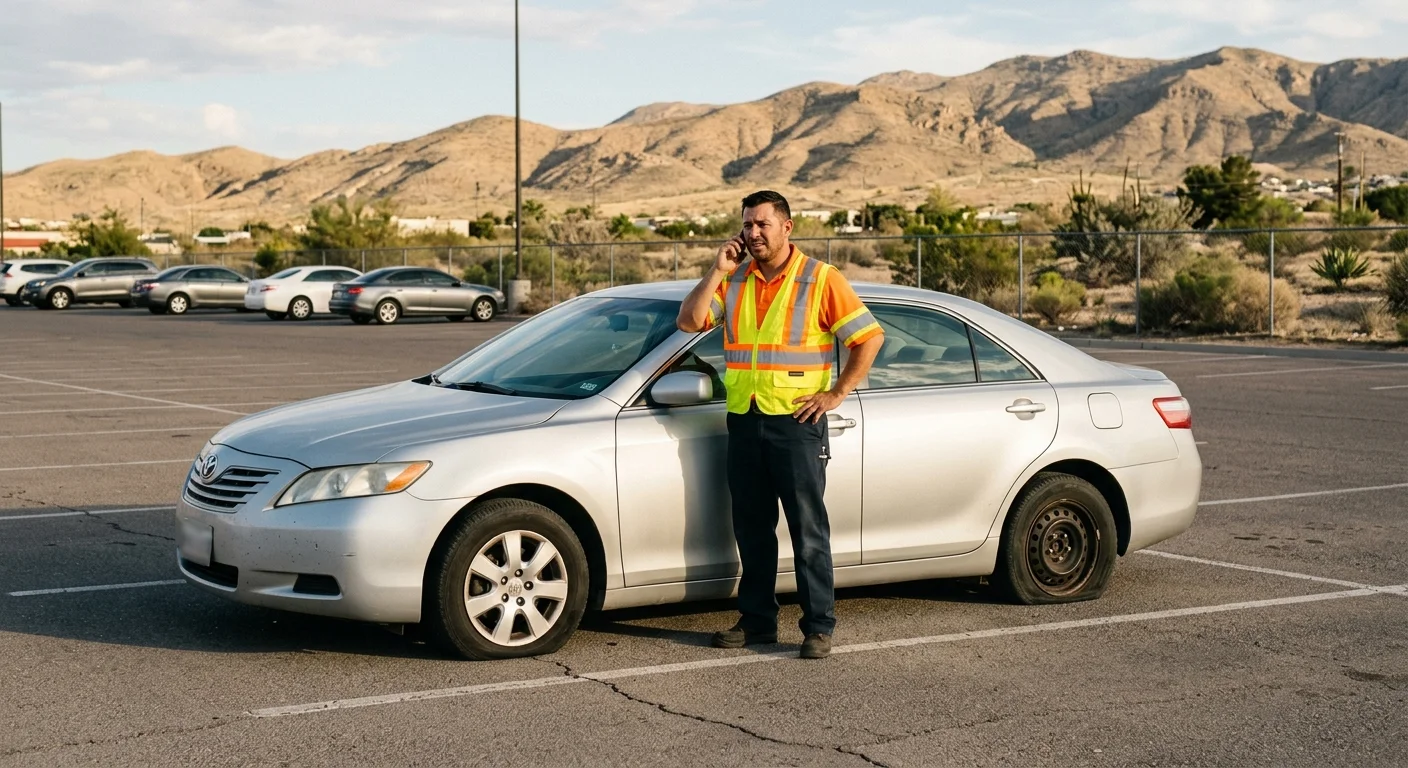
If you’ve only ever dealt with one flat tire in El Paso, this is the next step, not the same job. A single flat can sometimes wait on a spare. Two flats usually cannot. The call is still a consent tow you request, not a private-property grab. The operator you get connected with does the work. We take the intake and route the request.
Describe both flat tires without diagnosing the cause
Do not try to name the cause. Nails, heat, a curb, a pothole, a valve stem, or a slow leak all look similar from the driver’s seat. Dispatch does not need a diagnosis. The operator needs a clear picture of what is sitting on the ground.
Say which two tires are down. Use left front, right front, left rear, right rear. If both flats are on the same axle, say that. If they are diagonal, say that too. Same-axle flats change how the car sits and how it will load. Diagonal flats can make the car feel crooked even when it is in park.
Describe what you can see, nothing more. Completely flat to the rim. Soft but still round. Sidewall torn. Wheel sitting on the pavement. Sparks or grinding if you already tried to roll. If the tire is in pieces in the lane, say where those pieces are so the driver is not walking into traffic to collect them.
Take photos if you can do it from a safe spot. One photo of each wheel. One of the whole car from the front or rear so the operator can see stance and clearance. One of the street or lot so access is obvious. Do not crawl under the car. Do not jack it. Do not pull the wheel.
Where you are in the metro changes the scene, not the rule. A stall at a Westside shopping center under the Franklin Mountains is a different walk-up than a two-lane stretch of FM 76, the road locals call North Loop Drive, through farmland between Horizon Boulevard and Fabens. A Northeast shoulder on US-54 is a different traffic pattern than a quiet street in Central. Name the setting. Leave the cause alone.
Summer heat makes waiting harder. The National Weather Service normal for El Paso in July is a 96.1°F average high. That is a climate normal, not a promise that every afternoon hits that number. It is still a reason to get out of moving lanes, use shade if you have it, and stay with the car only if that is the safer choice.
If you are on a highway shoulder, hazards on, passengers on the safe side of the barrier when you can reach it. Texas’s Move Over law applies when a tow truck is stopped with proper lights. Other drivers must vacate the nearest lane on a multi-lane road going the same way, or slow to 20 mph under the posted limit when that limit is 25 or more. That is Texas Transportation Code § 545.157. It protects the operator once the truck is on scene. It does not tell you to stand in the lane and wait.
Check whether the vehicle can roll or steer
Before anyone talks about a spare, check whether the car can still roll and whether it can still steer. Two flats change both.
If both front tires are down, the steering wheel can feel heavy or dead. Do not test that in traffic. Turn the wheel a few degrees in park, with your foot on the brake, only if the car is already in a lot or well off the travel lane. If it will not turn, say so when you call. A car that will not steer is a load problem, not a “we’ll just limp it” problem.
If a tire is already on the rim, rolling it even a few feet can chew the wheel and the fender. Do not drive it to the shop. Do not bump it into a better stall “just a little.” If you already rolled it and heard metal, tell dispatch. That is not a diagnosis of hidden damage. It is a fact the operator should hear before hooking up.
Ask yourself three yes-or-no questions. Can the car sit in park without sliding. Can you leave it where it is without blocking a lane. Would you need to move it more than a few feet for a truck to reach it. If it cannot sit still, if it is in a live lane, or if a wrecker cannot reach the stall, say that in the first minute of the call. The operator decides how to approach. You decide not to make it worse.
A car with two flats is often still in gear and still has keys. Bring the keys to the pickup. If a wheel will not turn, or the car is in a tight apartment space, say so. Tight downtown blocks, gated complexes on the Eastside, and dirt aprons off North Loop Drive all change how a truck lines up. The operator needs that before arrival, not after the truck is already committed to a driveway it cannot use.
Do not assume the car must go on a particular kind of truck. Wheel-lift and flatbed towing are both used in this metro. Which one fits depends on the vehicle, the two-flat stance, and the pickup spot. Compare the two methods in our flatbed vs. wheel-lift guide, then let the operator confirm on the phone. No single method is the right answer for every two-flat job.
Choose roadside help or a tow
Roadside help and a tow are not the same request. Roadside assistance is the spare, the air, the on-the-spot check. A tow is the car leaving the scene on a truck, usually headed to a tire shop you name.
A spare solves one flat. It does not solve two. If you have one usable spare and one tire that still holds air, a roadside stop might get you rolling on a short, careful drive. That is a maybe, and it depends on the spare matching, the remaining tire actually holding, and a safe place to work. If both tires are dead, the spare is missing, the spare is also flat, or both flats sit on the same axle, the honest path is to tow the car to a tire shop.
Some newer cars ship with a kit and no spare. Some trucks carry a spare that does not match the other three. Some drivers already used the spare last month and never replaced it. None of that is a reason to invent a fix on the shoulder. Tell dispatch what you actually have in the trunk. “I have a spare” and “I have a usable spare that matches” are different sentences.
Do not treat this like a one-flat jack job. Do not start a roadside repair you cannot finish. Two positions down means the car may not jack safely even if you wanted to try. Leave the tools in the trunk. The licensed operator on the other end of the dispatch call will say whether a spare swap is still in play or whether the car needs a ride.
You can tow your car to a tire shop. That is a normal consent tow. You pick the shop. You ride along or you meet there. The operator does not choose the destination unless you ask for a nearby option and you still confirm it. Getting a car towed to a repair shop is the same intake: pickup location, destination, vehicle type, and the two-flat detail so the truck is set up for a car that may not roll.
Price is set by the operator, not by a page on this site. For a light-duty hookup, the starting figure we quote is a $95 hookup plus a per-mile rate. That is a starting figure, not the total. Confirm the number with the operator before the truck leaves for you. There is no approved flat rate, and there is no approved night or weekend add-on published here. If the pickup is in Sunland Park, you are already in New Mexico. Say you are across the state line. Do not expect a Texas figure to travel with you. Ask the operator for that job’s price before you agree.
Texas non-consent rate caps from TDLR are a different legal bucket. They apply when a car is towed without the owner’s consent. A tow you called for is not that job. Do not mix the two when you are shopping a tire-shop drop.
Some drivers ask about a “$3,000 rule” for car repairs. We could not confirm a Texas towing or tire-shop statute by that name. If you are weighing repair cost against the car’s value, that is a shop and insurance conversation. Dispatch cannot answer it.
Confirm the tire shop can receive the car
A tow to a tire shop fails when the shop is closed, full, or cannot take a drop from a wrecker. Call the shop before you send the truck. Ask four things. Are you open when we would arrive. Can you take a drop-off, or do you need the owner present. Can a tow truck enter your lot and unload. If you are closed, is there a night lot, and who has the key.
Do not assume a national banner and a local independent keep the same hours. A shop on Dyer in the Northeast, a bay near Alameda in the Lower Valley, and a Horizon Boulevard store in Horizon City can all be “a tire shop” and still disagree on after-hours drops. Horizon Boulevard (FM 1281) is the main commercial road through Horizon City. Access from I-10 often runs via Eastlake Drive. That is useful for the driver. It is not a promise the shop is open.
If the shop wants the car on the ground in a specific stall, say so on the dispatch call. If they only unload during bay hours, wait to roll the truck until that window is real. A car with two flats cannot be shuffled around a lot by hand. The unload has to land where the shop can work, or you pay for a second move.
Name the destination the way a local would. Not “the tire place on the east side.” Give the shop name, the street, and the nearest cross street. If it sits behind a larger center, say which entrance a wrecker should use. If the lot is tight, say that too. Downtown and older Central blocks pinch a long truck. A wide Horizon City parking field usually does not. Socorro and Clint along North Loop Drive mix farmland, houses, and small commercial pockets. A shop there may have a dirt apron or a shallow bay. The operator needs that before the last turn.
If you have not chosen a shop yet, say so. Do not ask dispatch to invent a recommendation as a fact. You can name a shop you already use. You can look one up while you wait. You still call that shop and confirm they will take the car. A tow without a receiving bay is just a car on a truck with nowhere to go.
Ask the shop whether they need the spare, the locked wheel nut key, or the owner’s ID at drop. Bring what they ask for. The operator is not the shop. The shop cannot mount tires they cannot pull off.
Share pickup and destination access
The rest of the call is access. Pickup and drop-off both need a truck-sized path.
For pickup, give the city or place name, the road, and a cross street. “Westside, Transmountain at I-10” is usable. “Somewhere on the freeway” is not. If you are on I-10, say which direction and the nearest exit you can read. If you are on Loop 375 (Joe Battle or the Border Highway, depending on the segment), say which one. If you are on US-54, say northbound or southbound. If you are in a lot, name the business and which side of the building.
Gated apartments, Fort Bliss-adjacent housing, and shop lots with a low entrance bar all stop a wrecker. Have the gate code, the management number, or a person who can open it. If the car is nose-in against a wall, say so. If it is boxed in by other cars, say so. A two-flat car cannot be jockeyed out of a tight stall the way a rolling car can.
For the Lower Valley, North Loop Drive (FM 76) is mostly two-lane with 4-foot shoulders from Horizon Boulevard down toward Fabens, widening to four lanes only north of Horizon. TxDOT treats that corridor as an emergency alternative for I-10, which means it has to stay open to emergency vehicles. A disabled car on a two-lane farm road is a tighter, slower pickup than a wide I-10 shoulder. Say you are on North Loop, not “out east,” and give the nearest named road.
If you are in Horizon City, say Horizon City. It is its own incorporated city (since 1988), not a nickname for far-east El Paso. If you are in Socorro, Clint, San Elizario, or Sparks, use that name. If you have already crossed into Sunland Park, you are in New Mexico. That changes who can take the job and how it is priced. State the line. Do not let the operator find it at the last exit.
For the destination, repeat the shop name, the street, and any unload note you got from the shop. If the shop closes soon, say the cutoff. If you will meet the truck there, say where you will stand. If someone else will sign for the car, give that name.
You can verify that the towing operator is licensed through TDLR’s license search. Towing in Texas is a TDLR license, not a contractor-board card. Search by name, city, or license number before you pay if you want that check in writing.
Have this list in your notes when you call. Both wheel positions that are down. Whether the car will roll or steer. Whether you have a usable spare. Shop name and confirmation that they will take a drop. Pickup access, including gates and surface. Destination access, including where to unload. Keys on hand. That is enough for dispatch to route a licensed, insured operator and enough for you to have the details ready without a second call.
When to call us
Call when two tires are down, the spare cannot cover both, or the car will not roll or steer to a shop on its own. That is licensed towing work, not a parking-lot experiment. Call us at (915) 615-2224 and we’ll connect you with an operator who handles this work.