A stall on a Chaparral shoulder is a location problem before it is a repair problem. Interstate Chaparral towing starts with the facts you give the person who answers, not with a truck already rolling. We take the call and connect you with a licensed, insured operator. The more exact you are, the less time that operator spends hunting a pin in open desert.
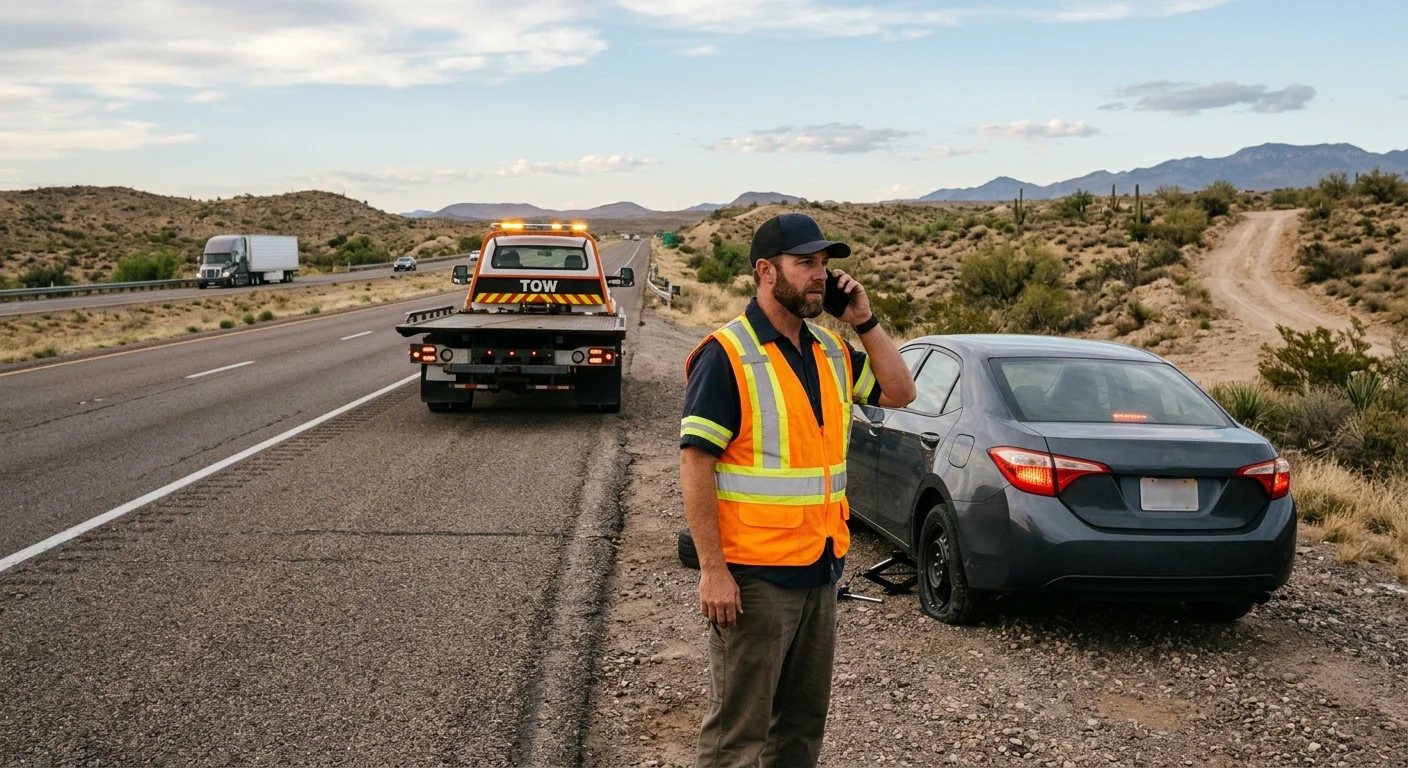
Give the exact Chaparral location
“I’m in Chaparral” is not a location. Chaparral is not Central El Paso, not the Westside under the Franklin Mountains, and not Horizon City or Socorro out east. It is a New Mexico community on the desert edge of the El Paso metro, with county roads, dirt pull-offs, and shoulders that do not always carry a readable sign. A dispatcher cannot route a tow truck Chaparral NM operators can actually find from a town name alone.
Give a live map pin first. Then the nearest named road you can read. Then a cross street, a mile marker if you see one, or a business sign if one is in sight. If you cannot confirm a street name, say that out loud. An honest “I do not see a sign” plus a pin is better than a guessed road.
We could not confirm a verified street grid, posted mile markers, or official Chaparral landmarks in the claims we are allowed to publish. Do not invent them on the call either. Share what you can see. Keep the pin on until the operator says they have it.
If you just left El Paso, say which Texas road you were on before you crossed. If you were heading toward El Paso, say that too. Direction of travel helps the operator pick an approach. It does not replace the pin.
Stay out of the travel lane while you talk. Hazards on. If you can get the car fully onto a shoulder or into a lot, do that before you start describing the scene. If you cannot move it, say it is still in or near a live lane.
People searching Chaparral towing often mean a house, a dirt lot, or a two-lane shoulder, not a numbered interstate ramp. Say which of those you are on. A driveway, a sand pull-off, and a paved shoulder are three different recoveries. The operator we connect you with loads the truck for the ground you describe, not for a city name.
If you are actually in Sunland Park or Anthony, that is a different pair of border towns. Use the notes in our Sunland Park and Anthony breakdown guide instead of forcing a Chaparral label onto the wrong place.
Say which side of the Texas and New Mexico line you are on
Chaparral sits on the New Mexico side of the line. El Paso sits in Texas. That line is the first legal fact on the call. Texas towing rules do not follow you into New Mexico on their own. New Mexico rules do not follow you back.
Tell dispatch the state you are standing in, not the state on your plate. If you are unsure, look at the last sign you passed, the GPS state label, or a mile marker prefix. If none of that is clear, say you cannot confirm the state and keep the pin on. Guessing the wrong state sends the wrong operator.
We dispatch. We do not run the truck. The operator we connect you with has to confirm they can pick up where you are. A Texas-only operator may not cover a Chaparral pin. An operator who works both sides still has to say so before they roll. Ask that question while you are still on the line.
Do not assume a “border tow” is one price or one license. We have no verified New Mexico fee schedule in our claims file, and we will not invent one. Never treat a Texas number as a New Mexico quote. If the pickup is in New Mexico, the operator sets that price. Confirm it with them before the hook goes on.
On the Texas side, nonconsent tows (tows you did not ask for) are capped by the Texas Department of Licensing and Regulation. Those statewide maximums are $272 for vehicles 10,000 pounds or less, $380 for 10,001 to 25,000 pounds, and $489 per unit (maximum $978) for vehicles over 25,000 pounds. Those figures are Texas law, not a Chaparral quote, and they do not apply to a consent call you placed yourself. You can read the consumer rules on the TDLR towing consumer page. You can also check a Texas tow operator’s license.
Texas also has a Move Over law for stationary tow trucks using proper lights on Texas roads. Drivers must change lanes away from the truck when there are two or more lanes in the same direction, or slow to 20 mph under the posted limit when that limit is 25 mph or more. That is Texas Transportation Code § 545.157. It is Texas law. We could not confirm a matching New Mexico rule in our claims file, so do not treat it as a Chaparral traffic rule.
If you crossed the line after the stall, say so. A car that died in Chaparral and a car that died two minutes after you entered Texas are different jobs.
Describe the vehicle and road position
Say make, model, color, and year if you know it. Then say what failed: no start, flat, overheat, crash damage, or it just rolled to a stop. Then say where the vehicle sits relative to the road. The same sedan in a live lane, on a paved shoulder, in sand, or in a driveway is four different recoveries.
A wheel-lift may work on a paved shoulder with both front tires sound. A flatbed is the safer ask when a tire is gone, the car will not roll, or the drivetrain is locked. If you are not sure, describe the problem and let the operator pick the truck. You do not need the equipment name. You need the facts.
Say whether the wheels turn, whether it is in park, and whether you have the keys. Say if anyone is still in the vehicle. Say if it is a car, a troca, a motorcycle, an RV, or something heavier. Heavy equipment and semis are not a light-duty hook. Motorcycles and low cars need a different load than a pickup with a hitch.
If the car is off the pavement in sand or a shallow wash, say that. Desert shoulders around Chaparral are not always a clean paved pad. Winch work is a different conversation than a simple pull onto a bed. We connect you with the operator. They tell you what they can do from the pin you sent.
Keep yourself visible and out of traffic. If night has fallen, a flashlight or phone light on the shoulder helps the driver spot you once they are close. Do not stand in the travel lane to flag anyone down.
If this is a crash, call 911 first when anyone is hurt or the roadway is blocked. Then call us for the tow. Dispatch still needs the same pin, state, and vehicle facts. For a fuller list of what to have in hand on any El Paso-area call, see what to have ready when you call for a tow.
Choose roadside help or a tow
Not every Chaparral stall needs a tow. A dead battery, an empty tank, or a spare that will actually go on can be a roadside assistance call. A locked drivetrain, two flats, a broken axle, or a car that will not steer is a tow. Roadside assistance Chaparral callers often want a jump or a tire change. Say that in the first sentence if that is all you need.
Tell dispatch which one you want, then stay open to the operator’s read. They see the scene. You see the dashboard. If roadside will not get you moving, they can switch to a tow. That is a new confirmation, not a silent upgrade. Ask what it will cost before they change the job. If the pin is in New Mexico, confirm that number with the operator. We will not put a New Mexico dollar figure on this page.
A light-duty starting hookup of $95 plus a per-mile rate is a Texas-side starting figure this brand may quote for a consent light-duty tow. It is a starting figure, not the total. It is not a New Mexico price. Do not treat it as one. The per-mile rate is set by the operator. Ask for it before the truck leaves.
If you need emergency towing because the car is in or near a live lane, say that first. Lane block is the priority. Destination comes second. A car in a driveway can wait for the right truck. A car in a travel lane cannot.
If the plan is a shop in El Paso, a house in Chaparral, or a lot on the Texas side, say the destination now. A roadside jump that leaves you in the same spot is a different job than a tow across the state line.
Membership programs, insurance roadside, and a direct dispatch call are not the same ticket. If you already opened a claim with an insurer or a motor club, say so. The operator still needs your pin and your state. We still route the call. You still confirm the work with the person who shows up.
Confirm destination and coverage with the operator
Interstate Chaparral towing usually means pickup in one state and drop in the other. That is the part people skip. Name the drop: a shop, a driveway, a dealer, or a storage lot. Give the city and the street if you have them. If you do not have a shop yet, say you need the operator’s input on a Texas-side drop you can confirm.
Coverage is a yes or no from the operator, not from us. Ask: can you pick up at this pin. Ask: can you drop at this address. Ask: is any part of this run outside your service area. If they cannot cover Chaparral, we route you to an operator who can. We do not own the truck and we do not pretend we do.
Longer runs back into El Paso can look like long-distance towing. That still needs a destination, not a guess. We have no verified mileage from a Chaparral pin to any El Paso shop in our claims file, so we will not invent one. The operator prices the miles they actually drive. Ask for that number before they hook the car.
Payment happens with the operator. Texas storage and retrieval rules apply only if the vehicle ends up in a Texas vehicle storage facility on a nonconsent tow. A consent tow you asked for is a different path. If the car is stored in Texas, owners must bring photo ID and proof of ownership before release. Proof can be a matching driver’s license, an insurance card, the title, a tax collector’s receipt, a lease, or TDLR forms. You can get personal items and papers from the car at no charge during access hours. Those are Texas Department of Licensing and Regulation rules, not New Mexico rules. We could not confirm a New Mexico storage or retrieval rule in our claims file. Ask the operator which state’s facility they use, then confirm release rules with that facility.
Before they hook the car, repeat the pin, the state, the vehicle, and the drop. Short list. No extras. That is the whole brief.
When to call us
Call when the vehicle cannot move, when it is in a live lane, or when roadside will not finish the job. Call us at (915) 615-2224 and we’ll connect you with an operator who handles this work.