A dead battery on a Northwest El Paso shoulder is one job. A car that will not roll onto a wheel-lift is another. You still have to pick roadside help or a tow, and that pick only works if dispatch can find the real pin, not a neighborhood name.
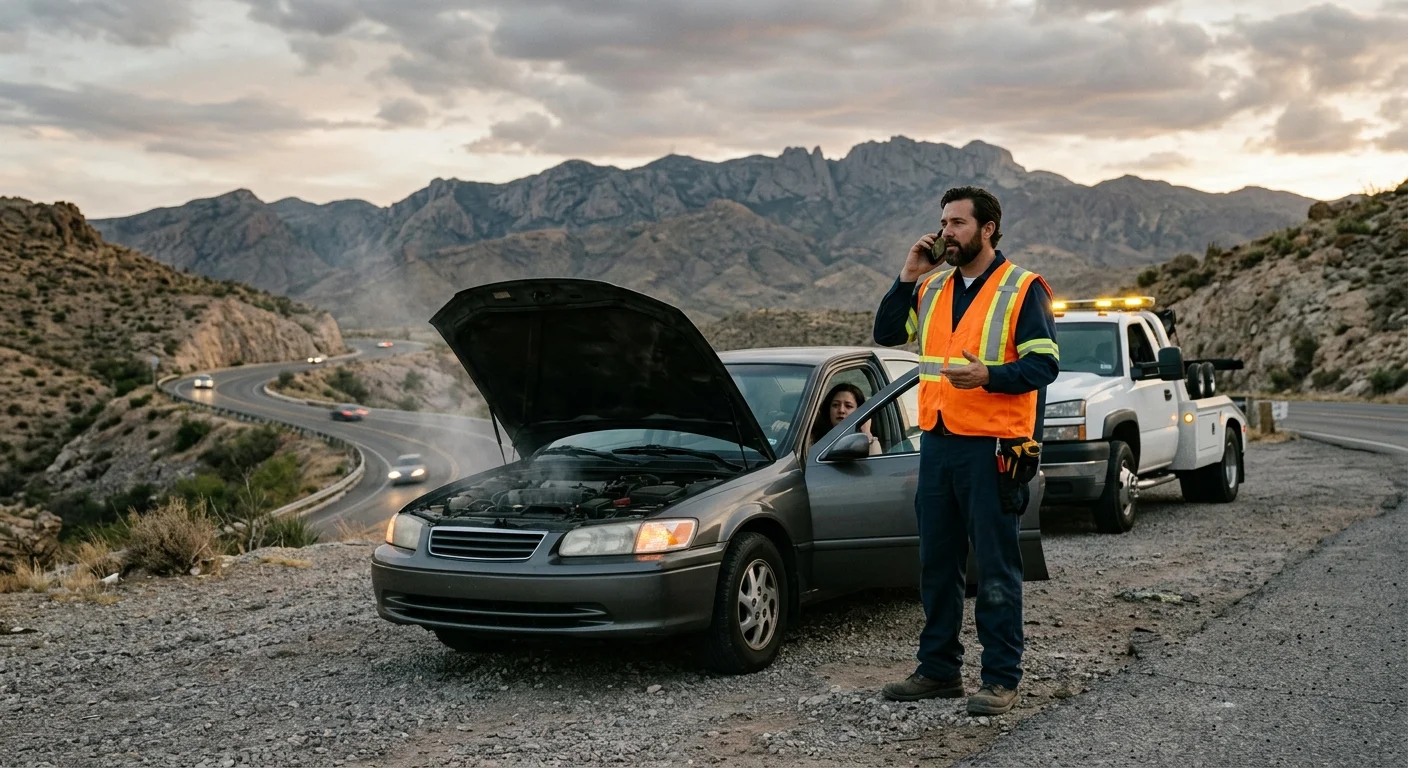
Give a precise Northwest El Paso pickup point
“Northwest El Paso” is a search people type. It is not a pickup. An official boundary for that label could not be confirmed from our verified El Paso sources. If you only say northwest, the operator we dispatch still has to guess which side of town you mean.
Share a live map pin first. Then name the nearest verified cross street, the side of the road, and a building or mile marker you can actually see. If you are on a highway, add the direction of travel. If you already pulled into a lot, name the lot and the closest entrance. A pin plus a cross street beats a suburb nickname every time.
If the real place is not Northwest El Paso, say the real place. Someone sitting in Canutillo is not in the same spot as someone on the Westside. Someone who crossed into New Mexico is in another state. Sunland Park and Anthony sit on that line. We still take the call. The operator still needs the true city and the true pin.
Keep people safe while you talk. If anyone is hurt, or the car is blocking a live lane, call 911. A specific El Paso non-emergency police number could not be confirmed from our verified sources, so do not wait on a number we cannot stand behind. For a private breakdown that is already out of traffic, stay with the vehicle if it is safe, or wait in a lit lot and tell dispatch where you moved.
Have the details dispatch needs for an El Paso tow in front of you before you dial. Year, make, model, color, plate if you have it, and whether the car will roll. That list is what we pass to the operator. We answer the line and route the work. We do not roll our own truck.
You do not need a membership to call. Roadside help without a club plan is a paid dispatch call to a licensed operator. TxDOT 511 is a separate system. Whether 511 roadside help is free on a given Northwest El Paso stretch could not be confirmed here. Check current TxDOT 511 information before you wait on it.
Use only verified routes and landmarks
We will not invent a Northwest street grid for this page. I-10, Loop 375, and Transmountain corridor traffic counts and crash figures are not verified in our claims file. Those names can still help if you are actually on them. They do not replace a pin, and they do not tell us how long the run will take.
Other El Paso corridors are documented, and they are not this one. Horizon City sits east, with Horizon Boulevard (FM 1281) as the main commercial road and access from I-10 via Eastlake Drive. Farm to Market Road 76, the road locals call North Loop Drive, is a Lower Valley corridor through Socorro and Clint toward Fabens. A breakdown there is a different job than a car on the northwest side of town. Do not borrow those roads as if they described your shoulder.
If you can see a named highway, say which one and which way you were heading. If you only see a neighborhood sign, still drop the pin. Cell signal can drop in washes and on mountain grades. If the call cuts out, text the pin when you can, or have a passenger stay on the line.
Summer heat is a real local factor. The National Weather Service El Paso/Santa Teresa climate normal for July is a 96.1°F average high. That is a normal, not a promise that every afternoon hits triple digits. Individual days run hotter. If the car overheated, say so. Tell us whether you already added water, whether the engine is still steaming, and whether you can restart it without driving it another mile.
Landmarks only help when they are things you can confirm from where you stand. A store name on the sign in front of you is useful. A guessed distance to downtown is not. We have no verified mileage from a generic northwest pin to a shop, a house, or Fort Bliss, so we will not quote one. The operator prices the miles after they know the start and the end.
If you already know you are on Transmountain Road, say that clearly. We have a separate note on overheating on Transmountain. If you are on I-10, say the direction and the nearest exit you can read. Guessing the exit number wastes the first call.
Describe the vehicle and road position
Roadside assistance in Northwest El Paso fails most often on position, not on the mechanical complaint. Tell us whether the car is in a travel lane, on a paved shoulder, in a lot, against a curb, or off the pavement in dirt or rock. A car that still sits in a live lane is an emergency recovery problem. A car in a grocery lot is a different setup.
If you are on a highway or a multi-lane road and a permitted tow truck is already on scene with lights on, other drivers must follow Texas Transportation Code § 545.157, the Move Over law. They either vacate the lane closest to that stationary truck when two or more lanes run the same way, or they slow: no more than 20 mph below the posted limit when that limit is 25 mph or more, or to 5 mph when the limit is under 25 mph. First-offense fines run $500 to $1,250. You cannot control other drivers. You can keep your people away from the traffic side of the car. The statute is at Texas Transportation Code § 545.157.
Describe the vehicle in plain words. Sedan, crossover, pickup, van, motorcycle, motorhome. Two-wheel drive or four-wheel drive. Aftermarket lowering, a locking spare, or a missing wheel changes the truck the operator brings. An EV that ran out of charge is a tow in most cases, not a jump. Keys in the car, keys lost, or a steering wheel locked all change the hook.
Say what already happened. You tried a jump and it died again. You have a spare and you cannot break the lugs. You are out of gas and the nearest station is on the other side of a grade you do not want to coast. You locked the keys in a running car in a lot. Each of those is a different roadside assistance ask.
If the car left the pavement, do not have friends yank it with a strap. Tell us how far off the road it sits, whether it is nose-down, and whether the tires still hold air. That is recovery talk, not a parking-lot jump. For crash damage, say whether airbags fired and whether fluids are on the ground. We connect you with an operator who handles accident recovery when the car cannot roll.
Stay out of the travel lane while you wait. Put on hazards if they work. If dust is moving across the road, wait in the car with seatbelts on unless the car itself is in danger. We will not invent a dust-storm protocol beyond that. Share the pin, the cross street, and the vehicle condition, then stay where the operator can see you.
Choose roadside help or a tow
Choose roadside help when the car can be made safe to drive a short, known distance after one on-scene fix. A jump that holds, a spare that is inflated and legal, a lockout with no broken ignition, or enough fuel to reach a station you can name. Choose a tow when the car should not be driven, or when you cannot prove the fix will hold.
If the engine overheated in mid-90s heat, treat a restart as a maybe. Driving a hot engine to “just get home” can turn a simple tow into an engine job. If a tire is shredded to the sidewall, a spare is the only on-scene tire fix. If you have no spare, you need a tow. If the transmission will not go into gear, you need a tow. If the car is an AWD unit that should not be wheel-lifted on two wheels, say so and ask for a flatbed.
Quick Tow El Paso is a dispatch and referral line. We quote the call and connect you with a licensed, insured operator. You contract with that operator. The operator sets the price and confirms it before the hook. For a light-duty job, the starting figure we may state is a $95 hookup plus a per-mile rate. That is a starting figure, not the total, and not a promise that every hour of the day prices the same. No other brand price is approved. We will not invent a per-mile number on this page. Confirm the miles and the method with the operator before they load the car.
That $95 figure is for Texas work we can describe. Do not attach it to a New Mexico pickup. If the pin is across the state line, say so up front and let the operator price that run.
Texas towing on public roads is regulated by TDLR, not by a contractor board. Operators hold consent, incident-management, or private-property licenses depending on the work. You can check a tow truck operator in the TDLR license search. TDLR also publishes statewide maximums for nonconsent tows (tows you did not ask for) on its consumer information page: $272 for vehicles 10,000 pounds or less, with listed drop-fee caps if the truck is fully hooked and has not left the lot. Those caps are law for nonconsent work. They are not our menu. A roadside call you place yourself is consent work, priced by the operator.
If this started as a private-property removal you did not request, that is a different path. Ask for the storage facility name, keep every receipt, and read the hearing deadline on the TDLR page. A hearing request on a nonconsent tow has a 14-day clock, excluding weekends and holidays. Filing a TDLR complaint does not replace that hearing request.
Club memberships, insurer roadside add-ons, and rental-car roadside are also separate from our line. If you are in a rental, call the rental company first and keep their case number. Our rental breakdown note covers that order. You can still call us if they send you to a local operator.
Confirm destination and access before dispatch
A roadside fix ends when the car can leave under its own power. A tow does not end until the operator knows the drop. Home, a shop you name, a dealer lot, or “the closest open bay” are four different instructions. If you do not care which shop, say that. If the car must go to a specific service department, give the gate, the hours you know, and who takes the key.
Access matters as much as the address. Gated apartments, steep drives, low trees, and dirt shoulders change the truck. Tell us the gate code or meet the driver at the curb. If the destination will not take a big rollback, say so before the operator leaves the pickup. A wheel-lift is not the right answer for every AWD car, every lowered car, or every missing-wheel hook. Ask the operator which method they plan to use.
If the car will not roll, will not steer, or has a seized parking brake, say that before dispatch. Those facts belong on the first call, not at the bumper. The same is true for motorcycles, campers, and work trucks. The operator we send has to match the vehicle.
Do not ask us for an arrival clock. We do not control which licensed truck is closest to your pin, so we will not promise one. Ask the operator for their own estimate once they accept the job. Distant or rural pins take longer. A car already in a safe lot can wait. A car in a live lane cannot.
Payment is between you and the operator. Have a card or cash ready if they ask. For a vehicle already in a storage facility, TDLR lists the ID and ownership papers you need to get it out, and you can retrieve personal items without paying for that access. This page is about a breakdown you are still sitting with, so the cleaner path is a consent tow you directed to a place you chose.
If the honest answer is that the car should not be patched on the shoulder, skip the jump and go straight to the tow. If the honest answer is a spare, a jump, or a fuel can, say that and keep the drop address in your pocket in case the fix fails.
When to call us
Call when the car is stuck in Northwest El Paso and you need a licensed operator for a jump, a spare, a lockout, fuel, a winch, or a tow, and you can share a pin plus a verified cross street. Call us at (915) 615-2224 and we’ll connect you with an operator who handles this work.