The car is dead in an El Paso lot, and the U-Haul is already on the reservation. People type tow car behind uhaul at that moment because they want one answer before anything gets dragged together. The rental contract, both vehicle manuals, and how the car sits decide more than the truck’s size.
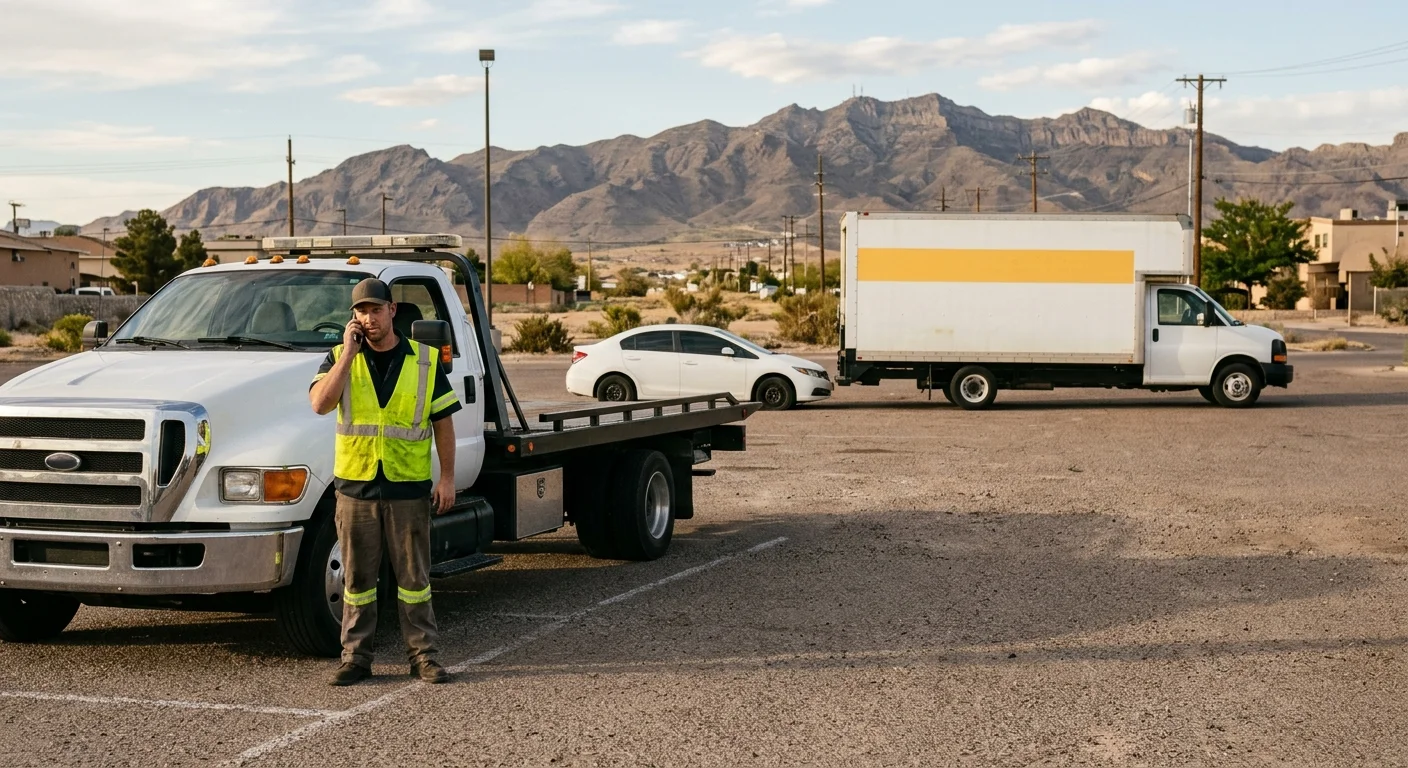
Start with the disabled car and the rental gear
A U-Haul vehicle tow starts with two separate things in the same parking lot. One is the rental: a moving truck, a tow dolly, a car carrier, or the mix the counter assigned. The other is the car that will not drive itself. Quick Tow El Paso answers the phone and connects you with a licensed, insured towing operator. We do not rent trailers, dollies, or moving trucks.
That split shows up fast on the pavement. A running sedan you meant to pull toward San Antonio is one job. A car that will not start, will not shift, or will not unlock the steering is another. Heat does not help. The National Weather Service normal high for El Paso in July is 96.1 degrees. A dead car in a lot off Mesa, Alameda, or Dyer sits in that air while you sort the paperwork.
Name both vehicles before anyone rolls a tire. Year, make, and model. Front-wheel drive, rear-wheel drive, all-wheel drive, or an EV. Keys in hand, or keys missing. Parked nose-out in a surface lot, or jammed in a covered space downtown. Those facts change the next hour more than the logo on the rental truck.
A personal pickup with a hitch is a different setup. If that is the plan, read our guide on whether to tow a car with a pickup or call a towing operator. This page is the rental-trailer decision. You already have U-Haul gear, or you are about to pick it up, and you need to know if that gear can take this car.
Leave the coupler alone until you have read the contract. A lot in Central El Paso, a driveway in Horizon City, and a shoulder on the Westside under the Franklin Mountains all look simple until the car will not roll. The rental desk, the owner’s manual, and a licensed operator each own a piece of that call.
Compare a U-Haul move with a referred towing operator
Towing a car with a U-Haul means you drive the rental and pull the second vehicle on the rental company’s equipment, if that exact combo is on the contract. You stay responsible for lights, mirrors, hitch hardware, and how the load behaves on I-10, Loop 375, and US 54. The rental company writes the rules for its gear. We cannot bless a hookup the counter has not approved.
A referred towing operator is a different path. Texas requires towing operators who work over public roadways to hold a TDLR license for the type of tow they perform. You can check a license at the TDLR license search. The customer contracts with the operator who shows up. The operator chooses the truck, often a wheel-lift or a flatbed, after seeing the car.
Cost is the question people ask next. Is it cheaper to tow a car behind a U-Haul, or to drive it, or to hire an operator. We do not have a verified public figure for a U-Haul pull-behind in El Paso. Forum numbers and old quotes do not count. Ask the rental company for the current rate on your dates, your truck size, and the towing add-on on that reservation.
For a referred light-duty tow, work starts at a $95 hookup plus a per-mile rate. That is a starting figure, not the total. The operator sets the rest. Confirm it before the truck hooks up. We publish no dollar figure for a New Mexico run, including a drop in Sunland Park across the state line. Ask the operator on that trip.
The cheapest way to tow a car is the method the car and the contract both allow. Paying for a dolly the counter later refuses still costs you the day. A long hop out of town, Fort Bliss to another duty station, or an I-10 run east past Horizon City, may fit long-distance towing better than a rental combo you have never pulled. A local hop across Central El Paso can still need an operator if the car will not roll onto the rental gear.
U-Haul vs tow truck El Paso is not a slogan. It is a fit test. If the car drives, the contract lists that car, and you are comfortable towing a long vehicle through tight lots, the rental path can be the one you came for. If the car is disabled, the driveline is unknown, or the lot will not take a truck plus a trailer, dispatch an operator and keep the U-Haul for the household goods.
Check the rental contract and both vehicle manuals
The rental contract is the first document, not a blog post and not a memory of what a cousin did in 2019. It lists the truck, the towing equipment, and the vehicle that equipment is allowed to carry. If the dead car is a different year, make, or drivetrain than the one on the paper, stop. The counter has to recut the reservation. Never load a different car than the one named on the contract.
Read the user instructions that come with the dolly or carrier. Those pages set how that rental wants the car faced, how straps and chains are meant to sit, and what the tow vehicle must have. Hitch ball size, hitch rating, mirror rules, and lighting rules live there. We do not publish those ratings here because they belong to the rental company and they change with the equipment you actually receive.
Then open both vehicle manuals. The moving truck has limits of its own. The dead car has tow-mode notes, parking-brake notes, and driveline notes. Rear-wheel drive and all-wheel drive cars often need extra steps the rental will not invent for you. An electronic parking brake that stays clamped can grind. A steering lock can fight a dolly. An EV may need a flat surface under all four wheels. The manual is the source. If the manual is silent, treat the tow as unconfirmed until a licensed operator looks at the car.
A tow dolly in El Paso has clear limits on what it can and cannot carry. Two wheels up is a different job than four wheels up. Cargo left in the dead car can change how the combo steers. The contract and the manuals are the place to confirm cargo rules. We will not guess a weight cap, a speed cap, or a distance cap for U-Haul gear.
If you are still at the rental counter, put both vehicles into their system before you leave the lot. A combo that fails at a U-Haul on the Eastside, near a Westside store, or out toward Socorro is cheaper to catch there than on a shoulder. If you already have the truck and the car will not match the paper, call the rental company first, then call us for an operator if the car still has to move.
Describe wheels, steering, and pickup access
Wheels tell the operator almost as much as the engine. A car that rolls, steers, and holds a park position can use more kinds of equipment. A car with a locked column, a transmission stuck in park, a missing wheel, or a seized brake needs a different hook. Tell dispatch which wheels turn, which ones sit on the ground, and whether the steering wheel moves with the key.
Pickup access is the other half. Downtown and Central lots are tight. A moving truck plus a dolly needs room to line up that a single wrecker may not. Apartment gates on the Northeast and covered spaces near the hospitals often stop a long rental combo at the entrance. On the Westside, grades under the Franklin Mountains and Transmountain Road change how a loaded trailer wants to sit. Out east, Horizon Boulevard (FM 1281) is the main commercial road through Horizon City, with access from I-10 via Eastlake Drive. Farther into the Lower Valley, North Loop Drive is the local name for FM 76. TxDOT describes most of that corridor as a two-lane, two-way rural road with 4-foot shoulders, running toward Socorro, Clint, and Fabens. A truck-and-car combo on a narrow farm shoulder is a different problem than a wrecker that can work in a shorter footprint.
Sunland Park sits across the New Mexico line. Anthony does too. A plan that is legal on the Texas side still has to be confirmed for the drop on the other side. Share both addresses with dispatch. Do not assume the rental contract covers a state-line pull.
Leave loading to the people who own the gear. We will not walk you through ramps, straps, or facing the car on a dolly. If the car is already partly on the rental equipment and something feels wrong, stop. Get people away from the tongue. Then get an operator on the phone. A bad hookup in a Cielo Vista lot, a Horizon City driveway, or a pull-off on Alameda is still a bad hookup.
Let the operator confirm whether a tow is possible
The operator on scene is the person who says yes. Dispatch can route the request. The driver who sees the car, the lot, and the rental gear is the one who confirms a tow is possible with the truck they brought.
Have this ready when you call. Where the car sits, with a cross street: I-10, Loop 375, US 54, Transmountain, Alameda, North Loop Drive, or a named plaza. Whether you are in El Paso, Horizon City, Socorro, or already toward Sunland Park. Year, make, model, and drivetrain. What failed. Whether it rolls. Keys, or no keys. Where it needs to go. Whether a U-Haul truck or dolly is already in the way.
If the rental combo is still the plan, say that. The operator may tell you the car will not ride that way, and that a flatbed is the clean path. That is a useful answer. It keeps you from leaving El Paso with a swaying load you cannot inspect in the mirrors. For consumer towing rights and storage rules on nonconsent jobs, TDLR keeps a consumer information page. This move is a consent job you are requesting, so the operator’s quote is the number that matters. Confirm it before pickup.
Stay with the vehicles if you can do it safely. A dead car and a rented truck in the same stall confuse a lot of people. The operator needs a clear path, a contact who can sign, and a destination that is open when the car arrives. If the car is a classic, a low EV, or a locked AWD unit, say so early so the right truck is the one that gets sent.
When to call us
Call when the car will not roll onto rental gear, the contract and the manuals disagree, or the lot is too tight for a truck-and-trailer combo. Call when you need a licensed operator for a local hop or a longer run out of El Paso. Call us at (915) 615-2224 and we’ll connect you with an operator who handles this work.