A stall on I-10 after dark, a no-start in a Horizon City driveway, or a fender-bender on Loop 375 all raise the same money question. Night towing cost in El Paso is set by the operator on your call, and that operator confirms the full amount before the truck rolls, at any hour. Quick Tow El Paso takes the request and connects you with a licensed, insured operator. We do not set the bill.
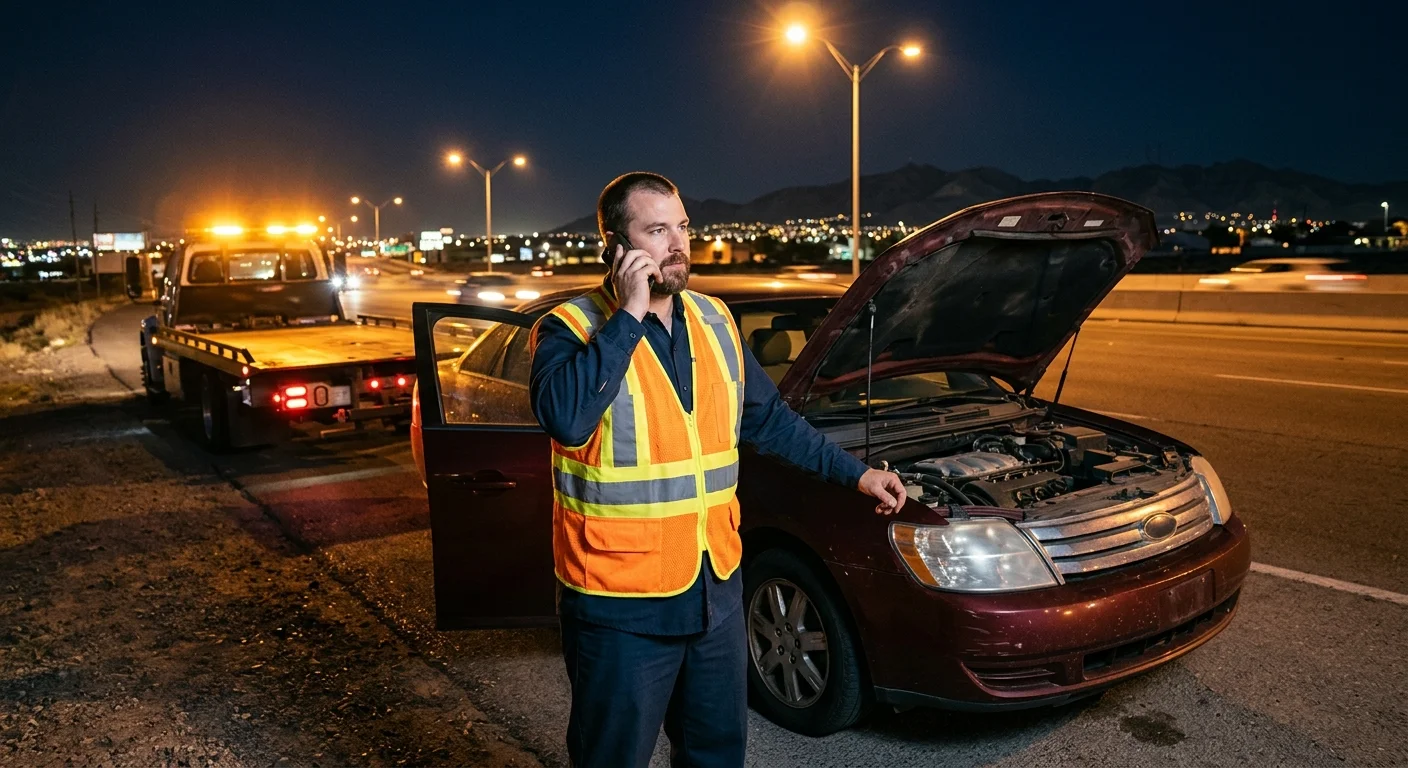
Availability and price are two different questions
Plenty of El Paso searches are about after hours towing. Shops on Alameda are closed. Dealers along Gateway are dark. You still need a truck that can move the car. That is an availability question. What you pay is a pricing question. Mixing the two is how people get surprised on the shoulder.
Quick Tow El Paso is a dispatch and referral line. We answer, we quote the starting figure we are allowed to share, and we route the nearest licensed operator we can. The operator who shows up is the one who performs the work and the one who sets the charge. We do not own the wrecker. We do not run a yard. We do not hold a tow license.
Whether an operator can take a late job is about trucks, drivers, and where you are sitting. A sedan on Mesa in Central is a different run than a pickup off North Loop Drive in the Lower Valley. Horizon City sits out Eastlake and Horizon Boulevard (FM 1281), off I-10. Socorro and Clint sit farther down FM 76, a two-lane farm road with four-foot shoulders for most of the 12.5 miles TxDOT studied between Horizon Boulevard and Alameda in Fabens. The Westside sits under the Franklin Mountains, with Transmountain as the cut across. Those corridors change how long the operator is on the road. They do not, by themselves, tell you the rate.
If you are trying to understand when help is even possible, read our guide to 24-hour towing in El Paso. That page is about finding an operator after shops close. This page is about the bill. One does not answer the other.
Do not assume a late call is cheaper because the roads look empty. Do not assume it is more expensive because the clock passed 9 p.m. The operator prices the job you describe: vehicle, location, destination, and what the truck has to do on scene. Ask for that number before anyone hooks the car. If the figure is not confirmed, wait.
Sunland Park sits across the New Mexico line. Anthony does too, depending on which side of the state line you stopped. A New Mexico recovery is a different jurisdiction. Do not treat an El Paso starting figure as a New Mexico price. Tell dispatch exactly which side of the line you are on so the operator can say whether they can take it.
How operators price a night tow
There is no brand-wide night rate on this site, and there is no published weekend or holiday add-on either. The operator sets the charge for that job, on that call, and confirms it before the truck rolls. That is the rule that actually governs what you pay, at 2 p.m. or 2 a.m.
For a light-duty consent tow, the starting figure we can share is a $95 hookup plus a per-mile rate. That is a starting figure, not the total. The per-mile number itself is not published here because it belongs to the operator. That $95 figure is the light-duty hookup start only. It is not a price for every job we dispatch.
A consent tow is the one you asked for. You called. You agreed. That is most night breakdowns: a dead battery that needs a haul, a blown tire on US 54, a car that will not move out of a Cielo Vista lot. The operator’s price is a private agreement. Confirm it before the truck leaves.
A nonconsent tow is different. That is a removal you did not request, usually from private property or after police involvement. Texas Occupations Code Chapter 2308 and TDLR set statewide maximums for those tows. As of TDLR’s consumer page, the caps are $272 for vehicles 10,000 pounds or less, $380 for 10,001 to 25,000 pounds, and $489 per unit (maximum $978) for vehicles over 25,000 pounds. Drop fees, if the vehicle is fully hooked but has not left the lot, cap at $135, $190, and $244 for those same weight bands. Local ordinances may set lower caps. We could not confirm an El Paso city cap from a verified city source, so treat the TDLR numbers as statewide ceilings, not as an El Paso price list. Read the current figures on TDLR’s towing consumer page.
Those statutory caps are law. They are not our rate. They do not apply to a consent night tow you ordered yourself.
If you want the broader cost picture, including what a daytime consent tow looks like, see how much a tow costs in El Paso. The same starting hookup applies. The operator still has to confirm the rest.
Do not accept a vague “we’ll settle up later” on a dark shoulder. Get the hookup, the mileage method, the destination, and any recovery work named before the truck is in motion. If the operator cannot say it, you do not have a price.
What still changes the charge
The clock is a weak predictor. The job details are not. Tell dispatch the facts that actually move the number.
Vehicle class comes first. A compact sedan on the Westside is a light-duty hook. A work truck in East El Paso may still be light-duty, or it may not. A motorhome, a fifth-wheel, or a commercial unit needs a different truck. Heavy equipment is a different conversation. The $95 starting hookup is for light-duty. It is not a heavy-duty figure.
How the car sits matters next. A car in a marked stall at an apartment off Zaragoza is a straight hook if the wheels roll. A car in park that will not release, a car missing a wheel, or a car nose-down off the pavement on Transmountain is recovery work. Winching, uprighting, or a flatbed instead of a wheel-lift changes labor and equipment. The operator prices that after you describe it. We do not invent a surcharge list for night work.
Keys change the job. If the car is locked, in park, or the steering is locked, say so. An operator can often still load it. The method may change. A Tesla or another EV that is out of charge needs a flatbed, not a drive-on guess. Say the make.
Destination is the other half of the bill, because the unpublished per-mile rate runs on distance. Home in Central is a short run from downtown. A dealer on the Eastside from a stall in Canutillo is a long one. A shop in Socorro from a breakdown on North Loop Drive may be close. A haul from Horizon City to a Westside shop crosses most of the metro. Give the exact drop. “Just take it somewhere” is how totals drift.
Where you are sitting also changes the work even when the rate shape stays the same. I-10 through town is lit and wide, but a shoulder stop still needs cones and lights. Loop 375 along the Border Highway has fewer exits. FM 76 toward Clint and Fabens is mostly two lanes. The operator has to work in that space. That can add time on scene. Time on scene is not a published fee on this site. Ask the operator if extra labor applies before the truck rolls.
If police are already there, say so. An accident recovery is not a parking-lot hook. The operator still confirms the charge. Statewide nonconsent caps apply only when the tow is nonconsent. A crash you called in yourself is still a consent job unless an agency ordered the removal.
Storage is separate if the car goes to a vehicle storage facility instead of home or a shop. TDLR lists standard daily storage and 2023 adjusted rates on the same consumer page. Access to papers and personal items from a stored car is free. That is statewide. City of El Paso impound details are not verified on this site, so we will not name a lot, hours, or a city fee. If the car was taken without your say-so, ask who authorized it and where it went.
A tow compared with roadside help
Not every night call needs a wrecker. Some need a jump, a spare, a gallon of fuel, or a lockout. That is roadside help. A tow is when the car has to leave.
A dead battery in a Northeast lot after a movie may take a jump. If it starts and holds, you may drive it. If it dies again on the on-ramp to US 54, you now need a tow. Two flat tires usually need a tow, because one spare does not cover two wheels. An overheat on Transmountain, after the engine has already cooked, is often a tow, not a water can.
Roadside work and towing are priced as different jobs. The operator sets the roadside figure and the towing figure separately. Do not assume a jump is “included” in a later tow, and do not assume a tow is the default if a tire change would get you home.
If you only need a jump, a lockout, or a tire, start with roadside assistance. If the car cannot roll, or you do not want it driven, ask for emergency towing. Say which one you want on the call. Mixed requests stall the quote, because the truck and the labor are not the same.
A flatbed is the safer call for AWD, EVs, lowered cars, and anything that should not roll on two wheels. A wheel-lift is common for a standard sedan that rolls. The operator picks the truck from what you describe. Night does not change that choice. The pavement and the vehicle do.
Accident scenes are their own category. If you are on I-10 with airbags out, or on Loop 375 with a bent rim, you likely need recovery, not a parking-lot hook. See accident recovery for what to share. Texas’s Move Over law still applies to a stationary tow truck using proper lights. Drivers must change lanes away from that truck when there are two or more lanes in the same direction, or slow to 20 mph under the limit if the limit is 25 or more (5 mph if the limit is under 25). That is Transportation Code § 545.157. It protects the operator working your car. It is not a fee.
Memberships and insurance are not a night discount. If you have roadside through a carrier, call that number first and ask what they will authorize. If you still need a local operator, we can connect you, and you still confirm that operator’s charge. We do not bill your insurer from this line.
Confirm the amount with the operator
The only number that matters is the one the operator states before the truck rolls. Write it down. Repeat it back. Include the destination. If anything on scene changes, the operator should say so before adding work.
Have this ready when you call:
- Exact location. Not “on I-10.” Say eastbound or westbound, the nearest exit, and the side of the road. On the Westside, name the cross street. In Horizon City, name Horizon Boulevard or the subdivision street. On North Loop Drive, say you are on FM 76 and which town is closest: Socorro, Clint, or toward Fabens.
- Vehicle. Year, make, model, two-wheel or four-wheel drive, and whether it rolls.
- Problem. No-start, flat, crash, off the pavement, keys locked in, EV with a dead pack.
- Destination. Home, a named shop, a dealer, or “I don’t know yet.”
- Who is with the car, and whether police are on scene.
We can share the $95 light-duty hookup plus a per-mile rate as a starting figure. We cannot promise a flat rate, a firm quote, a written quote, or a no-hidden-fee pledge. The operator sets the rest. Ask that operator, on that call, for the hookup, the mileage method, and any recovery labor. If you do not hear those pieces, you do not have the price.
Pay attention to who you are hiring. Texas requires towing operators to hold a license that matches the work: incident management, private property, or consent. Companies that control tow trucks on public roads must be licensed too. You can check a name, city, or license number in TDLR’s license search. Pick “Tow Truck Operators.” A late hour does not relax that rule.
If the job is a private-property removal you did not request, your rights are different. You may request a tow hearing within 14 days, excluding weekends and holidays, after the vehicle is placed in storage. That hearing is about probable cause, and the filing fee is $20. Filing a TDLR complaint does not replace the hearing. Those rules live in Occupations Code § 2308.452. They do not apply to a consent tow you called in at night.
Keep the phone you used for the call in your hand until the operator is on scene. Conditions change. A second stall, a new destination, or a cop asking the car to move are all reasons to update the quote before more work starts.
When to call us
Call when the car cannot stay where it sits, when roadside help will not get it rolling, or when you need a licensed operator to move it off I-10, Loop 375, Transmountain, North Loop Drive, or a dark lot in Horizon City or Socorro. Call us at (915) 615-2224 and we’ll connect you with an operator who handles this work. Confirm the $95 hookup plus the per-mile rate, and the rest of the charge, with that operator before the truck rolls.