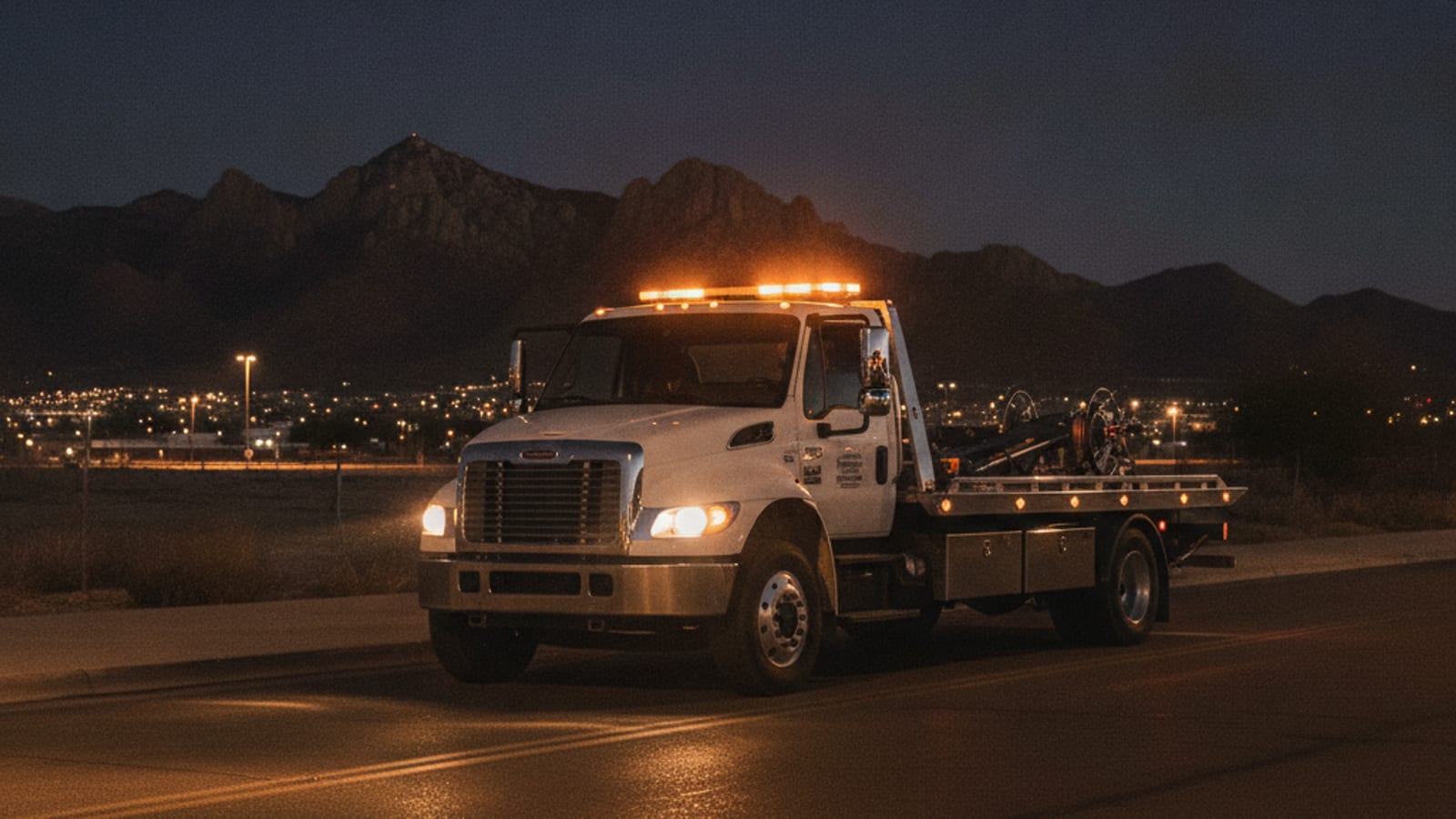
Call (915) 615-2224 at any hour and we route you to the licensed operator covering your area. El Paso doesn’t go quiet at 3 AM. Bar close downtown, late shifts near the ports of entry, and casino nights across the New Mexico line all send people to the shoulder at hours when most repair shops are dark. If your car died and you’re searching “24 hour towing near me” from a parking lot or a freeway shoulder right now, here’s who actually answers, what to expect, and where the free options run out.
Why “24 hour towing near me” doesn’t help you at 3 AM
Search “24 hour towing near me” at 3 AM and the results are mostly noise. Yelp pages point to businesses that stopped answering years ago. Reddit threads recommend a company that changed hands or a number that’s disconnected. National directories list ten “24/7” companies in El Paso, and half of them route to a call center in another state that has no idea where Zaragoza Road is.
None of that gets a truck to you. What actually works is a call that routes to an operator who knows the El Paso metro well enough to confirm your location and give you an arrival estimate before you hang up. Quick Tow El Paso runs 24/7 emergency towing dispatch every day of the year, connecting callers with drivers who cover the city and the border towns.
What TxDOT’s HERO patrol can do, and where it stops
El Paso does have a free roadside program. TxDOT’s Highway Emergency Response Operator (HERO) patrol runs marked trucks on I-10 from Transmountain Road to Horizon Boulevard, Loop 375 from I-10 West to Paisano, and US 54 from McCombs to Loop 375, helping with flat tires, a little fuel, and jump starts at no charge.
It’s a real program and genuinely useful if you qualify. It’s also limited in ways that matter at 3 AM. HERO runs Monday through Friday from 5 a.m. to 9 p.m. and Saturday through Sunday from 9 a.m. to 9 p.m., so it’s off the road entirely overnight. It only covers those specific highway corridors, not residential streets, apartment lots, downtown surface streets, or the New Mexico side of the metro. And its trucks are built to clear a travel lane, not to haul your car to a shop or your driveway.
That gap, overnight and off those corridors, is where a private tow does the job HERO can’t. If you break down on a covered corridor during HERO hours, calling 915-790-4376 first is worth it since it’s free. Confirm current coverage with TxDOT. Any other time or place, a dispatched tow is the faster option, often the only one.

Where night calls come from across the metro
Where you are still matters at 3 AM, even though nobody can honestly publish a wait time. Ask for a live arrival estimate when you call.
Central El Paso and the I-10 corridor. Downtown, Mesa Street, and the Airway and Hawkins interchanges see the most late-night calls.
Downtown and Union Plaza. The bar district downtown is dense and central, though one-way streets and bridge-approach queues near Paso del Norte can slow a truck on a busy weekend night. Coverage details for downtown El Paso are worth a look if you’re a regular there.
Lower Valley (Ysleta, Socorro, San Elizario, Clint, Fabens, Tornillo). This stretch runs 15 to 40 miles from central El Paso along Alameda Avenue and FM-258. Fabens and Tornillo are the farthest of those drives.
Horizon City and the far East Side. A growing commuter area with direct I-10 access.
Northwest Valley and the New Mexico line (Canutillo, Vinton, Anthony, Sunland Park, Santa Teresa, Chaparral). Distance, and in Chaparral’s case real geographic isolation behind the Franklin Mountains, is the issue.
If it happened on the interstate specifically, the guide on breaking down on I-10 covers where those breakdowns cluster and how to reach a safe shoulder.
Why the calls spike after 2 AM
There’s a pattern to the 3 AM calls, and dispatchers see it every weekend. Texas bars with a late-hours permit can sell alcohol until 2 AM, and last call usually lands 10 to 15 minutes before that. Downtown’s Union Plaza district and the bar strips near UTEP empty out fast right after, and that’s when dead batteries, fender benders in tight parking lots, and cars that wouldn’t start after sitting all night start calling in.
Across the state line, Sunland Park Racetrack and Casino stays open until 4 AM on Friday and Saturday nights, and its Futurity Drive parking lots produce their own late run of dead batteries and minor collisions. If you’re leaving a game or a show, that’s not an unusual time to need a jump or a tow. Dispatch doesn’t blink at a 3:30 AM call from Sunland Park. It’s a normal Saturday.
What to have ready when you call
A call at 3 AM goes faster when you can answer three things right away.
- Where you are. A cross street, an exit number, or a business name works better than a guess at an address. If you’re on I-10, the nearest mile marker or exit sign helps.
- What’s wrong. Dead battery, flat tire, won’t start, or something more serious like an accident. This decides which truck gets sent.
- Whether anyone’s hurt. If there’s an injury or the car is blocking a travel lane, call 911 first. A tow truck doesn’t replace emergency response.
Once dispatch has those three things, the operator taking the job can confirm a price and an arrival estimate before the truck leaves. A light-duty tow starts with a $95 hookup, plus a per-mile rate after that, whether it’s a wheel-lift or a flatbed (flatbeds handle all-wheel-drive cars or anything that shouldn’t roll on its own). That $95 is a starting figure, not the total. Ask about any night or holiday charge and get the full price confirmed before the truck rolls.
Waiting safely until the truck arrives
If you’re on a freeway shoulder, stay inside with your seatbelt on and your hazards flashing. Don’t stand behind the car or try to flag down traffic. If you’re in a parking lot or on a side street, you’re generally safer out of the car and away from traffic, especially near a bar or club exit where other drivers may not be paying close attention.
Roadside help short of a full tow, a jump start, fuel delivery, or a lockout, works the same way a tow does: one call, real dispatch, a truck on the way. Not every 3 AM problem needs a flatbed.
If you’re stuck in El Paso right now, call (915) 615-2224. Tell the operator where you are and what’s wrong, and a truck gets sent your way. Same number at 3 PM or 3 AM.
Frequently asked questions
Who do I call for 24 hour towing in El Paso at 3 AM?
Call (915) 615-2224. The line takes calls around the clock, every day, and routes you to a licensed operator covering the full El Paso metro, including the Lower Valley, Horizon City, and the New Mexico border towns. The operator taking the job gives you an arrival estimate before the truck leaves.
Does TxDOT’s HERO patrol help at night?
No. HERO operates Monday through Friday from 5 a.m. to 9 p.m. and Saturday through Sunday from 9 a.m. to 9 p.m. on I-10 from Transmountain Road to Horizon Boulevard, Loop 375 from I-10 West to Paisano, and US 54 from McCombs to Loop 375. Call 915-790-4376 during those hours on a covered corridor. It’s off the road overnight, so a 3 AM breakdown anywhere in the metro needs a private tow.
How much does a tow cost at night in El Paso?
A light-duty tow starts with a $95 hookup plus a per-mile rate, whether it’s a wheel-lift or a flatbed. That $95 is a starting figure, not the total. Ask about any night or holiday charge and get the full price confirmed before the truck is dispatched. The full cost breakdown covers what else moves the price.
How long will I wait for a tow truck at 3 AM?
Nobody can honestly publish a wait time. Ask dispatch for a live arrival estimate when you call. Distance, traffic, and how many other jobs are active all change the answer.
Is it safe to wait in my car for a tow truck at night?
On a freeway shoulder, yes. Stay inside with your seatbelt on and your hazards on until the driver confirms it’s safe to get out. In a parking lot or on a side street, it’s usually safer to wait outside the car, away from traffic and other vehicles leaving the area.
What if I just need a jump start or I’m locked out, not a full tow?
Same call, same number. Roadside assistance covers jump starts, flat tires, fuel delivery, and lockouts around the clock, and dispatch sends the right vehicle for the job instead of automatically sending a flatbed.