If the wheel will not turn, stop trying to drive the car. A disabled car that will not steer is already a recovery job, whether you are on I-10, Loop 375, Transmountain, or a lot in Horizon City. What we need on the phone is what the wheels are doing, whether the car can roll, and how a truck can reach it.
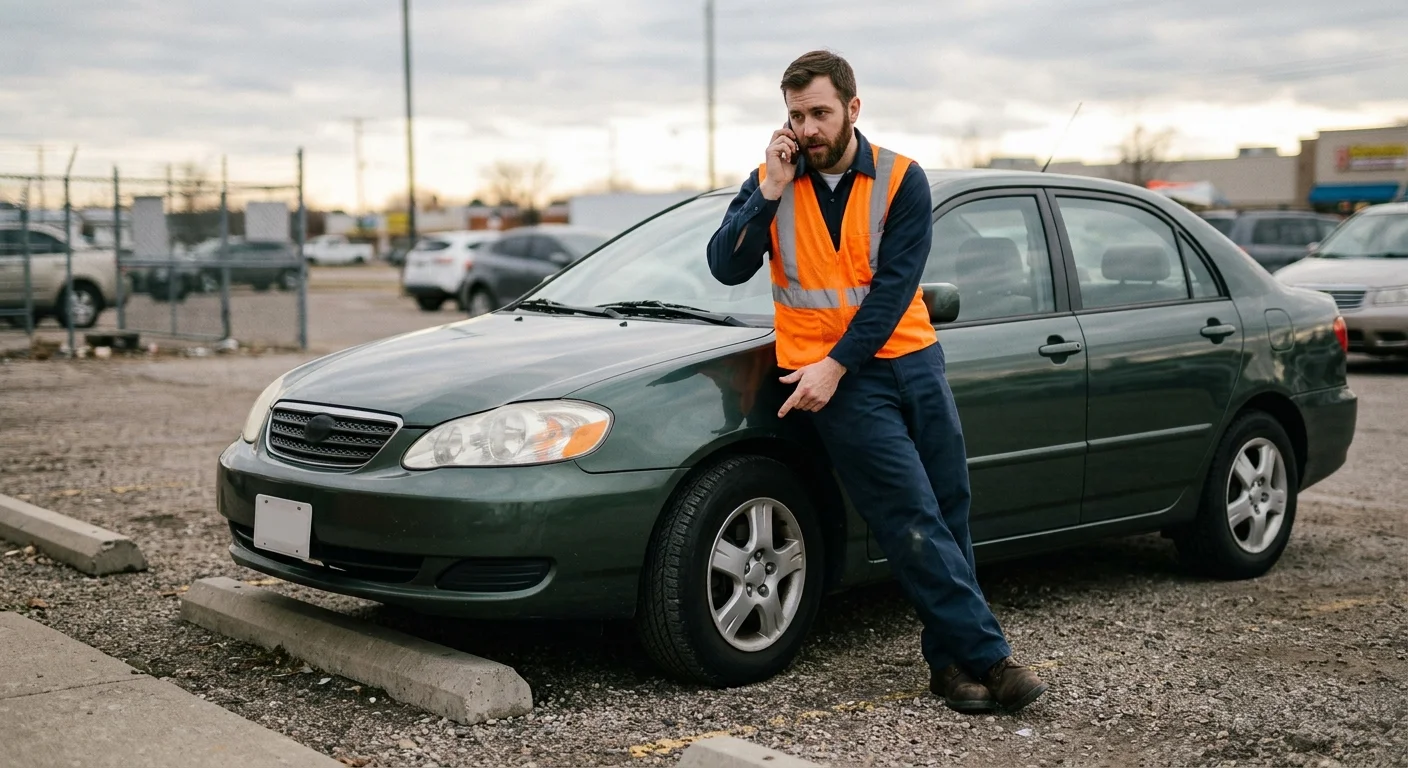
Describe what the steering and wheels are doing
We are not going to diagnose the rack, the pump, the belt, or the tires from a phone call. A shop does that after the car is off the road. Dispatch needs a plain picture of what you can see and feel, so the operator we send can pick a method that matches the car in front of them.
Say what the wheel does when you try to turn it. Heavy and slow is different from locked with no movement. A wheel that spins in your hands while the tires stay pointed the same way is different from a wheel that will not move at all. If the column is locked with the key out, say that. If the key is in and the column still will not move, say that too.
Then look at the tires, from a safe spot. Tell us if they sit straight, cocked into a curb, or turned hard against a parking block. A car on Mesa Street with both fronts against a curb is a different load-out than a car in a Fort Bliss-area lot with the fronts pointed down the aisle. If a tire is flat, off the rim, or sitting at an odd angle, name which corner. Do not crawl under the car to inspect it.
If this started while you were moving, say where you were able to stop. A sudden heavy wheel on I-10 through central El Paso is not the same job as a car that would not turn out of a space at Cielo Vista. If you used the flashers and eased to a shoulder, say which side of the road you are on. If you could not leave the travel lane, say that first. Do not force the wheel to finish a turn. Do not yank it to get into a driveway. Fighting a dead steering system can push the car into traffic, a median, or a ditch.
Noise and fluid on the pavement are useful only as observations. “There is a puddle under the front” or “it started groaning when I turned into the lot” helps the operator look before they hook. That is not a diagnosis. Leave the cause to the shop you are heading toward.
If someone is with you, have them watch the front tires from the sidewalk or the far side of the shoulder while you try a small, gentle input. Report what they see. If nobody can stand somewhere safe, skip that step. A clear sentence beats a guess. “The wheel is locked, fronts are straight, I have not tried to roll it” is enough to start a tow car with steering problem request.
Say whether the vehicle can roll
Steering trouble and rolling trouble often show up together, and they change the job. Dispatch needs to know if the car can roll a few feet, even in a straight line, or if it is planted.
Try only what is already safe. If you are in a live lane, do not experiment. Stay with the car, keep the flashers on, and wait for the operator. If you are in a lot, a driveway, or fully on a shoulder, you can check whether the car moves with the transmission in the position you would use to push it. Many cars need to be in neutral to roll. If it is stuck in park, say so. If you do not have the key, or the key will not turn, say that. We have a separate checklist for details to have ready when you call for a tow in El Paso, and keys, park, and roll all belong on it.
Tell us about the parking brake. Set, stuck, or you are not sure: all three answers help. A disabled car will not steer and also will not roll if the brake is holding it on a grade. Westside streets under the Franklin Mountains and the drop off Transmountain can pin a car that would roll on flat asphalt in the Lower Valley.
Say whether all four tires are on the ground. A car with a collapsed corner, a curb-launched wheel, or a tire in a hole is not a simple roll-out. Do not jack it. Do not try to drag it with a pickup. The operator we connect you with decides whether a winch, dollies, a wheel-lift, or a bed is the right tool once they see it.
If the engine will not start, say that in the same breath as the steering problem. A car that will not steer and will not start still gets towed. The operator needs to know they cannot use the engine to help line the wheels up. How you tow a car that will not start is the same rule as the rest of this page: describe roll, wheels, and access, then let the person on scene choose the equipment.
Four short facts cover most of this. Can it roll. Is it in park or neutral. Do you have a working key. Are the tires holding air. If you only have two of those answers, give the two you have. Guessing the other two wastes the operator’s first minutes on scene.
Share clearance and access conditions
A car that will not steer cannot be walked into a better spot. Access is the whole job. Tell us what is around the car, not just the street name.
Start with the surface. Asphalt lot, concrete garage, dirt shoulder, gravel, or packed desert. After a rain, a soft shoulder off FM 76 (North Loop Drive) through Socorro and Clint is a different recovery than a paved stall downtown. TxDOT’s El Paso District treats FM 76 as an emergency alternative for I-10, and much of that corridor is still a two-lane, two-way road with about four-foot shoulders. There is not much room to stage a truck there. Say if you are on the pavement, in the shoulder, or off in the dirt.
Then give height and width. Parking structures along Mesa, downtown decks, and apartment carports can stop a tall truck. Measure with your eyes: can a pickup-height vehicle pull in behind you, or is the ceiling tight. Say if there is a speed bump, a boot, a cart corral, or a row of cars boxing you in. A disabled car will not steer around those obstacles. The operator may need a longer approach, a winch, or a different piece of equipment.
Name the side of town with a landmark, not only a pin. “Northeast, Dyer near the loop” is clearer than “El Paso.” “Westside, up Transmountain, turnout east of the crest” tells us the grade. “Horizon City, on Horizon Boulevard, Eastlake side toward I-10” is a real corridor. “Lower Valley, North Loop toward Fabens” is not the same run as a stall on the Border Highway. If you are in Sunland Park, say you are on the New Mexico side of the line. That changes the route. It does not change the questions we ask about the car.
If you are on a highway, say which direction and which side. I-10 eastbound in a center lane is a different setup than Loop 375 on the Border Highway with a wide shoulder. Texas’s Move Over law (Transportation Code § 545.157) requires other drivers to change lanes away from a stationary tow truck using proper lights, or to slow when they cannot. That only helps if the truck can park with its lights visible. If you are hidden below a crest or around a barrier, say so.
Do not stand in the lane to “save a space” for the truck. Stay behind a barrier, on the sidewalk, or in the car with the seat belt on if that is the safer option. The operator will tell you where they need you when they arrive.
Give the pickup and destination details
We route a licensed, insured operator. We do not own the truck, and we do not run a yard. The destination still matters, because a car that will not steer has to be loaded as it sits and carried as a dead steer.
Give the pickup as a full address or a mile marker plus a cross street. “By the gas station” is not enough on Mesa or on Gateway. Add the business name, the lot entrance you used, and which row you are in. If a gate code, a HOA arm, or an apartment office is involved, have that code or a contact ready. A car that cannot be steered through a gate may need the gate held open, or a meeting point outside the fence.
Say who is with the car and who has authority to release it. If it is a rental, the contract may require a call before anyone hooks it. If it is a family car and the title holder is not there, say who is on scene. The operator still needs a person who can confirm the destination.
Then give the drop. Home driveway in the Northeast, a dealer on the west side, a shop in Socorro, or a lot in Horizon City: all of those are fine as long as the operator can get a truck in and the car off. If the driveway is steep, narrow, or blocked by another vehicle, say that now. A car that will not steer cannot be rolled by hand around a tight corner at the house. The operator may choose a different drop point in the same block.
If you want the car taken across the state line, say so before anyone is dispatched. We can connect you with an operator who will talk through that run. Do not expect a dollar figure from us for a New Mexico tow. The operator sets the price and confirms it with you before they load. For a light-duty hookup on the El Paso side, the starting figure we quote is a $95 hookup plus a per-mile rate. That is a starting figure, not the total. There is no approved flat rate, and we do not promise the same number at every hour. Ask the operator to confirm the number before the car leaves the ground.
Keep the destination to one place. Changing shops after the truck is already rolling wastes time and can change the rate. If you are still choosing between a dealer and an independent shop, say that. The operator can hold for a minute while you pick. They cannot hold a live lane on I-10 while you search.
Let the operator choose the towing method
This is the part people get wrong when they search car won’t steer towing. They ask for a wheel-lift, a flatbed, or a dolly by name before anyone has seen the wheels. Equipment choice belongs to the operator on scene. A wheel-lift can be the right tool when the car can roll and the steered axle can be controlled. A flatbed can be the right tool when the car should ride fully off the pavement. Neither one always fits. Access, weight, wheel position, and whether the car rolls all decide it.
Read our comparison of flatbed vs. wheel-lift towing in El Paso if you want the difference in plain language. Then still let the driver in front of your car make the call. Asking for one method on the phone is useful as a preference, not as an order. If a parking garage will not take a bed, say that. If the fronts are cocked and will not straighten, say that. Those facts steer the choice. A brand name for the truck does not.
Do not set up the car for “flat towing” while you wait. That phrase belongs to dinghy-towing behind an RV, which is a different job. People ask whether the steering wheel should be locked for that kind of tow. For a disabled car on an El Paso street, do not lock, unlock, or force the column based on a forum rule. Tell dispatch if it is already locked. The operator decides how the steering is secured for the method they use.
Will a tow hurt the alignment. We cannot promise a mechanical outcome. Alignment lives in the suspension and the tires, and we will not guess from a phone call. What we can do is send an operator who looks at wheel position, load path, and clearances before they hook. If a wheel is already pointing the wrong way, say so. That is the fact that protects the car, not a method you picked from a search result.
Texas towing on public roads is regulated by TDLR, not by a contractor board. Towing companies and operators must hold the right license for the work. You can check an operator through TDLR’s license search. The crews we connect you with are licensed and insured. We are the dispatch line. We are not the truck.
Once the operator is there, they will walk the car, confirm the destination, and tell you how they plan to load it. Ask your questions then. If the price they give does not match what you were ready to pay, settle it before the car is fully hooked. On a non-consent tow the state publishes maximums. Your call is a consent tow you asked for, so the operator’s quoted figure is the one that matters.
When to call us
Call when the car will not steer and you cannot move it to a shop under its own power. That includes a heavy wheel in a lot, a locked column on a shoulder, or a disabled car that will not steer on I-10, Loop 375, or a two-lane stretch of North Loop. Call us at (915) 615-2224 and we’ll connect you with an operator who handles this work.