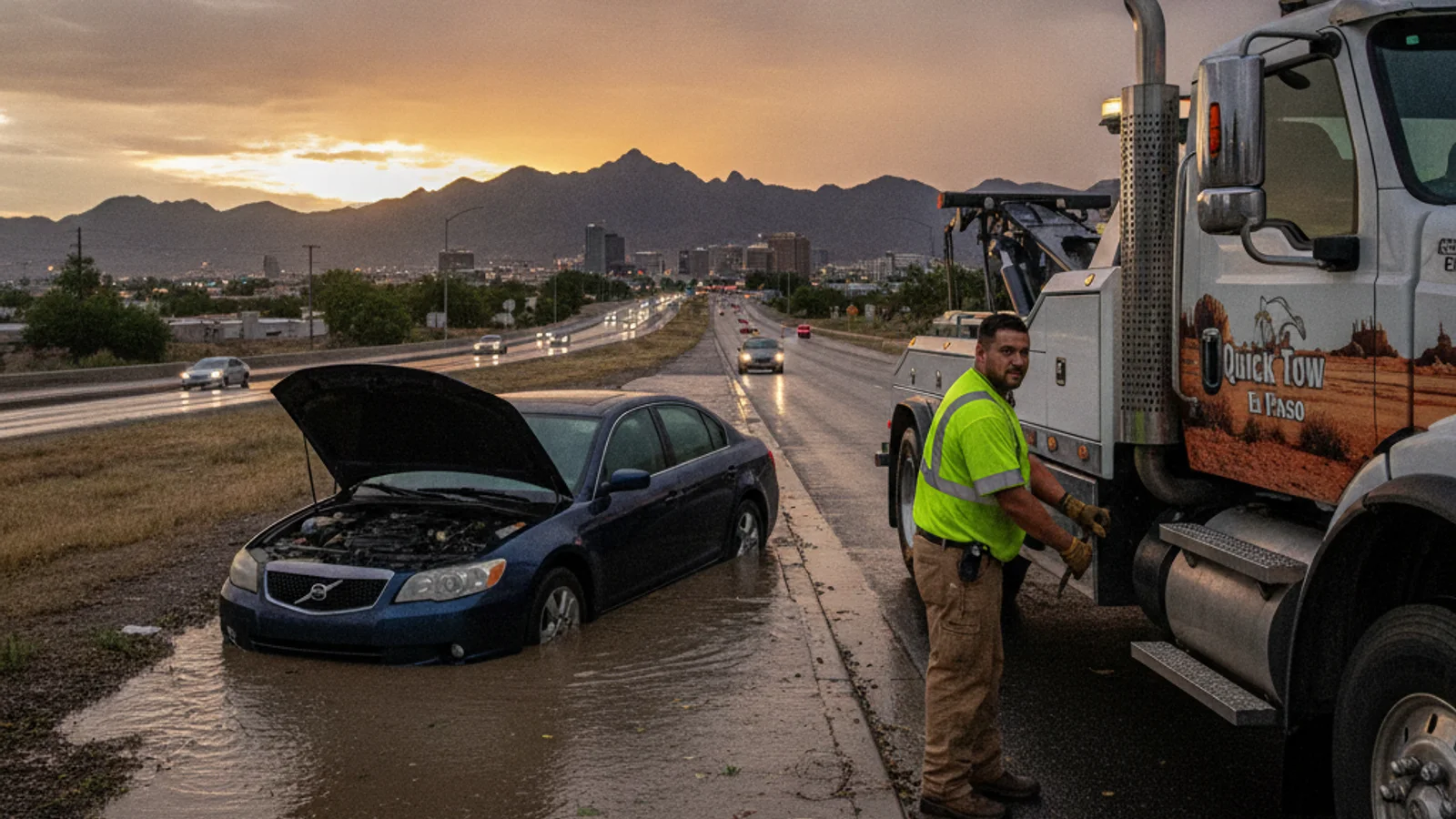
If your car stalled in flood water in El Paso, don’t try to restart it. Turning the key can pull water into the engine and turn a stall into a full rebuild. Get yourself to high ground, leave the car where it’s safe to leave it, and call for a flatbed tow. Here’s how to handle the next few minutes, and how to stay out of the water in the first place once monsoon season sets in.
Why El Paso floods so fast in the summer
Most of El Paso’s rain falls in a few violent storms between July and September. That’s the North American monsoon, and it drops a lot of water in a short window onto ground that can’t take it.
The desert floor and the paved city don’t soak up a sudden downpour. The water runs off, and it runs downhill fast. It collects at the low points, and El Paso has plenty of them: the underpasses along I-10, the dips under railroad bridges, the arroyos that cut down out of the Franklin Mountains, and the low crossings in the Lower Valley near the river and the irrigation canals.
A street that was dry twenty minutes ago can be running two feet deep by the time you reach it. That’s how good drivers end up stalled in water they never saw coming. It isn’t carelessness. The water just moves faster than the storm looks like it should.
What to do when your car stalls in flood water in El Paso
The moment the engine dies in water, your priority shifts from the car to you. Here’s the order that keeps you safe.
- Don’t restart it. One turn of the key can hydrolock the engine. More on that below, but it’s the single most expensive mistake people make.
- Judge the water before you open the door. If it’s shallow and not rising, you have time. If it’s climbing or moving, get out now while you still can.
- Get to high ground. Move away from the low spot, uphill and out of the current. Don’t stand in moving water, and don’t walk through it to reach your car once you’re clear.
- Don’t go back for the car. Nothing in it is worth stepping into a flooded roadway. Water hides drop-offs, open manholes, and current that can take your feet out from under you.
- Call for a tow once you’re safe and dry. When you can see the roadway and the water has dropped, that’s when a flatbed comes in and takes over.
If you’re stuck deciding whether the water is safe to sit in and wait out, don’t. Treat rising water as the reason to leave, not a thing to watch.
Why you should never restart a car that died in water
Engines breathe air through an intake. If that intake is below the water line, one attempt to start can suck water into a cylinder. Water doesn’t compress the way air does, so the engine seizes against it. That’s called hydrolock, and on most cars it bends or breaks internal parts.
A car that stalls in water and gets towed out dry often just needs to be dried and checked. The same car, cranked twice by a driver hoping it’ll catch, can need a new engine. The difference between those two outcomes is you keeping your hand off the key.
Water also gets into places you can’t see: the transmission, the differentials, the electrical connectors, the cabin. Even if it fires back up, a car that sat in a flood needs a real inspection before it’s safe to drive any distance. A short drive home can finish off a component that the water already started on. This is the same reason we tell people not to limp home an overheated engine off Transmountain. Once the damage is mechanical, driving makes it worse.
Turn around, don’t drown: the water is deeper than it looks
The reason cars end up stalled in flood water is almost always the same. The driver looked at a flooded dip and thought it was passable. From behind the wheel, moving water reads as shallower than it is.
The National Weather Service puts real numbers on it. As little as a foot of moving water can float a car. Two feet can carry off most vehicles, including trucks and SUVs. And you can’t see how deep a flooded underpass is until you’re already in it.
So the rule during monsoon season is simple. If a street, a dip, or a low crossing has water running across it, turn around. Take the long way. A ten-minute detour beats a stalled car, a ruined engine, and a walk through moving water. This is the summer version of the same call you make in a dust storm on I-10: the road conditions decide, not your schedule.
If you live in a part of town that floods, know your low spots before the storm hits. Drivers in the Lower Valley and along the arroyos in west El Paso already know which crossings go under first. Plan a dry route around them for July and August.
When to call a tow, and what kind
A car that stalled in flood water needs a flatbed tow, not a quick jump or a push. There are two reasons for that.
First, you don’t want the engine running or even turning, so a tow that drags the car on its own wheels is fine, but you’re not driving it anywhere. Second, a flatbed keeps the car level and fully off the road, which matters if it’s sitting in a spot where more water could come through.
Call for a tow if any of this is true:
- The car stalled in water and won’t start, or you’re not sure it’s safe to try
- Water reached the floorboards or higher inside the cabin
- The car got pushed off the road or into a curb by the current and needs recovery
- Anything about driving it feels wrong
When you call, ask for a price quote up front. A flooded car is stressful enough without a surprise bill, and any honest operator will quote you before the truck rolls. If you want to know what a tow across the metro usually runs, we break it down in our guide to what a tow costs in El Paso.
We’ll come get you when the water goes down
When the storm passes and you’re stranded with a car that won’t start, call Quick Tow El Paso at (915) 615-2224. We connect you with tow operators running flatbeds across the metro and the I-10 corridor, we’re reachable around the clock through monsoon season, and you’ll know what the job costs before anyone heads your way.
Get to high ground, keep your hand off the key, and call us once you’re safe. We’ll handle the car. You can find every neighborhood we cover on our El Paso towing map, or start with roadside assistance if the car’s drivable and you just need a hand.
Frequently asked questions
My car stalled in flood water and now it won’t start. Should I keep trying?
No. Stop trying to start it. Each attempt can pull water into the engine and cause hydrolock, which usually means major internal damage. Leave the key alone, get to safety, and have the car towed on a flatbed so a shop can inspect it before it’s started again.
Is my car totaled if it stalled in flood water in El Paso?
Not necessarily. A car that stalled and was towed out without being restarted often just needs to be dried, inspected, and serviced. The cars that get totaled are usually the ones that sat deep in water for a long time or were cranked repeatedly after they died. The faster you stop trying to start it and get it towed, the better the odds.
How deep does water have to be to stall or float my car?
Less than most people think. The National Weather Service warns that a foot of moving water can float many cars, and two feet can sweep away most vehicles, including trucks and SUVs. Water only needs to reach the engine’s air intake to stall it, and on a low sedan that can happen in water that looks shallow from the driver’s seat.
Why do I need a flatbed instead of a regular tow for a flooded car?
A flatbed carries the whole car off the ground, so the engine and drivetrain never turn and the car stays level and fully clear of the road. That protects a water-damaged car from further harm and keeps it out of any water still moving through a low spot. It’s the right call any time a car shouldn’t be driven or started.
When is El Paso’s flooding season, and where does it flood worst?
El Paso’s flooding risk peaks with the monsoon from July through September, when short, heavy thunderstorms drop a lot of rain fast. The worst spots are the low points: I-10 underpasses, dips under railroad bridges, arroyos coming off the Franklins, and low crossings in the Lower Valley. Know the ones near you and route around them when it storms.