A classic sitting dead in a Westside driveway, or on an I-10 shoulder, can pick up new scrapes, drivetrain strain, or bumper contact during a tow. That risk is real. Nobody can honestly promise a zero-damage move before the operator is on scene and has seen the car.
Towing can mess up a car when the method fights the drivetrain, the ride height, or the way the car is sitting. It can also go cleanly when you document what was already there, share real access facts, and make the operator walk through the plan out loud. Quick Tow El Paso is a dispatch line. We connect you with a licensed, insured operator. We do not transport the car ourselves.
Document the classic car before pickup
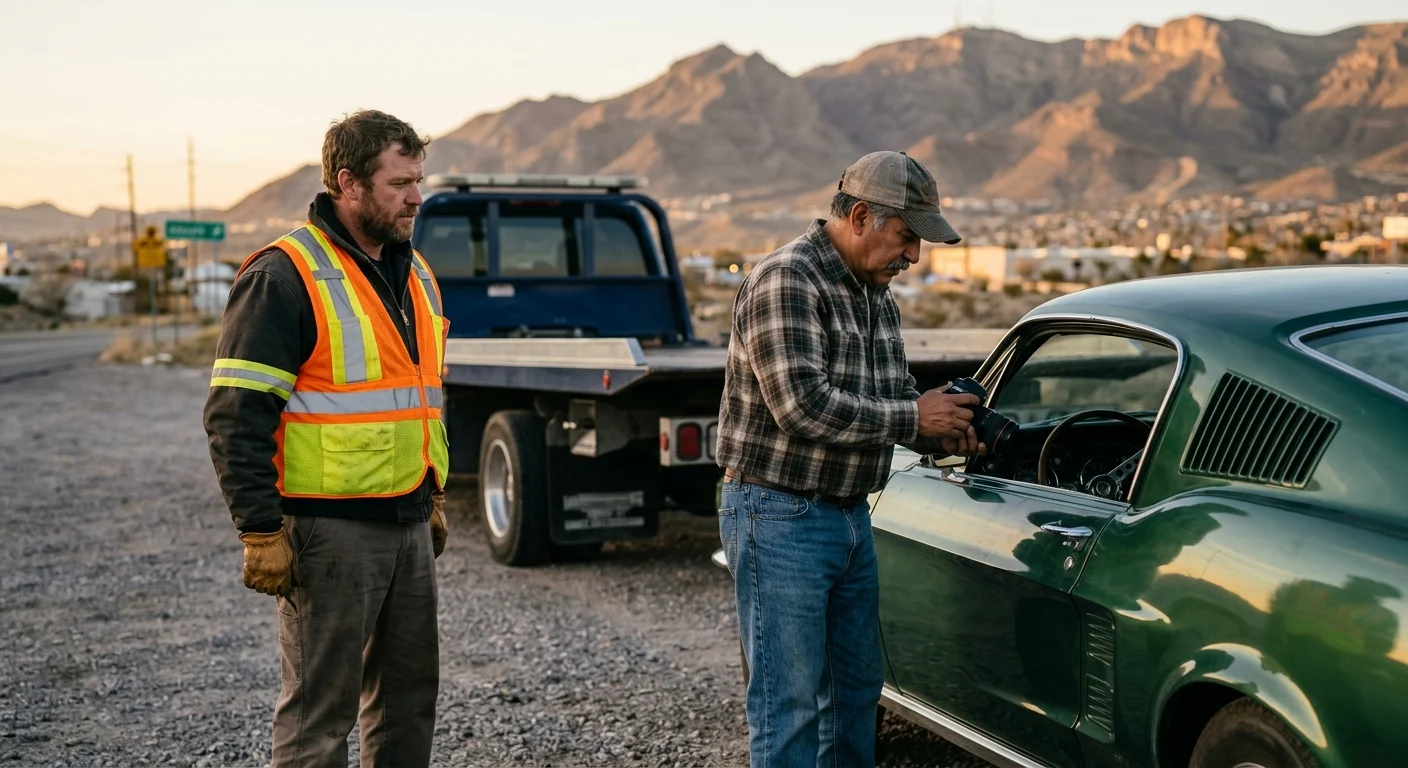
Photograph the car before anyone hooks it. That is the single most useful thing you can do if you later have to show what changed. Walk all the way around. Get each corner, both rocker panels, the front air dam, the rear valence, and the roof. Shoot the wheels and tires close enough to see curb rash that was already there. If you can see the underside without crawling into traffic, photograph what you can from a safe angle.
Do this in place. A Mustang in a Kern Place garage, a lowered coupe in a Horizon City apartment stall, and a truck-based classic on a dirt pad off North Loop Drive will not photograph the same. Capture the ground it sits on. Capture the slope. Capture any wall, fence, or tree that the operator will have to work around. If the car is on I-10 or Loop 375, stay out of live lanes. Texas’s Move Over law requires other drivers to change lanes or slow when a permitted tow truck is stopped with proper lights. Your job is still to keep your body off the pavement.
Take a timestamped set, not one pretty shot. Phone photos with the time visible in the file are enough. Photograph existing chips, faded paint, a cracked taillight, and a sagging bumper so those do not get argued later as new. Open the doors if you have keys and shoot the interior, the dash, and the odometer. If a classic car that will not start is the reason you are calling, photograph the cluster with the ignition on so you have a record of warning lights before the car is moved.
Do not invent a legal theory out of those photos. They are your record of condition, not a guarantee that a claim will go your way. Insurance language, liability, and who pays if something happens are not facts we can confirm for your policy from this page. Ask your insurer how they want damage documented. Ask the operator what they photograph on their side.
If you are waiting in July heat, remember El Paso’s normal July high is 96.1°F per the National Weather Service climate normal. That is an average, not a promise that every afternoon hits three digits. It is still hot enough that you should not stand in the sun arguing about chrome while the car sits. Get the photos, get to shade, and keep the conversation for when the operator arrives.
Write down what you see in one note on your phone: location, time, what already looks wrong, and whether the car rolls. That note travels with you if the signal drops on Transmountain or out toward Fabens.
Share verified vehicle and access details
Dispatch can only route the right operator if the facts you give are true of this car, in this spot, today. Year, make, model, and an honest weight class beat a nickname. Say if it is rear-drive, four-wheel drive, or all-wheel drive if you know. Say if it is lowered, has an aftermarket front splitter, side exhaust, or a trailer hitch that changes the rear. If you do not know a spec, say you do not know. Guessing a drivetrain is how a car gets hooked in a way the manual never allowed.
Keys matter. So does a locked steering column, a frozen parking brake, a seized caliper, and a car that will not go into neutral. Tell us which of those you have actually checked. If you have not checked, say that too. Do not claim the car rolls if you have not tried, especially on a grade coming down from the Franklin Mountains or on a rutted farm approach in the Lower Valley.
Access is local, and El Paso is not one driveway. Central and downtown can mean tight alleys, one-way streets, and garage ramps. The Westside under the Franklins can mean steep concrete and limited truck swing. The Northeast is a different grid. Horizon City’s main commercial run is Horizon Boulevard (FM 1281), with access from El Paso and I-10 via Eastlake Drive. Out east, North Loop Drive is the local name for FM 76. TxDOT’s study corridor runs about 12.5 miles from Horizon Boulevard to Alameda Avenue (SH 20) in Fabens. Most of that stretch is a two-lane, two-way rural road with 4-foot shoulders, widening to four lanes only north of Horizon Boulevard. Land along it mixes farmland and homes through Socorro and Clint. A wrecker that fits a Mesa Street lot may not like a soft shoulder on that corridor.
If you are across the state line in Sunland Park, say so. That is New Mexico, not an El Paso city street, and the operator needs that before they roll. We will not quote a New Mexico price on this page. Confirm cost with the operator who would actually take the job.
Gate codes, HOA rules, apartment office hours, and a car blocked by another vehicle are facts. Overhead clearance in a parking garage is a fact. A dirt driveway that looks firm until a truck sits on it is a fact. Share those. We dispatch from what you tell us. The operator still has to see the spot.
If the car is already damaged from a crash, say what still works: steering, tires, leaking fluids, glass in the lane. That is a different job than a clean no-start in a driveway, and it may need accident recovery rather than a simple hookup.
Separate preferences from confirmed requirements
Owners mix wants with musts, and that mix is where damage arguments start. A preference sounds like this: you want every wheel off the ground, you want the car taken to a specific shop on Alameda, you want the operator to avoid a certain strap path across chrome. Those are fair to say. They are not the same as a confirmed requirement from the vehicle maker or from Texas law.
A confirmed requirement is something you can point to. The owner’s manual for that model, a drivetrain warning stamped in the glove box, a ride height you can measure, a locked garage you cannot open, or a car that will not roll. Texas does require towing operators who work over public roadways to hold a TDLR license, in one of three categories: incident management, private property, or consent towing. Towing companies that control or operate tow trucks on public roads must be licensed too. You can check an operator at TDLR’s license search. That is a real check. It is not a damage waiver.
What we cannot confirm from the approved record for this site is a Texas statute called the “80% rule” for towing. That phrase shows up in trailer-capacity talk for people towing with their own truck. It is not a verified TDLR rate, Occupations Code section, or operator training rule we can cite here. Do not treat a forum number as a legal limit on how an El Paso operator must load your Chevelle. If your manual or a trailer plate states a capacity, follow that document. If it does not, ask the operator what their truck is rated to carry and whether this car fits.
Same split on equipment. Many classic owners ask for a flatbed because they do not want drive wheels turning on the pavement. That is a preference until the operator says they can actually send that truck to your address. A wheel-lift may be what is available on a narrow street. For how those two methods differ, read our flatbed vs. wheel-lift explainer, then still ask the person on scene what they plan to do with your car. We do not invent a rule that one method is always required, or that one method never marks a bumper.
Price is a separate conversation from damage. For a light-duty hookup we can say a $95 hookup plus a per-mile rate, as a starting figure, not the total. The operator sets the actual charge. Confirm it before the car moves. Statewide TDLR maximums apply to nonconsent tows, not as our menu: $272 for vehicles 10,000 pounds or less, with other caps for heavier classes. A classic you called in yourself is a consent job unless something else is going on. Do not mix those fee tables into a driveway pickup unless the operator says the tow is nonconsent.
If you want exotic and classic vehicle towing, say the car is a classic when you call. That is how we know to route someone who takes that work. It still does not make Quick Tow the company that owns the truck.
Ask the operator to explain the transport plan
When the truck is there, slow the job down for two minutes. You are allowed to ask how they will move this specific car. You should. Does towing a car damage it in this setup, with this bumper height, on this slope? The person holding the controls is the one who can answer in the real world. We cannot answer it from a phone script.
Ask what will be on the ground and what will not. Ask how they will get the car from its stall to the truck without scraping a splitter on a steep Westside apron or a garage lip downtown. Ask where straps or chains will land. Ask whether they need the car in neutral, and whether that matches what your manual says. If the transmission, transfer case, or a locked differential is in play, the manual wins over a guess. Towing can ruin a transmission when a driveline is forced to turn in a way the gearbox was never meant to. That is a real mechanical risk. It is not a statistic we have for El Paso, and it is not a promise that a flatbed erases it. Low oil, a seized parking pawl, or a car already in gear can change the plan.
Ask where the car is going, by street, not by vibe. A shop off Dyer is not a shop in Socorro. A storage stall in Horizon City is not a driveway in Canutillo. If the drop is across the New Mexico line, say that again at the truck, because the run and the paperwork are not the same as an in-city hop.
Ask what they need from you: keys, a door unlocked, a neighbor to move a troca blocking the path, cones, or a spotter because the street is narrow. If you do not like an answer, say so before the car is fully hooked. In Texas nonconsent work, a drop-fee structure exists when a vehicle is fully hooked but has not left the property, with statewide maximums set by TDLR. Your classic pickup is usually consent. Still, once the car is on the truck, it is mostly too late to change the method. The time to talk is before it leaves the pavement it is sitting on.
Do not DIY this with a hitch on a friend’s pickup because the wait feels long. A consumer hitch and a licensed wrecker are not the same tool. We also do not promise when an operator will arrive, because we do not control which truck is closest. Ask the operator for their own arrival estimate if you need one. Rural stretches toward Clint and Fabens take longer than a Central job. That is geography, not a timed guarantee.
If the car is an EV-era restomod or has air suspension on the ground, say that. Handling notes live in the build sheet and the manual, not in a generic towing blog.
Record concerns before the vehicle moves
Say the concern out loud, then write it down. “The front lip already sits close to this driveway.” “The right-rear wheel has a bent rim.” “I do not want the bar on that bumper.” Short sentences. The operator can work with a specific worry. They cannot work with a vibe that the car is precious.
Take one more photo after the car is secured and before it rolls. That shot is the bridge between “how I delivered it” and “how it traveled.” If you are not riding along, photograph the truck’s plate and write the operator’s name as they give it. Keep the destination and the phone number they want used for updates. Our public number for dispatch remains (915) 615-2224. The operator’s own contact for the trip is whatever they tell you on scene.
If something already looks wrong after loading, speak then, not after the car has gone over I-10, Loop 375, or Transmountain. Heat, grade, and a two-lane farm road with narrow shoulders all change how carefully a load has to be driven. We do not have verified crash counts for those corridors, so we will not invent them. You still know, as a local, that a load headed out FM 76 toward Fabens is a different drive than a five-minute hop in central El Paso.
Do not sign a blank condition form if you disagree with it. If a form is put in front of you, read the damage boxes. Note pre-existing marks. If you cannot confirm a line, say you cannot confirm it. We are not going to invent warranty, insurance, or “we’ll make it right” language. Those terms, if they exist, come from the operator you contracted with, not from this dispatch brand.
If the tow was without your consent, Texas Occupations Code Chapter 2308 gives the owner or operator a hearing right on probable cause, with a request deadline of 14 days excluding weekends and holidays after the vehicle is placed in storage or booted. That path is for nonconsent and booting. A classic you asked us to move is not that case. Do not wait on a hearing clock for a job you called in.
Your last check is simple. You documented the car. You told dispatch the truth about the car and the spot. You separated what you prefer from what the manual and the site actually require. You heard the transport plan. You recorded the leftover worries before the wheels left the ground. That is how you answer “does towing car damage it” for this car, in this city, on this day: it can, so you treat pickup like a handoff, not like a leap of faith.
When to call us
Call when a classic, exotic, or low car in El Paso cannot move itself and you need a licensed, insured operator to take it, not a friend’s hitch. Call us at (915) 615-2224 and we’ll connect you with an operator who handles this work.