Your car is sitting on US 54 and the lanes next to you keep moving. The person who answers our line cannot guess your mile, your direction, or whether you need a hookup or a tire change. Give those facts first and we can connect you with a licensed operator who actually works this corridor.
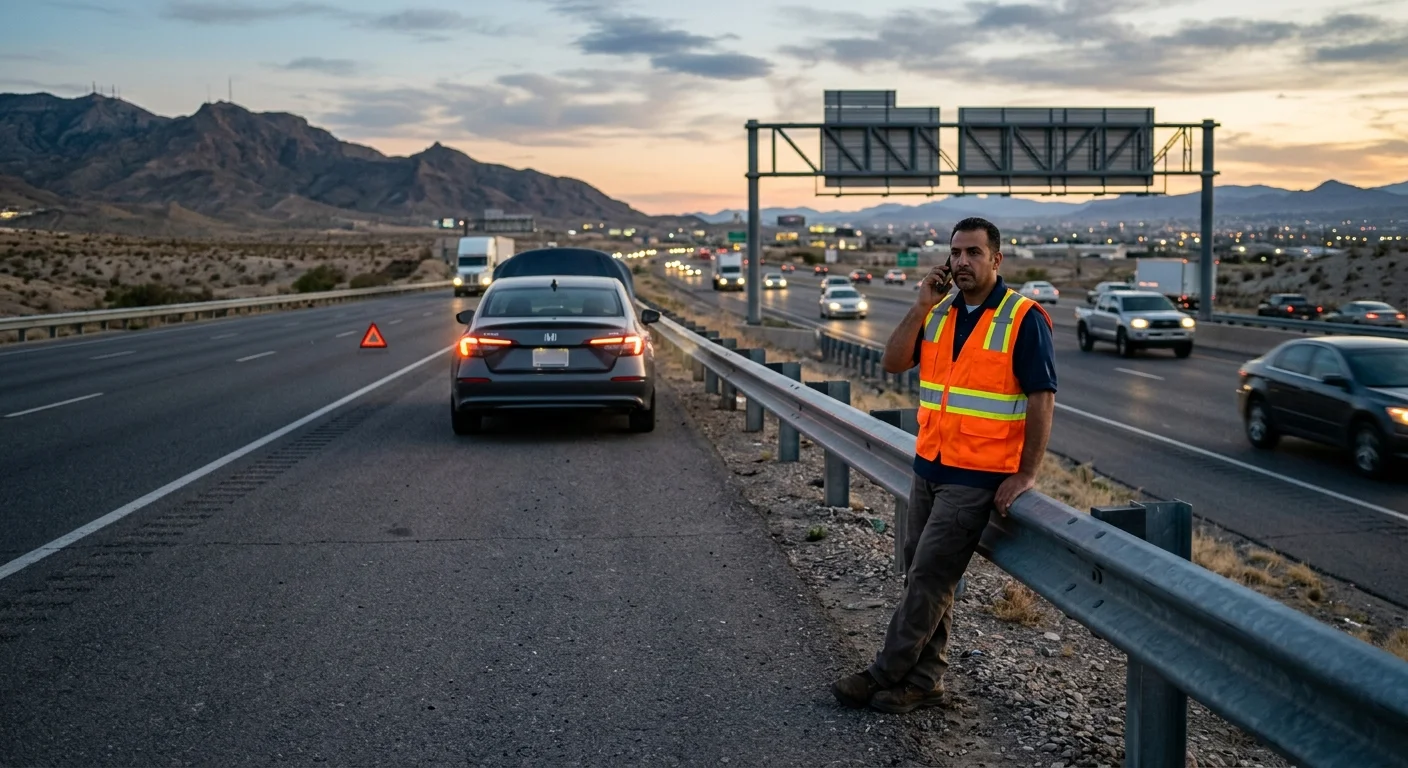
Give your exact position on US 54
US 54 is its own road. It is not I-10. It is not Loop 375. It is not North Loop Drive in the Lower Valley, and it is not Transmountain over the Franklin Mountains. If you only say you are in El Paso, the operator we connect you with still has to hunt for you.
Name the highway first. Say US 54, then northbound or southbound. Direction decides which shoulder the truck can work from and which ramp the driver uses to turn around. Locals also know this stretch as the Patriot Freeway. Either name is fine if you also give a direction.
Give a mile marker if one is in view. If it is not, name the last exit you passed and the next one you can read. An overpass name works. A phone pin helps, but a pin with no direction can put the wrecker on the opposite lanes.
Northeast El Paso sits on this corridor. If that is where you are, say Northeast. If you are still near the I-10 interchange in central El Paso, say that. If you are rolling toward the New Mexico line, say whether you are still in Texas. We dispatch for El Paso. A New Mexico pickup or drop is a different job, and we do not attach a dollar figure to it. The operator confirms that with you before they hook the car.
Do not use a business name as your only pin. Frontage-road stores look the same from the main lanes. Pair any landmark with the highway, the direction, and whether you are in the through lanes, on a ramp, or on a frontage.
Drivers who search 54 towing usually mean a stop on this highway, not a lot two blocks off. Lead with the route. Street names come after.
The Westside under the Franklin Mountains is a different run. Horizon City and Socorro sit out east on other roads. If you mix those in, the truck starts in the wrong part of the county.
A clean script is enough: “I am on US 54 southbound, at mile marker [number], right shoulder, Northeast El Paso.” Stay on the line while we route the call. If you want neighborhood-level detail once you are off the freeway, read what to share for a tow truck in Northeast El Paso.
Describe the shoulder, lane, or nearby access point
Position on the map is half the job. The other half is how a wrecker can reach you without blocking live traffic.
Say whether you are on the right shoulder, the left shoulder, a gore between ramps, an on-ramp, an off-ramp, or a frontage road. “On 54” is not enough if you are actually on a ramp that only an eastbound frontage can feed. The operator needs that so they do not drive past you on the main lanes.
Say if any part of the car is still in a travel lane. If a tire, bumper, or trailer tongue is over the white line, say so. That changes how the driver sets cones and where they park the truck. If you already moved fully onto the shoulder, say that too.
Look at the ground under the wheels. Pavement, dirt, a drop-off, or a cable barrier all change the hookup. If you went through a gap and the car is below the road grade, say you are off the pavement. That is recovery work, not a simple pull from the shoulder. The operator we send will confirm what they can do once they see the scene.
Name a nearby access point if you have one. An exit gore, a turnaround, a frontage break, or a wide pad at an overpass can be a safer place to wait than a narrow strip. Do not walk along the travel lanes to get there. If you can already roll the car a short distance under its own power, tell dispatch that before anyone leaves. If you cannot roll it, stay put.
Do not guess lane counts or posted speeds. Those details were not verified for this corridor, and a wrong number helps no one. Describe what you can see: how much shoulder you have, whether a wall or barrier is on your left, and whether headlights can see you.
If visibility is poor, say that. Night, rain, or blowing dust all change how the driver approaches. Keep your hazards on if they work. Stay in the vehicle if the shoulder is tight. July highs in El Paso average 96.1°F on the National Weather Service normal, so summer waits on this asphalt get hot. Water, shade inside the cabin, and a charged phone matter more than standing outside to flag traffic.
Choose roadside help or a tow
You do not have to diagnose the car on the call. You do have to say whether it will roll.
If the engine runs, the tires hold air, and you can steer, you may only need roadside assistance. That covers a dead battery, a flat with a usable spare, a lockout, or an empty tank. Tell us which of those it looks like. The operator confirms on scene. We do not sell parts out of a truck we own. The driver who arrives is the one who can say whether a jump or a spare is enough.
If the car will not move, you need a tow. No start after a jump, a wheel that will not turn, a blown tire with no spare, an overheat that will not cool, or damage from a crash all point to a hookup. For that we connect you with emergency towing on this route.
Overheating on US 54 is not the same job as overheating on the mountain. Transmountain is a climb with its own grades and pull-offs. If that is where you actually are, use the checklist in overheated on Transmountain Road. If you are on US 54, stay on US 54 in the call. Do not mix the two roads.
A light-duty consent tow with this brand starts at a $95 hookup plus a per-mile rate. That is a starting figure, not the total. The per-mile number itself is set by the operator. We do not publish it, and we do not call it a flat rate or a firm quote. Ask the operator for the total before they hook the car, and confirm it covers the drop you named.
If the stop is a nonconsent tow you did not request, Texas has separate rules. TDLR posts statewide maximums for those jobs, including $272 for vehicles 10,000 pounds or less. You can read the current consumer sheet on the TDLR towing page. Those caps are law, not our price. A call you place for help on US 54 is a consent job unless someone else already ordered the truck.
If an officer is already on scene and has called a wrecker, ask who they called before you order a second one. El Paso’s local rotation rules were not confirmed in our claims file, so we will not describe them. The practical step is simple: do not pay for two trucks.
Share vehicle and destination details
Once the operator knows where you sit, they need to know what they are picking up and where it goes.
Give the year, make, and model. Add 2WD, 4WD, or AWD if you know it. Say if it is a sedan, a troca, a van, a motorcycle, or something heavier. Light-duty gear handles typical cars and small pickups. Heavier units need a different truck. Guessing high is safer than sending a truck that cannot lift the vehicle.
Say whether all four tires are on the ground, whether a wheel is gone, and whether the car sits on a parking pawl that will not release. A car that will not roll onto a wheel-lift may need a flatbed. You do not have to choose the truck type on the call. Describe the problem and let the operator pick the right bed.
Keys matter. Say if you have them, if they are locked inside, or if the steering column is locked. A steering lock changes how the driver loads the car. For an EV, say it is an EV and about how much charge remains. Do not assume a jump will wake it.
Then name the drop. Home, a shop you already chose, or a lot you can access. Do not invent a shop because a search result showed an address. If you do not have a destination yet, say so. The operator can talk through options once they are with you. If the drop is across the New Mexico line, say that on the first call. We still will not quote a New Mexico dollar figure. The operator has to confirm that run on their own terms.
If a passenger needs a ride, say how many people are with the car. Some wreckers can take a rider. Some cannot. That is the operator’s call, not ours. Pets, child seats, and mobility gear should come with you if you leave the vehicle. Storage access rules apply only after a car is in a vehicle storage facility, which is not what this US 54 stop is unless a nonconsent tow already happened.
Have a photo ID ready if the car is going anywhere that will ask for it. For a consent pickup on the shoulder, the driver mainly needs you, the vehicle, and a clear drop. Payment is between you and that operator. They must be able to take the forms of payment they accept. Ask before the hookup so you are not surprised at the ramp.
Confirm scene control and access with the operator
The last things to settle are safety on the shoulder and how the truck will get in.
Texas’s Move Over law applies when a tow truck is stopped and using proper visual signals. Drivers on a highway with two or more lanes in the same direction must either leave the lane closest to that truck or slow down. If the posted limit is 25 mph or more, that slowdown is no more than 20 mph below the limit. A first offense is a misdemeanor with a fine from $500 to $1,250. The statute is Texas Transportation Code § 545.157. You cannot control other drivers. You can keep yourself out of their path.
Stay in the vehicle if the shoulder is narrow or traffic is close. If you must get out, exit on the side away from live lanes and stand well forward of the car, never behind it. Do not cross US 54 on foot. If the car is in a travel lane and you cannot move it, call 911 first, then us.
Tell the operator how they can reach you. Right-shoulder stops are usually a straight approach. Left-shoulder and gore stops may need a different entry. Ramps can be one-way. If a concrete barrier, cable, or fence is between the frontage and your car, say that. A truck that cannot physically get to the bumper cannot help you from the other side of the wall.
When the driver is on the way, they may ask you to stay on the phone or to watch for lights. Ask them for their arrival estimate. We will not give you one. We do not control which licensed truck is closest, and we do not publish hours or answer-speed claims. Distant stretches toward the New Mexico line take longer than a stop in the Northeast in-town lanes. That is geography, not a promise.
Before the hookup, confirm the work and the price with the person standing there. Confirm the drop. Confirm whether a rider can get in the cab. If you want to check that the operator is licensed, TDLR’s license search lets you look up tow truck operators by name, city, or license number. The pros we connect you with are licensed and insured. We are a dispatch and referral line. We do not own the wrecker, and we do not hold the tow license.
If the scene changes while you wait, call back. A push onto a wider shoulder, a police unit arriving, or the car rolling farther off the pavement all change the job. Give the new position the same way you gave the first one: US 54, direction, marker or exit, and what the truck will see.
When to call us
Call when the car cannot stay on US 54 under its own power, or when roadside work on the shoulder is safer than trying to limp to an exit. We take the location, the vehicle, and the drop, then we connect you with a licensed operator who does the work. Call us at (915) 615-2224 and we’ll connect you with an operator who handles this work.