The dash flickers, the radio cuts, and the car goes quiet on a Pleasant Valley street. People type “bad alternator Pleasant Valley” because that is the first phrase that comes to mind. You do not need a parts name to get moving. You need a clear report of what the car is doing, a pin for where it sits, and a choice between roadside help and a tow.
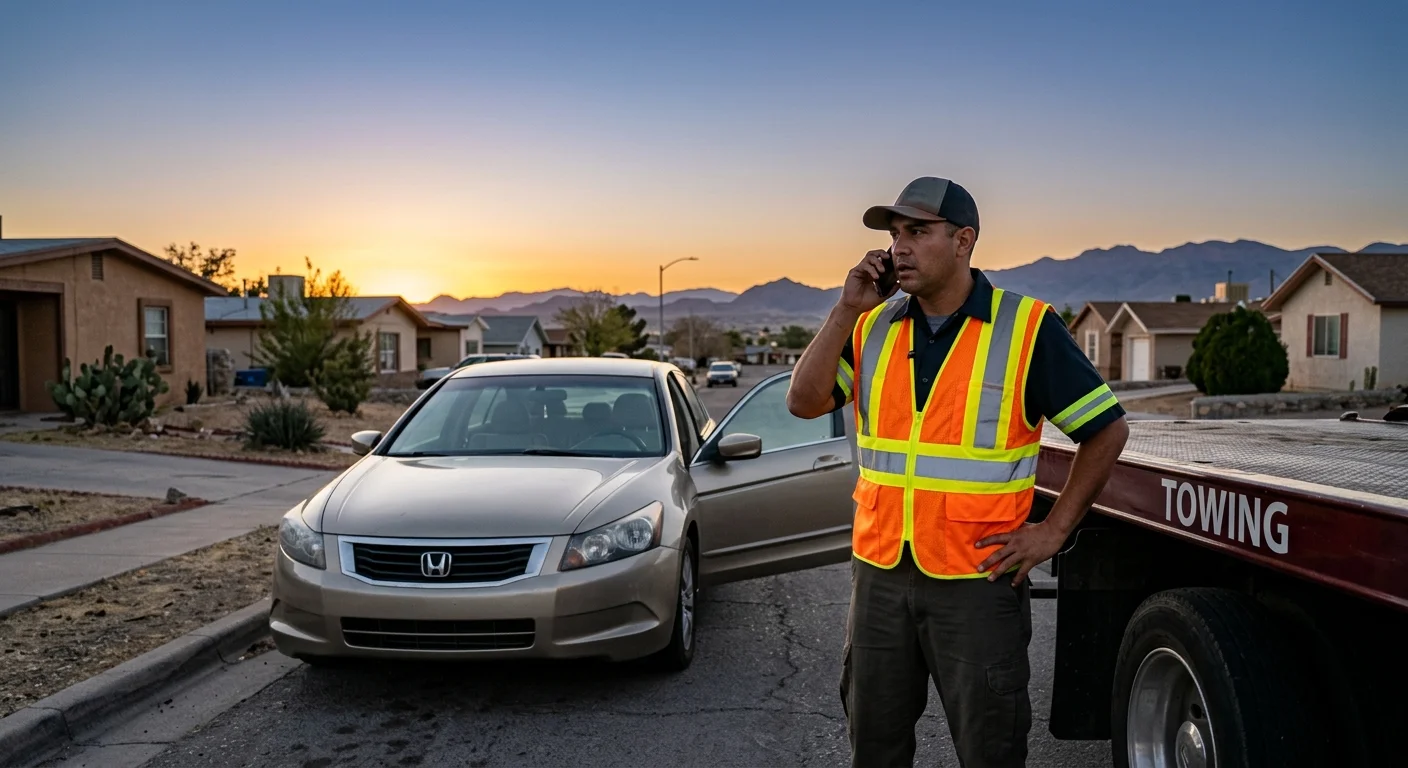
Report the power loss without naming a failed part
Power loss looks the same from the driver’s seat for more than one failure. Lights fade. Accessories slow. The engine stalls at a stop. The key gets a click, a slow crank, or silence. A shop with a tester names the part. A phone call does not.
Skip the diagnosis. Tell the sequence.
Start with the last thing that worked. Were you rolling, idling at a light, or already parked. Did the lights fade first, or did everything quit in one drop. Is anything still on: hazards, radio, windows, door locks. When you turn the key, what do you hear.
If you already tried a jump, say so. If it started, ran a few blocks, then died again, say that too. That pattern is useful even if you never name a component. Our guide on a car that will not start after a jump walks through what to share next in that case.
Do not keep cycling the key. Do not stack jumps to “make it to the shop.” If the car is already losing power, another start can leave you in a worse lane. Shut down extras: A/C, stereo, phone chargers. Turn on hazards if they still work.
If you can still roll a short distance, ease to a curb, a driveway apron, or a lot. Get out of the travel lane if you can do it without fighting traffic. If you cannot roll, stay in the car with the seat belt on until it is safe to step out on the passenger side.
Searches like “bad alternator Pleasant Valley” are common. Treat them as a symptom label, not a work order. Dim lights, weak accessories, and a stall can come from more than one system. Guessing the part on the shoulder does not change the next safe step.
We are a dispatch line. We answer, we quote the starting figure the operator will work from, and we route a licensed, insured operator. We do not test charging systems on the phone. We do not sell parts. The driver we connect you with looks at how the car sits, whether it rolls, and whether this is a roadside assistance stop or a tow.
If you are sitting in July heat, plan for it. El Paso’s National Weather Service climate-normal high for July is 96.1°F. Summer highs normally run in the mid-to-upper 90s, and individual days run hotter. A dead car with no A/C is not a place to wait while you diagnose from a forum. Get the report in, then get into shade if you can do it safely.
Keep the story short when you call. Neighborhood. What failed first. What still works. Whether anyone is with you. That is enough for intake. The operator can ask follow-ups on scene.
Give a verified Pleasant Valley location
Pleasant Valley is a named pocket people in El Paso use when they call. This site’s verified records do not list official Pleasant Valley boundary streets, a city landmark set, or a mapped edge we can quote. We will not invent a corner. You give the pin.
Share a live map pin from your phone. Then name the nearest signed cross street you can actually read. “Near Pleasant Valley” is not an address. “On the north curb, fifty feet west of this named street, facing east” is.
Add the setting in one line. Travel lane, bike lane, curb, driveway, apartment lot, or store lot. If you are in a complex, give the building or lot name on the sign in front of you. If you are blocking a driveway or a fire lane, say that. If you rolled onto private property, say that too, because the operator needs permission to hook there.
El Paso is not one grid. Central and the Lower Valley, the Northeast, the Westside under the Franklin Mountains, Horizon City and Socorro out east, and Sunland Park across the New Mexico line all change the run. A pin in Pleasant Valley is not a pin on FM 76 in the Lower Valley, and it is not a pin on Horizon Boulevard. If you drove out of the pocket before the car quit, say which named road you were on when it died.
If you can see a numbered highway from where you sit, name it. I-10, US 54, and Loop 375 are real El Paso corridors. Do not assume we know which one is closest. If the pin is across the state line toward Sunland Park, say New Mexico out loud. That is a different jurisdiction. We do not quote a New Mexico price on this line.
Stay with the vehicle if it is safe. If you had to walk to shade or a storefront, leave a note on the dash and keep the phone on. Tell us you are not in the car, and how far you walked. The operator still needs the vehicle, not only you.
If you are on a highway shoulder and a permitted tow truck is already on scene with lights on, Texas’s Move Over law applies to other drivers. They must change lanes away from the truck when there are two or more lanes in the same direction, or slow to 20 mph under the posted limit when that limit is 25 mph or more. That is statewide law. It does not change what you tell dispatch. It is why you stay out of the travel lane.
No city-listed Pleasant Valley landmark was confirmed in the sources this site uses. A pin plus a signed cross street beats a neighborhood name every time.
Choose roadside help or a tow
The choice is about what the car can still do, not about the part you searched.
Choose roadside help when the car is in a safe lot or against a curb, it still rolls a few feet, and you only need a start or a simple stop so you can decide the next move. Choose a tow when it died in a live lane, it will not roll, steering or electronics feel wrong, or you already jumped it and it quit again. A jump that dies a second time is not a second-chance plan. It is a tow.
Do not try to finish the trip on fading power. A short roll into a parking space is one thing. A run across town is another. If lights are dropping while you drive, pull out of the lane at the first safe opening and stop.
Tell us which service you want when you call. If you are in a live lane, ask for emergency towing. If the car will not roll, or you do not want driven wheels on the ground, ask whether a flatbed fits. If it rolls and the operator agrees a wheel-lift is enough, that is their call on scene. You can ask. They confirm before they hook.
Price on this brand is simple and limited. A light-duty tow starts at a $95 hookup plus a per-mile rate. That is a starting figure, not the total. The operator who does the work sets the rest. Confirm it with that operator before the truck leaves with your car. There is no flat-rate promise on this line, and no “same price at any hour” claim. If you only need a service call and not a tow, ask the operator what that call covers and what it costs before anyone starts.
If this were a nonconsent tow, Texas sets statewide maximums through TDLR. That is a different job from the one you are requesting. You are asking for help. You are not being removed from a lot against your will. Do not mix those fee tables.
You can check that a tow operator is licensed. Texas requires towing operators on public roadways to hold the right TDLR license for the work. Search by name, city, or license number at the TDLR license search. The crews we connect you with are licensed and insured. We are the dispatch office, not the truck.
Distance changes the job. A neighborhood curb is one run. A pin that turns out to sit toward Horizon City, Socorro, or a Lower Valley farm road is another. We will not quote an arrival window. Ask the operator for an estimate once they have the pin. Distant and rural recoveries take longer. That is honest, and it is the most useful thing we can say about time.
If the car is already in a safe lot and you would rather wait for a shop you know, say that. Roadside help is not a requirement. A tow to the bay you choose is often the cleaner path when power already failed once on the road.
Share what the car can still do
Dispatch does not need a parts theory. Dispatch needs a working picture.
Say whether the car is in park or stuck in gear. Say whether the steering still turns with the key on. Say whether the wheels roll if you shift to neutral. Say whether the parking brake is on, and whether you can release it. Say whether you have the keys, a fob, or a push-button start that no longer wakes up.
Hazards, headlights, and interior lights matter because they tell us how much electrical life is left, not because they name a failed part. If the windows still move, say so. If they do not, say that too. If an aftermarket alarm or kill switch is armed, mention it before someone tries to load the car.
Give the vehicle shape in one breath. Sedan, SUV, pickup, van. Two-wheel drive or four-wheel drive, if you know. Low air, a missing wheel, or a car sitting on a parking block changes the hook. If it is a motorcycle, an RV, or a heavy truck, say that up front so we route the right operator instead of a light-duty truck.
Tell us how it sits relative to traffic. Nose in, nose out, parallel to the curb, across a stall, or half in a lane. If a tire is against a curb or a landscaping block, say which corner. If the lot is gated, say whether the gate still opens.
People. Kids in the car. Someone with heat sensitivity. A pet. That does not change the mechanical report, but it changes how the stop is handled. In summer, get people into shade once the vehicle is marked and it is safe to step out.
Do not start a repair on the shoulder. No belt tricks. No “quick fix” from a search result. No parts swap in a travel lane. If the car still has some electrical life, use it for hazards and the phone, not for a second attempt to drive across El Paso.
If you already called a shop, have the shop name and the address ready. If you have not, that is fine. The next section is the destination, and you can choose it on the call.
Write the details down before you dial if you can. Cross street, pin, what still works, what does not. That list is what we pass to the operator. It is also what you will be glad you had if the phone battery is next.
Confirm the destination before dispatch
A power-loss tow is not finished when the car leaves Pleasant Valley. It is finished when it is sitting where you want it.
Name the destination before we route the truck. Home driveway, a shop you already use, a dealer service lane, or another address you can recite. We do not pick the shop, and we do not guess that you need a charging-system bay. You choose the door the car should face.
If you are torn between home and a shop, say both options. A dead car at home still needs a second move later. A shop that can take it today may be the shorter path. Our note on towing home or to a dealership is the same decision in more detail.
Give the operator a way to reach the destination. Gate code, lot hours, a service-writer name, a side alley that trucks actually fit. If the shop closes before the truck can arrive, say so. Then pick a second drop, or ask the operator what they can do. We will not invent shop hours, and we will not promise a clock time.
Confirm who is paying, and how. The operator sets the charge from the $95 light-duty hookup plus the per-mile rate, plus whatever the run actually requires. Ask for that number before the car is hooked. Keep a photo ID and proof you can authorize the tow. If the car is a rental, call the rental company first. If it is a work vehicle, get the fleet contact on the phone.
Keys stay with the vehicle unless the shop told you otherwise. Leave a number on the dash if you will not ride along. If you will ride, ask the operator. That is their policy, not ours.
If the pin you sent is wrong, fix it before the truck is rolling. A Pleasant Valley label with a pin that dropped on the other side of town wastes the run. Open the map, drop a new pin, and read the cross street again.
Once those pieces are set, the job is a consent tow to an address you named. Stay off the road, keep the phone on, and let the licensed operator do the hook.
When to call us
Call when the car has lost power in Pleasant Valley and you need a licensed towing pro to jump it in a safe lot or haul it to the address you name. We take the report, quote the starting figure, and connect you with an operator who handles this work. Call us at (915) 615-2224 and we’ll connect you with an operator who handles this work.