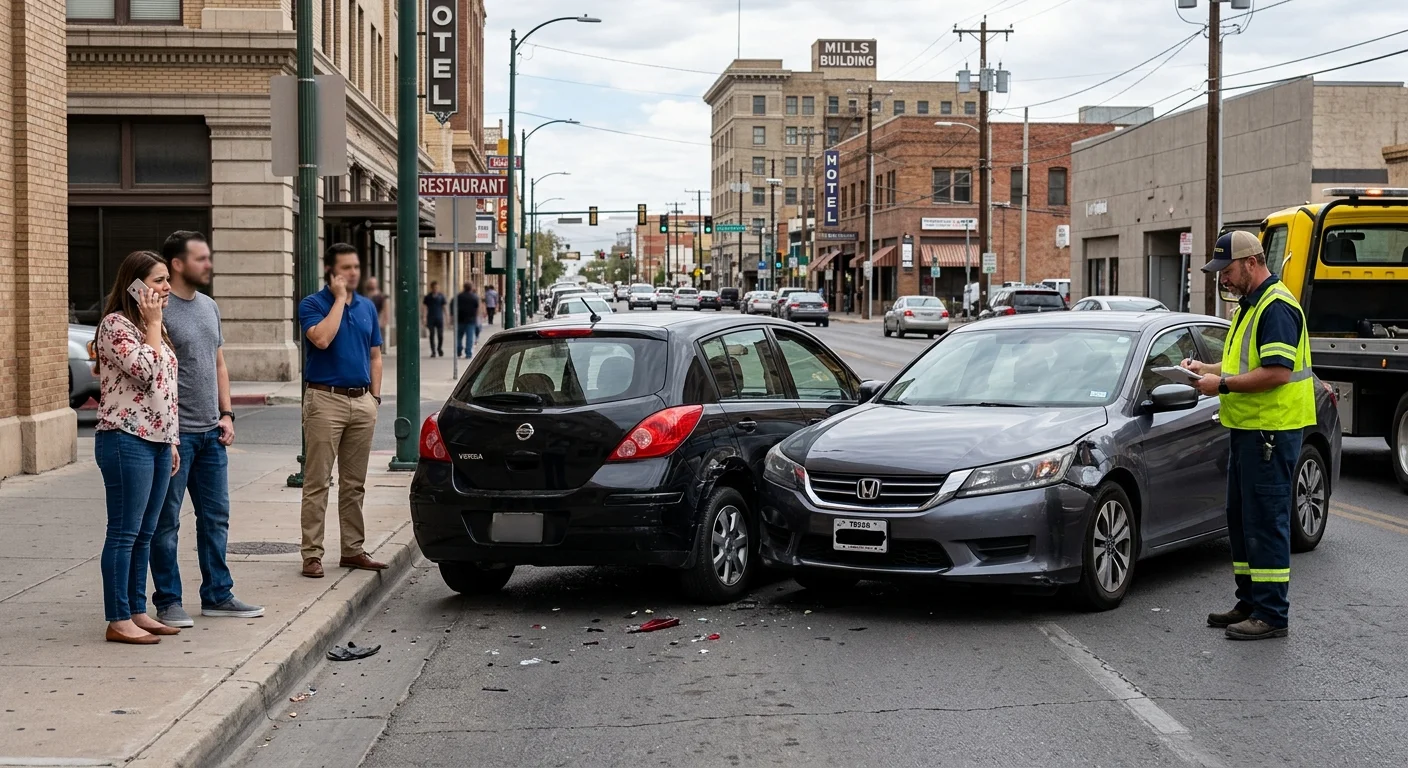
A fender-bender on Santa Fe, Mills, or Kansas still leaves a car that may not roll. Accident towing downtown El Paso starts with a clear call, not a guess at the one-way. Tell dispatch the block, the vehicles, who is running the scene, and the drop-off before anyone hooks up.
Give the exact Downtown El Paso location
Downtown sits in a tight grid between I-10 and the river. Juarez is across the bridges. The Franklin Mountains rise west of the core. A pin that only says “downtown” is not enough. The operator we route needs a street, a cross street, and a landmark a driver can see from a cab.
Name the street and the nearest cross street. Santa Fe Street near the Paso del Norte Bridge is not Oregon Street by San Jacinto Plaza. Mesa at Mills is not Kansas under the I-10 deck. Southwest University Park on Franklin Avenue is not the Convention Center. Union Plaza and Durango sit west of the plaza. Paisano Drive, US 62, runs along the south edge toward the Border Highway. Those are different approaches, different turns, and different places to stage a wrecker without blocking a whole block.
Say which way the one-ways run from where you stand. Downtown El Paso uses a one-way grid. A truck sent the wrong way on El Paso Street or Oregon has to loop the block. Tell us if you are on the north side of I-10, under an overpass, or on a surface street south of the freeway. A crash in the travel lanes of I-10 is a different job than a metered stall on Texas Avenue. If you are on the freeway itself, give the same level of detail you would after a wreck on I-10.
Stay precise about the line. A Downtown El Paso tow truck call is a Texas city-street job. Sunland Park is New Mexico. Ciudad Juarez is Mexico, south of the Rio Grande. If you are on a Santa Fe or Stanton bridge approach, say which side of the international line you are on. We cannot invent a border procedure. Ask the agency standing there if you are on the bridge itself.
Give a landmark: San Jacinto Plaza, City Hall, the county buildings, the ballpark, a named garage, a hotel on Mills. Note cones, a blocked lane, a loading zone, or event traffic around the stadium. Speak the names. Do not assume a photo of a sign is readable on a phone.
Horizon City, Socorro, and the Westside under Transmountain are other parts of this metro. They are not this grid. Downtown recovery is short blocks, tight turns, and foot traffic. The Lower Valley is a longer run on different roads. If you are not actually downtown, say the city or the corridor before we route anyone.
Describe the vehicles and visible condition
Collision towing El Paso dispatch needs the vehicle, not a story about fault. Start with make, model, color, and body type: sedan, SUV, pickup, van, motorcycle, or something heavier. A lifted troca and a low sports car are different loads on these streets.
Say what you can see. Airbags out. A wheel tucked under. Fluids on the asphalt. A bumper in the lane. Doors that will not shut. A car that still rolls in neutral versus one that will not move. Keys in hand or missing. If it is an EV, say so. If a motorcycle is down, say which side and whether it is in a lane, on a sidewalk, or against a curb.
Do not diagnose the frame. Do not pick the truck. The operator chooses the method. That is often a flatbed when a car cannot roll, or other recovery gear when a vehicle is against a curb or on a grade. Crash work on a public street is accident recovery, not a parking-lot hop.
Photos help if you can take them from the sidewalk. Shoot the whole car, the corners, the tires, and the street in both directions. Do not stand in a live lane for a better angle. Texas’s Move Over law, Transportation Code § 545.157, requires other drivers to change lanes or slow when a tow truck or emergency vehicle is stopped with proper lights. That protects the operator once they are working. It does not mean you should walk the lane to flag anyone down.
If two cars are locked together, say that. If only yours needs a tow, say that too. Mention a trailer, a rack, or work gear on the vehicle. If the car is a rental, say so before the hook. The rental company may have its own towing rules, and the operator needs to know who authorizes the destination.
Downtown adds its own limits. Narrow blocks, garage ramps, and valet lanes do not give a wrecker much room. Tell us if the car is nose-in to a garage, sideways across two meters, or sitting in a bus lane. That is the condition of the scene, and it belongs in the first call.
Confirm who currently controls the scene
Tow dispatch after a crash has to know who is in charge. If anyone is hurt, call 911 first. We are a referral line. We do not treat injuries, and we do not speak for the police.
If El Paso Police, sheriff’s deputies, or another agency is on scene, say so. Ask the officer whether you may call your own operator or whether a wrecker is already assigned. How El Paso assigns non-consent crash tows could not be confirmed from the sources we use, so do not guess. Repeat what the officer told you. If a truck is already coming, tell us. That keeps a second operator from rolling into a closed block.
If no officer has arrived, stay out of traffic. Downtown sidewalks, plazas, and building entries are safer than the travel lane. July highs in El Paso normally average 96.1°F per the National Weather Service. Wait in shade if you can. Do not stand in the street hoping a wrecker sees you.
Consent and nonconsent are different jobs. If you ask for the tow, you are requesting a consent tow. If police or a property owner orders the removal, that is a nonconsent tow under Texas Occupations Code Chapter 2308. For nonconsent work, TDLR sets statewide maximums: $272 for vehicles 10,000 pounds or less, $380 for 10,001 to 25,000 pounds, and $489 per unit, maximum $978, above that. Drop fees if the vehicle is fully hooked but not yet gone run up to $135, $190, or $244 by the same weight bands. Cities may set lower caps. We could not confirm an El Paso city cap, so treat the TDLR figures as the statewide ceiling and confirm the actual charge with the operator before you pay. The consumer rules are on TDLR’s towing page.
If the tow was not your request, Texas gives the owner or operator a hearing on whether probable cause existed. File within 14 days, not counting weekends and holidays, after the vehicle is placed in storage or booted. The court filing fee is $20. A TDLR complaint does not replace that hearing.
Talk of “predatory towing” online often mixes parking tows with crash tows. The verified Texas rule is simpler. Nonconsent tows have rate caps, a drop-fee limit, and a hearing clock. If a hook is already on your car and you want it set down, ask whether it is fully connected. If it is not fully hooked, Texas rules say you can retrieve it with no charge and no ownership proof. Operators must take cash, credit, or debit for a drop fee.
We could not confirm a specific Texas dollar rule on whether a towing company is liable for damage in transit. Document the car before it moves. Photograph existing damage from the sidewalk. Note it with the operator at pickup. You can verify a tow operator’s TDLR license at the TDLR license search.
Choose a destination before recovery
On a consent tow, where the truck takes your car is your call. Pick a body shop, a dealer, your driveway, or another address the operator can actually reach. Say the street. “My guy on the east side” is not an address. Downtown to a Westside shop, a Lower Valley yard, or a Northeast dealer are different drives. The operator sets the mileage part of the bill.
Do not assume the car is going to a city impound. El Paso’s impound lot address, hours, and release process were not verified for this site. If an officer says the vehicle is being stored, get the storage facility’s name from that officer and from the operator. Write it down. Storage is a vehicle storage facility with its own TDLR rules. Daily storage, as stated by TDLR, is $20 per day or part of a day for vehicles 25 feet or less, or $22.85 under the 2023 adjusted rate, and higher for vehicles over 25 feet. Facilities cannot charge for multiple days if the car is stored less than 12 hours total. Access to grab papers and personal items is free.
If you have roadside membership or insurance towing, call that benefit line too. “Free” towing is a contract term, not a city rule. Mileage caps, authorized shops, and who pays the hook vary by plan. Read what free towing and roadside assistance really means before you assume a $0 bill. The operator we connect you with still needs a destination and a payer.
If the car is a total and you only need it moved off the block, say that. If your insurer named a shop, say the shop. Change the destination before the truck leaves downtown. Changing it on Paisano, or already on I-10, is a new conversation with the driver, not with a pin on a map.
Keep the drop-off on the Texas side unless you have already confirmed a New Mexico plan with the operator. We do not publish a price for a New Mexico tow. Sunland Park is a different state, even when it feels like the same metro from the plaza.
Keep dispatch and operator roles clear
Quick Tow El Paso answers the phone and routes the request. We do not own wreckers, run a yard, or perform the recovery. You contract with the licensed, insured operator we connect you with. That split matters when you are standing on Oregon Street with a crumpled fender.
Have this ready when you call: the exact downtown block, the vehicle, whether police are on scene, whether the car rolls, and the drop-off. More on that list lives in our guide to details to have ready when you call. Ask the operator for an arrival estimate. We do not quote one. One-way loops, a closed lane by the ballpark, or a second job already underway all change the clock.
For a light-duty consent tow, the brand starting figure is a $95 hookup plus a per-mile rate. That is a starting figure, not the total. It is not a flat rate, and it is not a promise that nights or weekends cost the same. The operator sets the price. Confirm it before the hook. Do not attach that figure to a New Mexico tow. Nonconsent work is capped by TDLR as above, not by our starting hookup.
Texas requires the person operating the wrecker on public roads to hold the right TDLR towing operator license. The three categories are incident management, private property, and consent. The license has to match the work. Companies that control tow trucks on public roadways must be licensed too. Check the name before you pay.
When the truck gets there, stay on the sidewalk unless the operator asks you to move the car or grab plates and papers. What happens at pickup covers the handoff. Point out damage, confirm the destination, and settle the operator’s invoice. Search ads are not the bill.
If you later need the vehicle taken far from El Paso, that is a separate conversation. Clear the downtown stall first. Get the car off Santa Fe, Mills, or Kansas. Then deal with shops, claims, and a longer haul.
When to call us
Call when a Downtown El Paso crash leaves a vehicle that cannot stay in the lane, on the meter, or against a building, and you need a licensed towing pro to recover it. We take the location, the vehicle, and the destination, then we route an operator. Call us at (915) 615-2224 and we’ll connect you with an operator who handles this work.