Your car is dead on a city street beside Fort Bliss, or you are sitting in a lot on the installation with no wrecker in sight. “I’m near Fort Bliss” is not a pin. Dispatch can only route a licensed operator if you name the exact spot, say whether you are on or off post, describe the vehicle, repeat any access notes you were given, and lock the drop-off before anyone rolls.
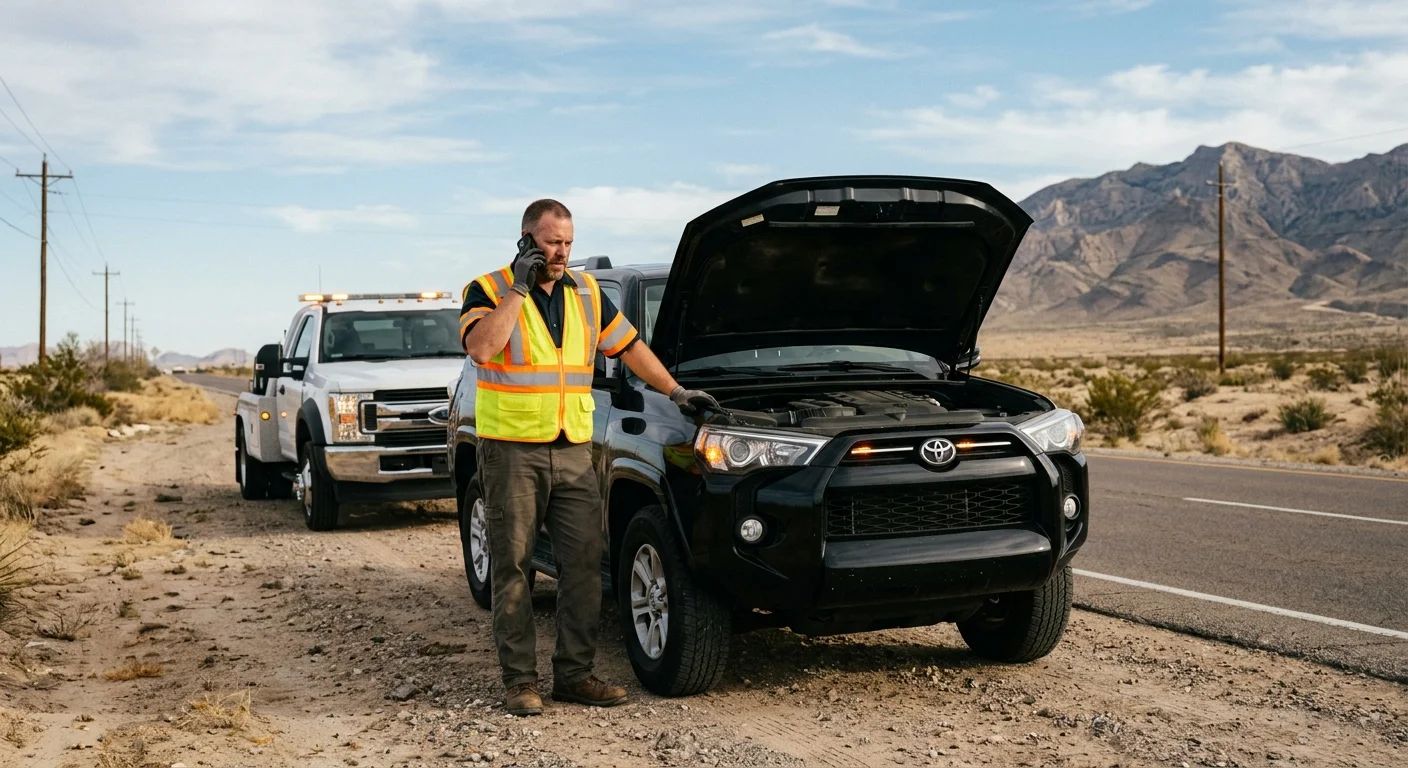
This is emergency towing for a breakdown that already happened. It is not a planned PCS move. If you are shipping a car off post on a timeline you control, that is a different job: shipping a car from El Paso for a Fort Bliss PCS move. For a stall right now, stay with the checklist below.
Give your exact location near Fort Bliss
Fort Bliss sits inside the El Paso metro. The streets around it are not Horizon City, not Socorro, and not the Westside under the Franklin Mountains. A pin that only says the post name sends the operator to the wrong side of town.
Read what is in front of you. Street name and nearest cross street. A numbered address on a building you can see. A parking-lot name on a sign you are looking at. A mile marker if you are on a public highway. Which direction you face. Which shoulder you are on. Whether you are in a travel lane, a turn pocket, or a lot.
If GPS still works, share the live pin. Then still say the words. Phones drop in lots and along fences. A spoken cross street is the backup.
Do not guess a commute distance from Horizon City or from downtown. Those figures are not confirmed here, and a wrong mileage sends the truck the wrong way. If you actually broke down in Horizon City on Horizon Boulevard (FM 1281), say Horizon City. That is a different call from a stall on the El Paso streets that wrap the installation.
If you are on a public highway, stay out of the travel lane if you can move the car. Texas’s Move Over law (Transportation Code § 545.157) covers stationary tow trucks using proper lights. Other drivers must change out of the lane next to that truck or slow as the statute requires. That protects you once the operator is on scene. It does not replace you giving a precise pin.
July’s normal high in El Paso is 96.1°F per the National Weather Service climate table. Individual days run hotter. If you wait outside, shade, water, and a spot off the pavement matter more than a long story. Call (915) 615-2224 when you have the pin, not after you have walked the fence looking for a landmark we cannot verify.
The same details belong on every El Paso tow call. If you want the full intake list, use what to have ready when you call for a tow in El Paso. Near Fort Bliss, the pin is the first thing that fails.
Say whether you’re on or outside the installation
This is the question that decides who can even roll. On-post and off-post are not the same job.
Off post means a public El Paso street, a private lot in the city, or a highway the city and state already treat as public roadway. Texas towing on public roadways is regulated by the Texas Department of Licensing and Regulation (TDLR) under Occupations Code Chapter 2308. The operator we connect you with has to hold the right TDLR license class for the work: consent, private property, or incident management. You can check a name at TDLR’s license search.
On post is the installation. We could not confirm, from sources in this site’s claims file, which civilian tow trucks Fort Bliss lets through a gate, what ID that gate wants, whether a sponsor has to meet the truck, or which office authorizes a recovery on the installation. Those rules are not published in our ledger. Do not let anyone, including us, invent them on the phone.
Say it in one sentence: “I am on the installation” or “I am on a city street outside the fence.” If you are not sure, say that too. A parking lot that feels like post may still sit on city pavement. A street that looks civilian may sit inside the line. Ask the person at the gate, military police, or the installation office that handles vehicles. Then repeat their answer to dispatch.
Quick Tow El Paso is a dispatch and referral line. We do not own wreckers, we do not hold a tow license, and we do not run a yard. We route you to a licensed, insured operator. That operator still cannot guess gate policy. If you are on post, the installation’s answer is the one that counts.
If a city wrecker already took the car from a public street, that is a nonconsent tow. El Paso’s own impound lot address, hours, and police rotation are not confirmed in our research, so we will not name them. Statewide, the owner of a vehicle placed in a storage facility without consent can request a probable-cause hearing within 14 days, not counting weekends and holidays, under Occupations Code § 2308.452. For the practical “where did it go” steps on the city side, see how to find where your car was towed in El Paso. If the installation authorized the removal, ask that office. We could not confirm their release process.
Describe the vehicle and current problem
The operator has to bring the right truck. A sedan, a troca, a motorcycle, and a diesel work truck are not the same hook.
Give year, make, model, and color. Plate if you have it. Two-wheel drive or four-wheel. Manual or automatic. Keys in hand, lost, or locked in. Whether it rolls, steers, and holds park. Whether a wheel is missing, an axle is down, or the car is against a curb.
Then the failure, in plain words. Dead battery. Overheat. Flat. Out of fuel. Won’t shift. Hit from behind. Airbags out. Fluid under the car. If it is an EV that ran out of charge, say that. If it is a motorcycle on its side, say that. If you only need a jump, a tire change, or lockout help, say roadside assistance instead of a full tow. The driver still needs the same pin and the same on-or-off-post answer.
Do not diagnose for ten minutes. Dispatch does not need a shop story. They need enough to pick wheel-lift versus flatbed, and to know whether the car can be pulled onto a public street or has to be winched first.
If the car will not roll, say so before the truck leaves. If it is in park and will not release, say so. If you are in a gated city lot, not on the installation, say the gate code or the office that can open it. City private-property tows follow Occupations Code § 2308.201. Post access is still the installation’s call, not a city-lot code.
A light-duty hookup with the operators we dispatch starts at $95 plus a per-mile rate. That is a starting figure, not the total. The operator sets the price for the actual truck, distance, and work. Confirm it with that operator before the hook goes on. We do not publish a per-mile number, a flat rate, or a night-and-weekend promise. Those would be invented.
If someone already towed the car without you asking, that is nonconsent. Statewide TDLR maximums (not our price) are $272 for vehicles 10,000 pounds or less, $380 for 10,001 to 25,000 pounds, and $489 per unit (maximum $978) over 25,000 pounds. Extra add-ons beyond the listed notification, impound, and government fees are prohibited on those tows. Owner-requested Fort Bliss towing is consent work. Do not mix the two.
Share any access instructions you received
If a gate guard, military police, a sponsor, or an installation vehicle office already told you how a civilian truck gets in, read it back word for word. Name, office, callback number they gave you, gate they named, ID they asked for, escort they required, hours they stated. We will not invent a Fort Bliss access SOP. Your notes are the record.
If nobody has told you anything yet, and you are on the installation, stop guessing. Call the installation contact who handles the lot or the gate you used. Ask whether a civilian tow is allowed at that spot, what the driver must bring, and who meets the truck. Then call us at (915) 615-2224 with that answer so we can pass it to the operator.
Do not send a truck to a gate on a hope. A driver who cannot enter still bills for the roll in many cases. That waste is on a bad pin and a missing access note, not on “Fort Bliss” as a place name.
Off post, access still matters. Apartment gates, contractor lots, and fenced yards in Northeast El Paso will not open for a wrecker that does not have a code or a manager on the line. Give the code, the office hours you were told, and whether the car is blocked in. If a property already called for a nonconsent tow, that is a different path. You did not summon it. Ask who authorized the removal, get the company name, and verify the operator on TDLR’s search before you pay a drop fee.
Drop-fee caps on a nonconsent hook, if the vehicle is fully hooked but has not left the lot, are $135 / $190 / $244 by weight class on the TDLR consumer page. If it is not fully hooked when you return, retrieval is at no charge and you do not have to prove ownership on the spot. Operators must take cash, credit, and debit for that drop fee. Read the current list on TDLR’s consumer information page. Local El Paso caps below those state numbers are not confirmed here. Ask the operator and the property, and do not take a made-up extra line item.
None of that is a Fort Bliss gate pass. Keep installation instructions in their own sentence so dispatch does not mix a city lot code with a post rule we cannot see.
Confirm the destination before the operator travels
A wrecker that leaves without a drop-off is a second dispatch. Name the shop, the dealership, your driveway, or the lot the installation told you to use. Full street address. City. Whether it is still in El Paso County. Whether anyone has to be there to open a gate at the other end.
If you want the car at home in Horizon City, say Horizon City and the street. If you want a shop on the El Paso side, name the shop. Do not say “just take it somewhere close.” Close to the post and close to the Lower Valley are not the same run.
A planned ship-out of the metro is long-distance towing or auto transport, not this breakdown call. Repeat: emergency recovery here, PCS shipping on the other article.
Ask the operator for an arrival estimate. We cannot give you one. We do not control which licensed truck is free or how a gate delay will run. Honest distance still matters. A rural or far pin takes longer than a stall on a city street next to the fence. That is geography, not a promise.
Confirm the hookup and the per-mile shape before the truck moves. Starting light-duty figure is $95 plus mileage, not a locked total. No “free tow” from this line. If a policy, a club, or a credit-card benefit pays, that is between you and that benefit. Read what free towing and roadside assistance really means before you assume the truck is $0.
Predatory pattern, in Texas terms, not rumor: an unlicensed truck, a nonconsent bill above TDLR’s listed caps, extra fees that are not on the consumer page, a refusal of cards on a drop fee, or a driver who will not wait when the car is not yet hooked. Check the license. Keep the receipt. If it was nonconsent, the 14-day hearing clock is real. Filing a TDLR complaint does not replace that hearing.
If the car is already in storage, retrieval needs photo ID, proof of ownership (license matching the registration, insurance card, title, notarized POA, tax receipt, lease, or TDLR forms), and payment of the towing and storage charges. Access to grab documents and personal items from the car is free and must be given within an hour during the facility’s access window. Daily storage on the statewide sheet is listed at $20 / $35 and at the 2023 adjusted $22.85 / $39.99 by length. Confirm the figure the yard is actually charging. We could not confirm a City of El Paso lot fee.
When to call us
When the car will not move near Fort Bliss, you need a licensed, insured operator, not a guess about gates or a truck that cannot enter. Call us at (915) 615-2224 and we’ll connect you with an operator who handles this work. Have the pin, on-or-off-post status, vehicle, access notes, and drop-off ready before you dial.