A stranger’s sedan has sat on the curb outside your house for days. You want it gone, and you want to know who is allowed to order that tow. In El Paso, the answer turns on whether that car is on a public street, on land you control, or across a city or state line.
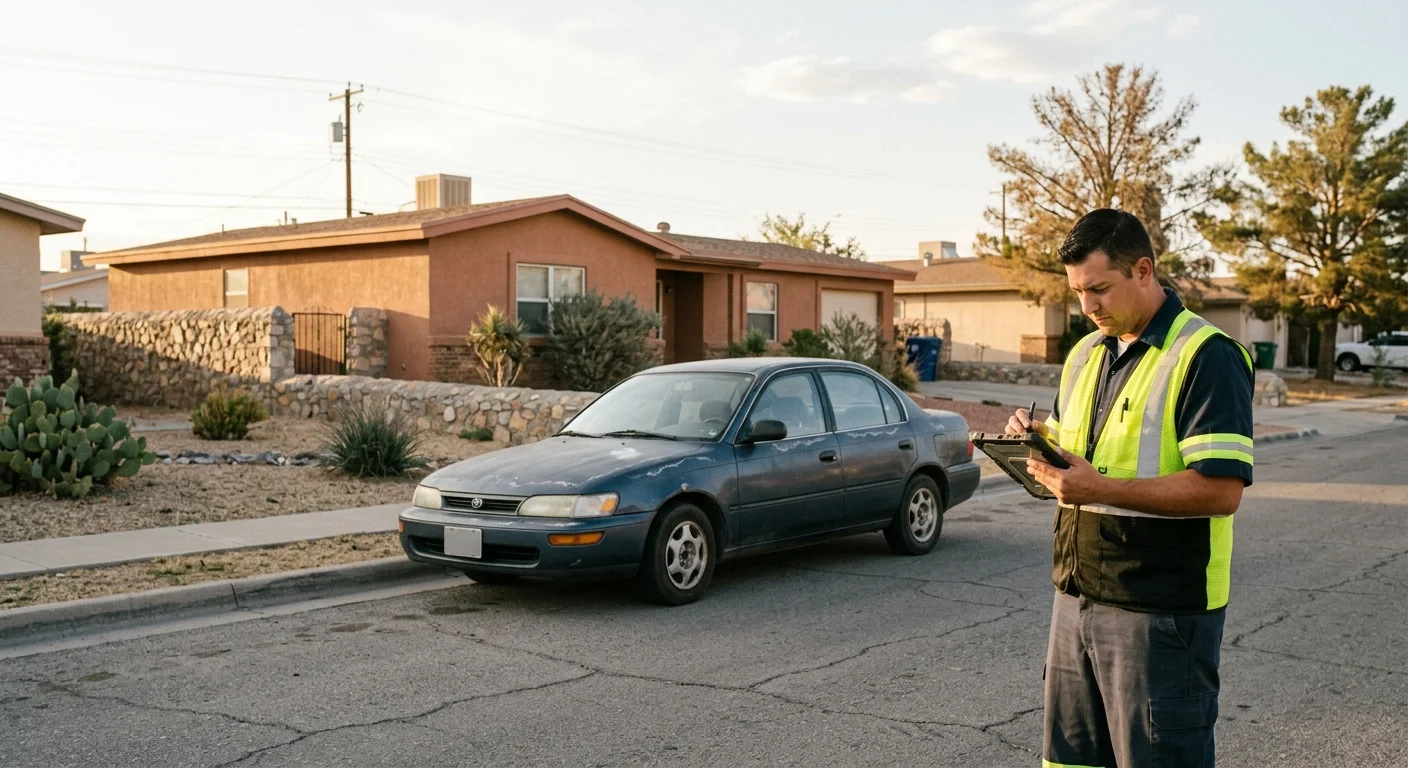
Identify whether the vehicle is on public or private property
The curb in front of most El Paso houses is public street, even when you mow the strip and park there every night. Your lot usually starts at the property line, not at the painted stall you wish you had. A car sitting along the roadway in front of a Central home, a Westside house under the Franklin Mountains, or a Northeast street off Dyer is, in the usual case, on public right of way.
That is a different problem from a car in your driveway, on your lawn, or in a space you control. Keep this page for the public-curb case. If the bumper is actually blocking the driveway opening, use our guide to a car blocking a driveway in El Paso. If the fight is over an assigned apartment stall, that is a third path.
Walk the scene before you call anyone. Find the curb, the driveway apron, the sidewalk, and any posted signs. Note painted curbs, hydrants, corners, and alley mouths. Do not treat your fence, mailbox, or xeriscape as the legal edge of the street. On many blocks those sit inside the right of way.
The same curb question does not look the same in every part of the metro. Downtown and Central streets are tight, with cars stacked along both sides. Westside neighborhoods sit against mountain grades and narrower turns. Out east, Horizon City and Socorro mix residential streets with longer, more open frontage. Along North Loop Drive (FM 76) in the Lower Valley, much of the corridor is still a two-lane rural road with farmland and houses, not a dense city curb. Across the state line in Sunland Park, New Mexico rules apply. Do not mix that call with a Texas tow.
A private street inside a gated community or HOA is not the same as a city curb either. The association or the owner of that private way may control parking there. The City of El Paso, Horizon City, Socorro, and the county do not all run the same streets. Name the city and the actual roadway when you report it.
If you cannot tell public from private, stop and ask the city or county that maintains the street. Do not tell a towing operator the curb is your private lot just because it sits in front of your house. That misstates the location, and it can put the wrong kind of tow on a public road.
Document the location without confronting anyone
Write down what you can see from a lawful spot on the sidewalk or your own yard. Date and time you first noticed the car. Make, model, color, and plate. Whether it has moved. Visible condition: flat tire, broken glass, stacked mail, or nothing unusual. “It has not moved since Tuesday evening” is an observation. “The owner abandoned it” is a conclusion you do not get to make for the city.
Take wide photos that show the car, the curb, your driveway opening, nearby signs, and a house number in the same frame when it is safe. A tight shot of one bumper does not show whether the car is on the street or on your lot. Capture both ends of the vehicle. Include the intersection if you are near a corner. Do not step into traffic on Dyer, Alameda, or Mesa to get a hero angle.
Do not touch the car. Do not open doors, cover windows, or move it a few inches to “prove” a block. Do not chain it, boot it, or park so tight the owner cannot leave. Do not leave a threatening note. A short, calm note asking the owner to move is your choice. Confrontation on the curb is how a parking problem becomes a fight.
If a neighbor’s visitor is the likely owner, a knock on that door often ends it. Ask. Do not accuse. Holiday parking on the Westside and packed weekend curbs near Fort Bliss create a lot of one-night guests. A car that looks abandoned at 7 a.m. is sometimes gone after work.
Keep the record if the car comes back to the same spot. Recurring parking is still not the same as a legal right for you to order a street tow. It is useful context for police or the city when you report it. Separate what you saw from what you assume about the driver.
If the vehicle looks occupied, damaged, or tied to a crime, call 911. A parking complaint is not that call. Use the non-emergency path the City of El Paso or El Paso Police publish on their site for a car that is only sitting there.
Check who may request removal
A homeowner does not own the public parking space in front of the house. A legally parked car on a public El Paso street is not yours to remove because you dislike the view, want the spot for guests, or have mowed that strip for years. We could not confirm a City of El Paso rule that lets a resident authorize a private tow from the public curb simply because the car sits in front of the house. Treat that as unconfirmed until the city or police tell you otherwise for your block.
Who may request a tow depends on the land.
On a public street, removal is typically a public-authority question. Police, the city, or another agency that controls that roadway is the party to ask. A licensed operator can still perform the physical tow when that authority orders it. You calling a truck and pointing at a legally parked neighbor is not the same thing. If you want the current towing car rules that apply when a truck takes a vehicle without the owner’s go-ahead, start with Texas law and then ask the local agency what it requires on your street.
On private property you control, a nonconsent tow is a different process. Texas Occupations Code Chapter 2308 governs towing statewide, including private-property (nonconsent) work. Cities and counties may add local registration rules for nonconsent tows in their territory. El Paso’s extra local rules, if any, were not verified against city code for this page. Confirm them with the city before you sign an authorization. If the car is truly on your driveway or lot, private property towing is the service path, and the operator still has to follow Texas nonconsent rules.
A neighbor parking in front of your house on a public street is often legal when signs, curb paint, and access rules are followed. Courtesy is not the same as a towable offense. Blocking a driveway, a hydrant, or a signed no-parking stretch is a different fact pattern. Report those facts. Do not enlarge them.
An abandoned vehicle in El Paso is also not something you declare from the porch. Flat tires, dust, and a car that has not moved are clues. They are not a green light for a resident-ordered street removal. Ask the city or county which office handles abandoned vehicles on public streets, and use that office’s process.
If the car is in Sunland Park, you are in New Mexico. Do not apply Texas Occupations Code or a Texas operator’s El Paso authorization to that curb. Call the authority that actually governs that side of the line.
Verify the current El Paso process
Do not copy a 48-hour or 72-hour “rule” you saw on a national article. Those figures are not confirmed for El Paso on this site. A published hour-count that turns a curb-parked car into an abandoned vehicle, for the City of El Paso, could not be verified against elpasotexas.gov in the research behind this page. The city, not a blog, sets that process if it has one.
Look up the live source. Start with the City of El Paso website for parking, police non-emergency reporting, and abandoned vehicles. If you live in Horizon City, Socorro, Clint, or the county, use that government’s site. Horizon City is its own incorporated city. Socorro is its own city. A process that applies on a Central El Paso block may not be the process on Horizon Boulevard or on FM 76 through the Lower Valley.
When you report, give the facts you documented. Street name, nearest cross street, and the side of the block. Whether the car is fully in the travel lane, fully at the curb, or overlapping a driveway apron. Posted signs and curb color. How long you have watched it, with dates. Plate and description. Photos. Ask the agency what it will do next. Ask whether a resident can request a tow or whether only that agency can.
Texas still supplies the statewide floor. The Texas Department of Licensing and Regulation (TDLR) regulates towing operators and publishes consumer rules, including maximum nonconsent charges. For a vehicle 10,000 pounds or less, the statewide nonconsent cap is $272. Local ordinances may set a lower cap. Whether El Paso has adopted a lower local cap could not be confirmed here. Treat the TDLR figure as the state maximum, not as a city fee and not as a quote from us.
TDLR also requires specific operator licenses for incident management, private-property, and consent tows. You can check a tow truck operator’s license before anyone hooks a car. That check does not replace city authorization on a public street.
If a vehicle is already gone and you are the owner, a nonconsent tow can trigger a hearing right under Texas Occupations Code § 2308.452. The request window is 14 days, excluding weekends and holidays, after the vehicle was placed in storage or booted. That is the owner’s path after a nonconsent removal. It is not a tool for a resident who wants a neighbor’s car taken off the curb.
Until the city confirms the street process for your address, do not hire a truck to pull a car off a public curb on your say-so.
Know what Quick Tow can and can’t do
Quick Tow El Paso is a dispatch and referral line. We answer, we quote what we can, and we connect you with a licensed, insured operator. We do not own the trucks, run a yard, or hold a tow license. The operator who shows up is the company you contract with for the work.
What we can do is route a consent tow when you own the vehicle and want it moved. We can connect you with an operator for a true private-property removal when you control that property and the operator can follow Texas nonconsent rules. We can help you describe the location so the driver is not sent to the wrong side of I-10, Loop 375, or the New Mexico line.
What we cannot do is treat the public street in front of your house as your private lot. We cannot promise that a resident’s complaint is enough to hook a legally parked car. We cannot invent an El Paso parking ordinance, a notice period, or an abandonment clock. We cannot put the brand on a police rotation or an impound lot. City impound details for El Paso were not verified for this page. Ask the city where a police-ordered tow goes.
Price is the operator’s, except where state law caps a nonconsent job. For a light-duty consent hookup we may mention, the starting figure is a $95 hookup plus a per-mile rate. That is a starting figure, not the total. No other brand price belongs on this page. Do not expect a flat rate, a firm written quote from us, or a promise that nights and weekends cost the same. Confirm the number with the operator before the truck hooks up.
We also cannot promise when a truck arrives. Distance matters. A curb in Central El Paso is a different run from a house off North Loop Drive toward Fabens, or from a Horizon City street reached from I-10 via Eastlake Drive. Ask the operator for an arrival estimate. Rural and far-east calls take longer. That is geography, not a guarantee.
If the right next step is the city, call the city. If the car is yours and you want it moved, we can connect you. If it is on property you control and a nonconsent tow is lawful, we can connect you with an operator who does that work. If it is a public-curb dispute, get the authority’s answer first, then call us only if that authority or the operator still needs a licensed truck.
When to call us
Call when you need a licensed operator for a vehicle you own, or for a removal from property you actually control, after you have confirmed the location is not a public curb you cannot authorize. If police or the city have already directed a tow, we can still connect you with an operator who handles that kind of work. Call us at (915) 615-2224 and we’ll connect you with an operator who handles this work.