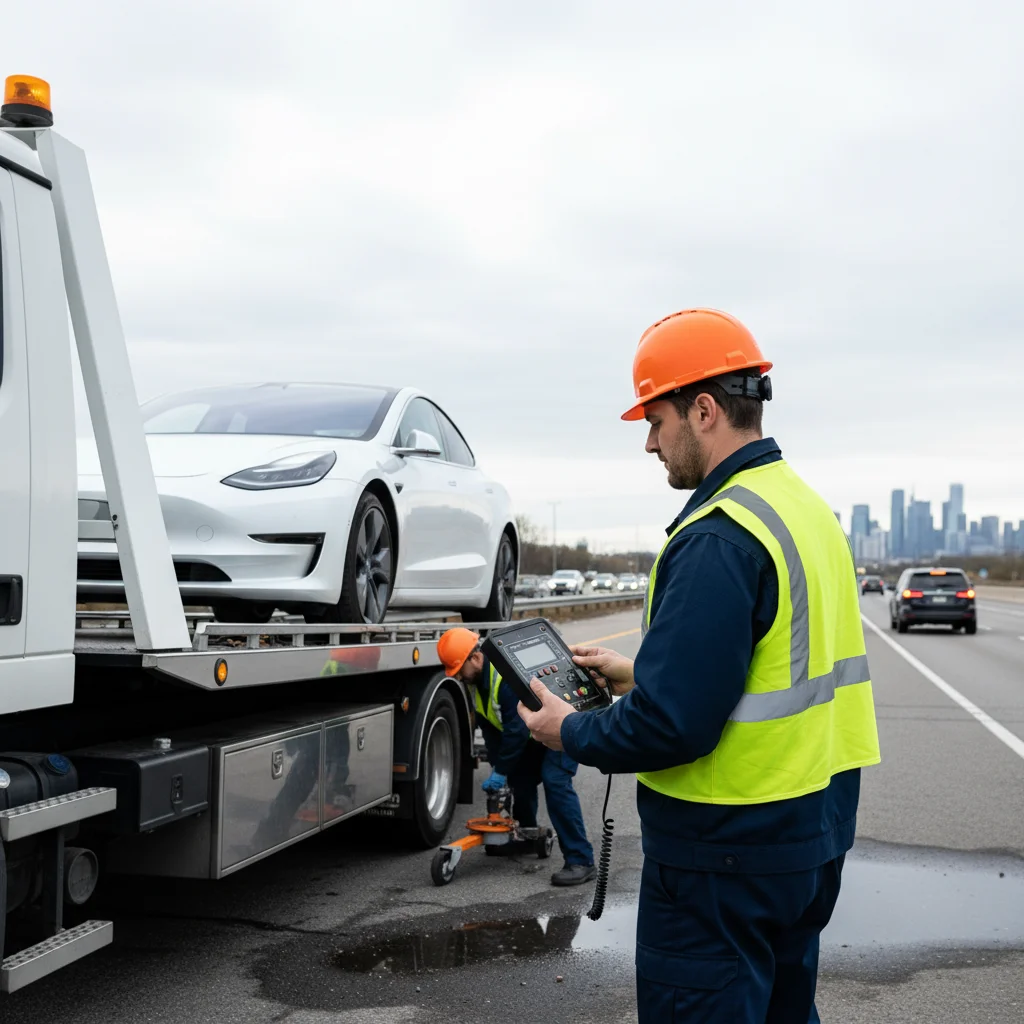
Flatbed only. If your Tesla or EV needs a tow in El Paso, all four wheels come off the ground, no exceptions. Call (915) 615-2224 and tell us it’s electric so we send the right truck the first time.
Why wheels-down towing wrecks an EV
A gas car in neutral can get dragged a short distance with the drive wheels down and mostly get away with it. An EV can’t. The electric motor is connected straight to those wheels, and when they spin freely during a tow, the motor spins with them. That motion generates current that has nowhere to go, and it can feed back into the drive unit, the inverter, and the regenerative braking system.
The damage doesn’t always show up right away. Sometimes it’s immediate. Sometimes the car drives fine for a few days, then a warning light shows up out of nowhere. Either way, repairs to an EV drive unit aren’t cheap. You’re looking at a bill that can run into the thousands, and if the damage traces back to an improper tow, most manufacturers won’t cover it under warranty. That’s an expensive lesson to learn from a driver who didn’t know better, or a tow company that didn’t check.
A flatbed sidesteps the whole problem. All four wheels stay off the pavement, nothing spins, nothing generates current it shouldn’t. It’s the method Tesla recommends, and it’s what any tow operator who actually works on EVs should show up with by default.
What makes Tesla towing different
Beyond the flatbed requirement, Teslas have a few quirks that catch inexperienced tow operators off guard. Tesla’s own guidance is to load the car in Transport Mode, a setting that releases the electronic parking brake and lets the wheels roll freely enough to winch onto the bed without fighting the system.
Here’s where it gets tricky. If the 12-volt battery is dead, or the main battery is fully drained, the car can’t communicate the way it normally would, and the parking brake can stay locked. Getting the vehicle unstuck at that point takes some know-how, not brute force. Tesla provides specific access points and procedures for exactly this situation, and a driver who’s towed EVs before knows to look for them instead of guessing.
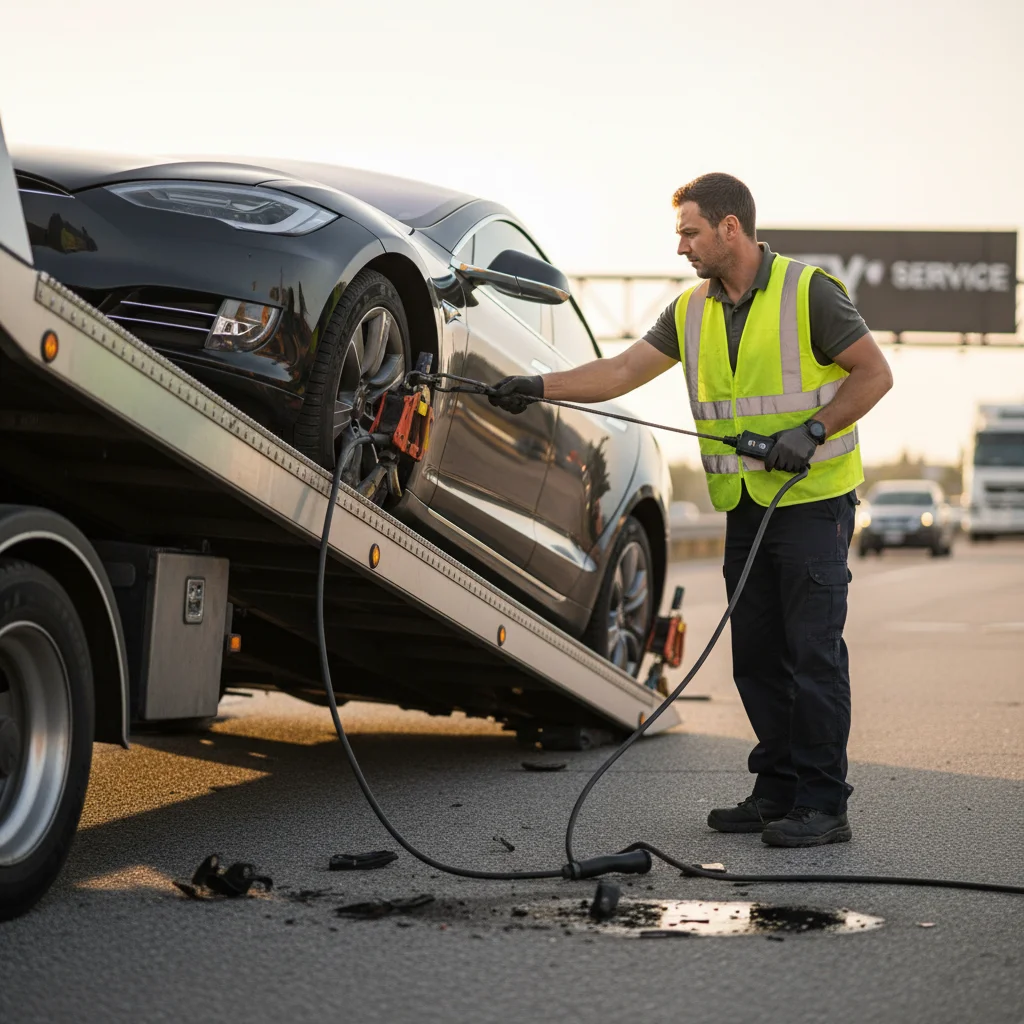
This is the difference between a tow that goes smoothly and one that turns into a longer ordeal on the side of the road. It’s also why we recommend calling a company that specifically offers Tesla and EV towing, not whoever answers first.
The El Paso heat makes this worse
Summer in El Paso isn’t gentle on any vehicle, but EV batteries feel it more than most. Sustained triple-digit days put real stress on the battery pack, and that stress shows up as faster drain, reduced range, and in some cases thermal issues that trigger a shutdown or a tow call in the first place.
We see it most on the kind of afternoon where the pavement is radiating heat back up at the car from underneath, on top of the sun already beating down. A battery that’s already working hard to manage its own temperature doesn’t have much margin left. If your EV is showing a sudden range drop or won’t charge properly on a hot July day here, the heat is probably part of the story, and a flatbed tow to a shaded spot or a service center is the right move rather than pushing the car further.
Where we see more EV calls in El Paso
West El Paso, especially around Kern Place and the Upper Valley, tends to have more Teslas and EVs on the road than the rest of the metro. It’s not surprising given the newer housing stock and the driveways with home chargers already installed. If you’re in that part of town and need a tow, we’re familiar with the neighborhoods and know how to get a flatbed in and out without hassle. Our West El Paso towing coverage runs through Kern Place, the Upper Valley, and the surrounding streets.
That said, we get EV calls from every part of El Paso, not just the west side. The flatbed rule doesn’t change based on zip code.
Flatbed vs. other towing methods
If you’ve read anything about towing before, you might have come across wheel-lift towing, where only two wheels leave the ground. For a gas vehicle in the right situation, that’s a fine method. For an EV, it’s not enough. Wheel-lift still leaves the drive wheels touching pavement and spinning on most electric vehicles, which brings back the same regenerative braking risk a flatbed avoids entirely.
Dollies are sometimes mentioned as a workaround, placed under the wheels that aren’t being lifted. They can work as a short-term stopgap in a pinch, but they’re not the standard, and they add complexity that a flatbed just doesn’t need. If you want the full breakdown of when each method applies, we cover it in flatbed vs. wheel-lift towing in El Paso. For an EV specifically, skip the comparison and go straight to flatbed.
FAQ
Can a Tesla be towed with a regular tow truck? Only if that truck is a flatbed. A hook-and-chain or wheel-lift truck can damage the drive unit on most Teslas and EVs, so ask specifically for a flatbed when you call.
What if my Tesla’s battery is completely dead? It can still be loaded onto a flatbed, but the parking brake release process is different than a normal tow. An operator familiar with EVs will know where to find the manual release points.
Will towing my EV wrong void the warranty? It can. Damage caused by an improper tow, meaning wheels-down when it should have been flatbed, is often excluded from manufacturer warranty coverage. That’s on top of the repair cost itself.
Does the desert heat actually affect my EV’s towing needs? Indirectly, yes. Extreme heat can push a battery into a state where it needs a tow in the first place, and it’s one more reason to get the car off hot pavement and onto a flatbed quickly rather than let it sit.
Get a flatbed out to you now
If you’re stuck with a Tesla or any EV anywhere in El Paso, don’t let a tow truck without a flatbed near your car. Call Quick Tow El Paso at (915) 615-2224 and we’ll send the right equipment the first time, whether you’re in Kern Place, the Upper Valley, or anywhere else in the city.