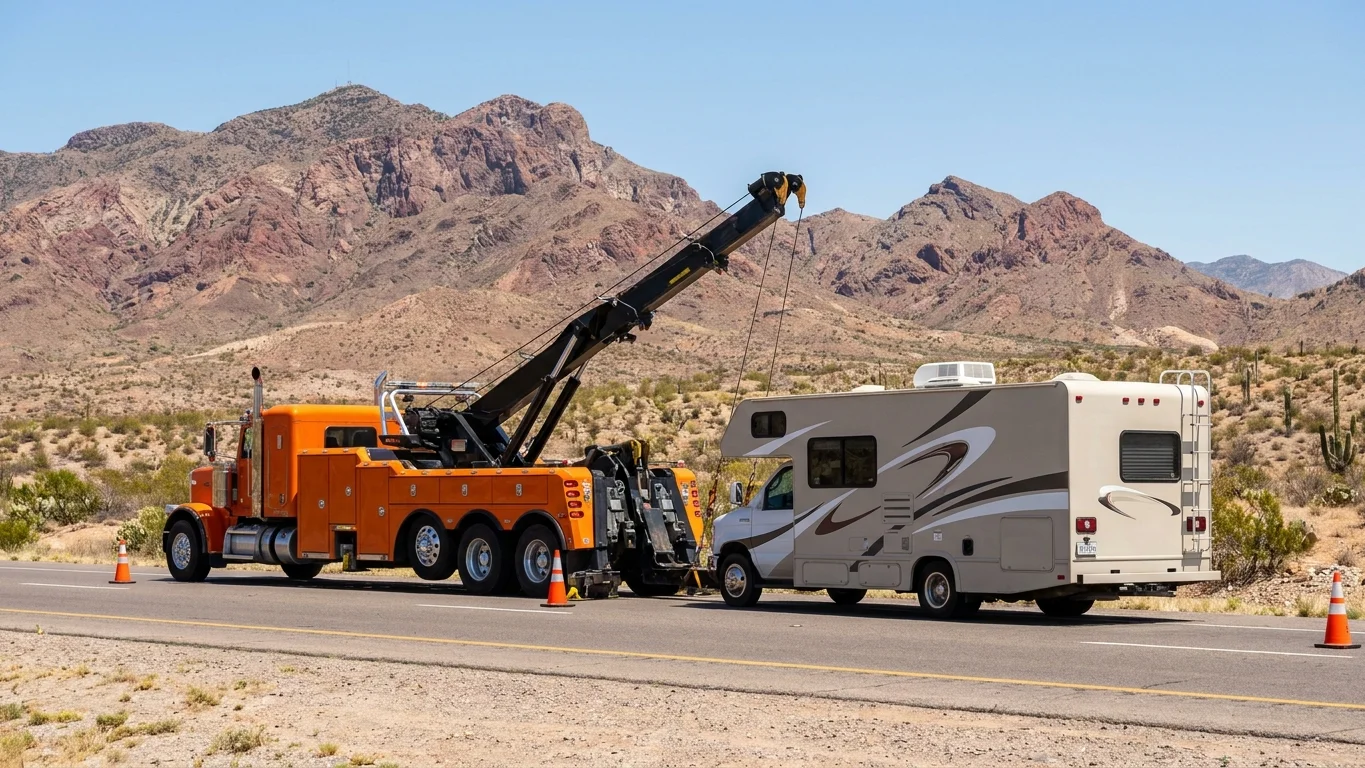
Call (915) 615-2224 for an RV-capable wrecker, and know that the right truck depends on what you’re driving. A Class A motorhome needs a heavy-duty wrecker built for its weight and length. A fifth-wheel trailer needs a safe disconnect from the tow vehicle before it can move anywhere. A travel trailer or bumper-pull needs trailer-capable recovery gear, not just any flatbed that happens to be free. Sending the wrong truck to the wrong RV burns an hour or more while a replacement gets dispatched, so telling the operator exactly what you’re driving is the fastest way to get moving again.
What to do when your RV breaks down in El Paso
Get off the travel lanes first, even if it means giving up shoulder space you’d rather keep. Set your hazards the moment something feels wrong, not after you’ve already coasted to a stop. Get everyone, including pets, out of the RV and onto the far side away from traffic once you’re safely stopped. El Paso summer heat regularly climbs past 100°F, and a stalled RV with the engine off turns into an oven within minutes, so waiting inside the cabin for help is not a safe option. Move people and animals into shade if there’s any nearby, then make the call. At Quick Tow El Paso, we dispatch RV-capable operators around the clock across the full metro and surrounding county, so calling gets a truck moving toward you regardless of the hour. Once everyone’s safe, describe the RV to the dispatcher: class, length, and whether it’s still attached to a tow vehicle.
What kind of tow truck moves an RV?
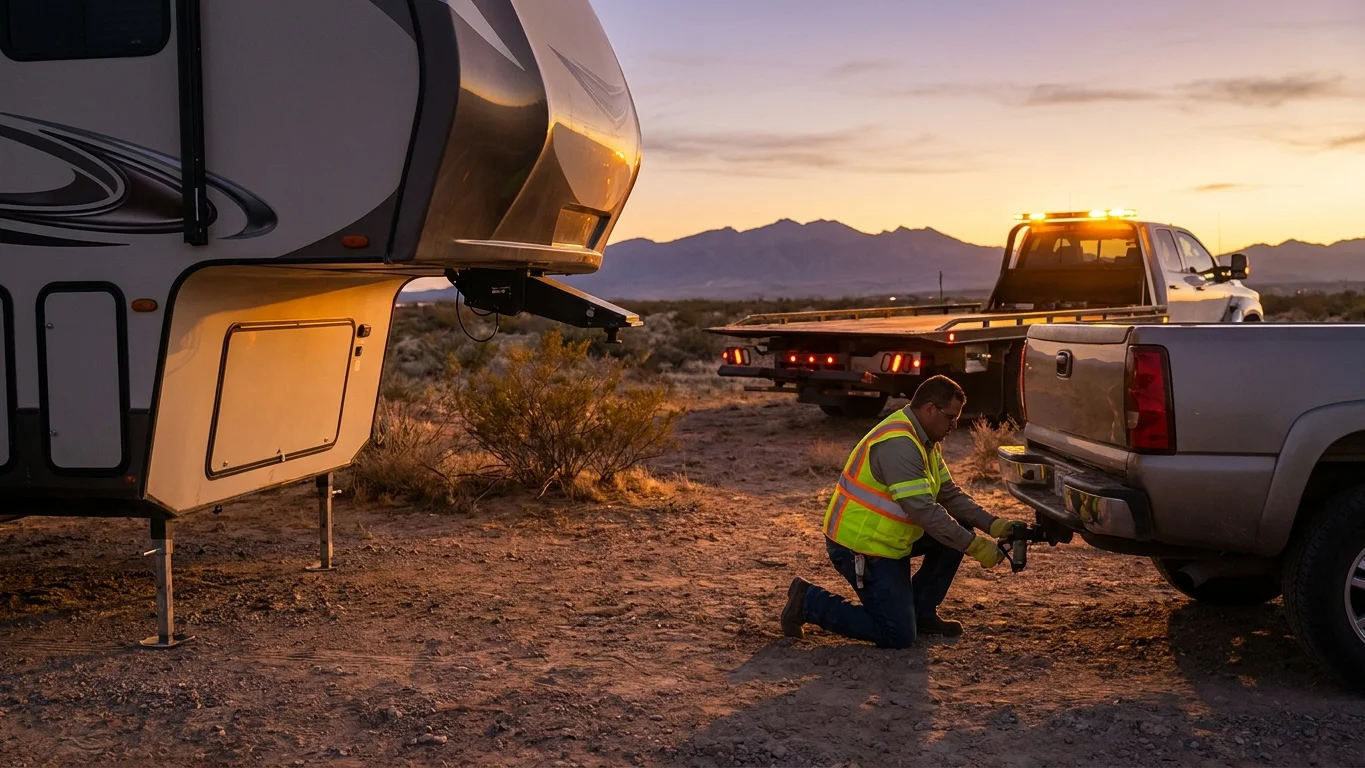
It depends on the class. Class A motorhomes are built on commercial bus or truck chassis and often weigh far more than a car or pickup, so they need a heavy-duty wrecker with the boom and winch capacity to lift and move that weight safely. Class B and C motorhomes are lighter, built on van or truck-cutaway frames, and can often move on a flatbed instead of a full wrecker. Fifth-wheel trailers ride on a hitch mounted in a pickup bed, so an operator has to safely disconnect the trailer from the truck before either one moves, never drag them as a single unit. Travel trailers and bumper-pull campers connect at the rear bumper or frame and need trailer-capable equipment rated for their axle count and weight, not a standard passenger-car tow setup. Naming your RV type when you call is what gets the right RV and trailer towing equipment sent the first time. For the biggest Class A rigs, that usually means asking for a heavy-duty wrecker directly.
Where RVs break down most around El Paso
I-10 through El Paso is one of the busiest RV corridors in the Southwest, carrying snowbirds and winter Texans between the desert Southwest and central Texas every fall and spring. The Transmountain Road grade through the Franklin Mountains is a known trouble spot for big motorhome engines, which overheat climbing that incline in a way a car engine rarely does. If that’s where you are, see our notes on overheating on the Transmountain grade for what’s actually happening under the hood. Summer heat also causes RV tire blowouts at highway speed on the long, flat runs east past Socorro and Horizon City toward the county line, where sidewalls take on more heat over more miles under heavier loads. Fort Bliss PCS families moving with trailers add another steady stream of RV traffic through the area, often on tight timelines. If you’re broken down anywhere out toward Socorro and the eastern county, say so when you call. That stretch sits far enough from central El Paso that dispatch needs to route the closest available operator, not just the nearest one to downtown.
How much does RV towing cost in El Paso?
RV tows cost more than a standard car tow because they need bigger equipment and take longer to hook up safely. Price depends on the RV’s class and weight, the distance to the shop or campground, and whether it’s a straight tow or a full recovery from a ditch or shoulder. A Class A stuck off the roadway after a blowout is a different job than a fifth-wheel that just needs a quick disconnect and a short pull to the next exit, and the quote reflects that difference. If your RV needs to travel further than a local shop, ask about long-distance RV transport instead of a standard local tow. For a general sense of how towing pricing works in El Paso before you call, read what an El Paso tow costs.
Frequently asked questions
Can you tow a Class A motorhome in El Paso?
Yes. Class A motorhomes need a heavy-duty wrecker rated for their weight and length, and the El Paso network includes operators equipped for that class specifically, not just standard car and light-truck tows.
Do I need to disconnect my fifth-wheel before it’s towed?
Yes, always. A fifth-wheel has to be safely unhitched from the tow vehicle before either one moves, and an RV-experienced operator handles that disconnect as part of the job rather than dragging both as one unit.
Can you tow my RV and my car at the same time?
Often, yes, but say so when you call. Moving a motorhome and a separately parked or disabled tow vehicle at the same time means coordinating two pieces of equipment, so mentioning both up front lets dispatch send the right combination instead of one truck at a time.
Do you tow RVs 24/7 in El Paso?
Yes. Dispatch runs around the clock across the full El Paso metro and surrounding county, because RV breakdowns don’t wait for business hours, especially on overnight drives through the corridor.
What if my RV breaks down on Transmountain Road?
Get off the grade and onto the widest shoulder you can reach, then call (915) 615-2224 right away. Engine overheating on that climb can escalate fast in summer heat, and a stopped RV on a mountain grade is a real hazard to the traffic behind you.