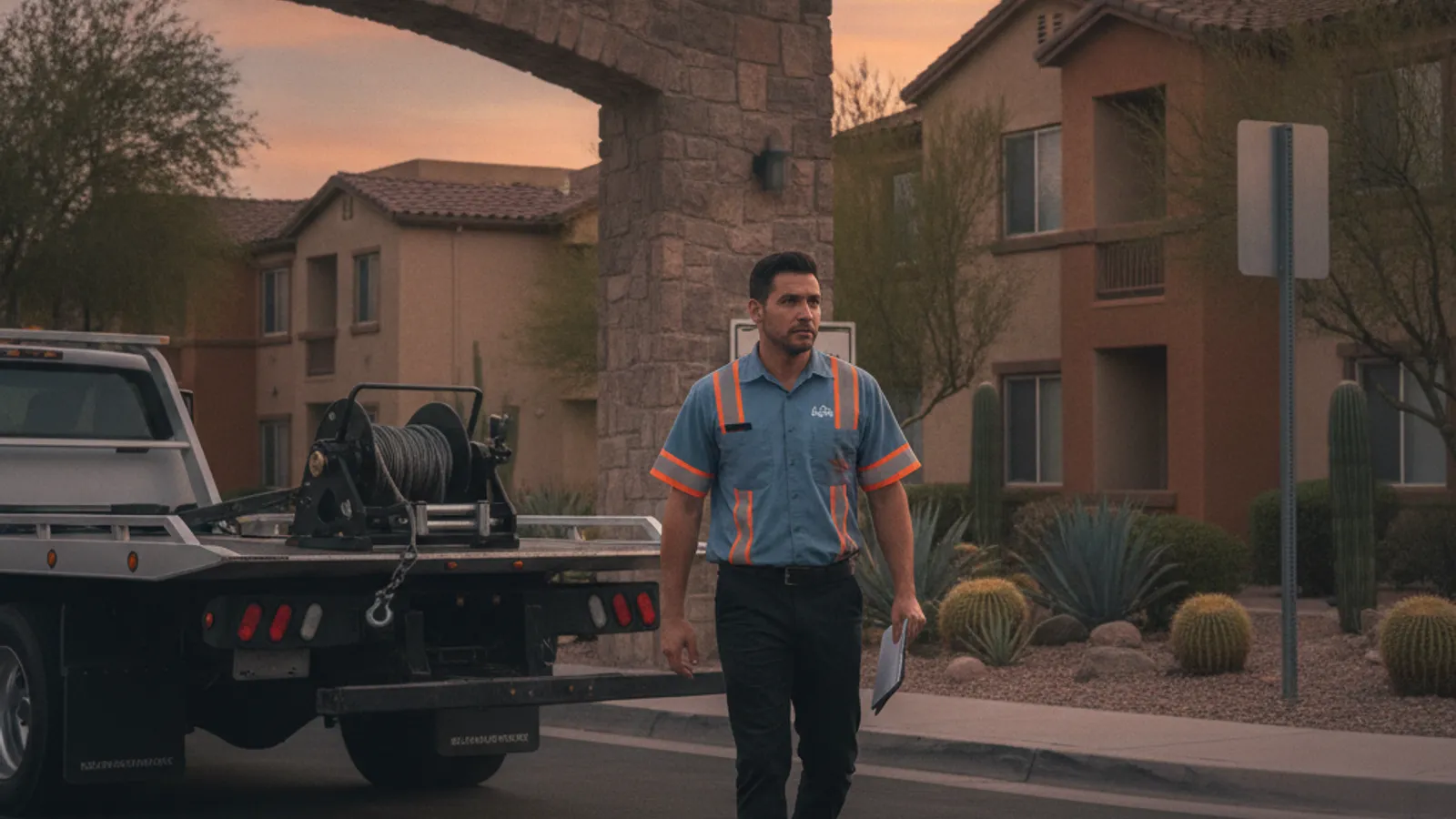
Yes, in some situations a tow truck can take your car in El Paso without you ever agreeing to it. Texas law calls that a nonconsent tow, and it covers everything from an apartment complex clearing a fire lane to a police officer ordering your wrecked car off I-10. The tow can be completely legal even when it feels like it came out of nowhere. But the company doing it has to follow real rules, and you have real rights from the moment the hook touches your bumper.
This is a plain-English walkthrough of Texas Occupations Code Chapter 2308, the Texas Towing and Booting Act, written for the moment you’re standing in a parking lot watching your car leave without you. If you’re dealing with a tow right now, or you need one done the right way, call Quick Tow El Paso at (915) 615-2224.
What makes a tow a nonconsent tow in Texas
Texas law splits every tow into two categories. A consent tow is one you asked for, or one requested by someone who has possession or control of the vehicle, like a spouse or a co-owner. Everything else is a nonconsent tow.
Nonconsent tows break down into two types. A private property tow happens when a parking lot, apartment complex, or HOA has your car removed for violating a posted rule. An incident management tow happens when police direct a tow, usually after a crash, an arrest, or a car left blocking traffic. Both are legal under Texas law. Neither one requires your permission in the moment. What the law does require is a specific process, and that process is where most illegal tows fall apart.
Can an apartment complex or HOA tow your car without asking you?
Only if the property follows two rules first.
The first is signage. State law spells out exactly what a tow-away sign has to look like: at least 18 inches wide and 24 inches tall, weather-resistant, mounted 5 to 8 feet off the ground, posted at or within 25 feet of each entrance, and carrying a phone number that’s answered 24 hours a day. The sign also has to state the days and hours of enforcement and say who is and isn’t allowed to park there. That’s Texas Occupations Code Section 2308.301. A property with a faded, hidden, or missing sign has a real problem if it starts towing cars.
The second is authorization. A towing company can only remove a vehicle from private property if the property owner or manager requests that specific tow, or if there’s a standing written agreement putting the towing company in charge of enforcement. A driver who decides on his own to clear a lot, without either of those, is not doing a legal nonconsent tow.
We connect apartments and HOAs across El Paso with private property towing enforcement operators who build their process around those two requirements on purpose. A property that skips the signage or the paperwork isn’t protecting itself. It’s creating a dispute waiting to happen.
Can you stop the tow before the truck leaves the lot?
Often, yes. If you get back to your car before the tow is complete, ask the operator about the drop charge. Texas caps what can be charged to drop a hooked vehicle: $135 for a light-duty vehicle, $190 for medium-duty, and $244 for heavy-duty, under TDLR rule 16 TAC Section 86.455. The operator has to accept cash, credit, or debit for that charge.
The catch is timing. Once the truck leaves with your car, you’re dealing with a vehicle in storage, which usually costs more and takes longer to sort out. If a driver quotes you a drop fee above the state cap for your vehicle class, that number is worth writing down for a complaint or a hearing. For a broader sense of what towing runs in El Paso in general, see how much a tow costs in El Paso.
What about tows the police order?
A crash on I-10, a car abandoned on the shoulder, or a vehicle towed after a DWI arrest all fall under incident management towing, a different lane from private property enforcement. An officer on scene can direct a tow without asking you, especially if the vehicle is blocking traffic or unsafe to leave in place.
If you’re dealing with a police-directed tow after a wreck, the process and the paperwork look different from a parking-lot tow. We cover what to do in the minutes after a crash in what to do after a car accident on I-10 in El Paso, and we dispatch accident recovery service to handle the vehicle once it’s off the road.
How do you find out where your car went?
Start with the sign. If your car was towed from a private lot, the required signage has to list the storage facility’s name and a 24-hour phone number. That’s the fastest way to track down where your vehicle landed.
If police ordered the tow, the responding officer’s report will name the facility, or you can call the non-emergency line for the department that worked the scene. Every towing company and vehicle storage facility in Texas has to be licensed through the Texas Department of Licensing and Regulation, and TDLR keeps a public license search online. If a company can’t produce a license number, write that down before you pay anyone.
If your car ended up in the City of El Paso’s own storage facility rather than a private lot, we walk through that entire process, including the address, hours, and what to bring, in how to get your car out of impound in El Paso.
Can you fight a tow you think was illegal?
Yes. Texas law gives you the right to a hearing on whether there was probable cause for a nonconsent tow, meaning whether the removal actually followed the rules. That hearing happens in the justice court named on the paperwork the towing company or storage facility gives you.
You have 14 days to file the request, and that clock starts when the storage facility gives you the required written notice with the information you need to file, not the moment your car was towed. If they never gave you that paperwork, or it was incomplete, you may have more time than you think. Once the court receives your request, it has to hold the hearing before the 21st calendar day. The hearing can also review whether the charges exceeded the state’s authorized amounts, not just whether the tow was proper. This isn’t a long shot, either. Missing signage, no written agreement with the property, or a tow that didn’t match the posted rules are the exact issues a hearing is built to catch.
What you need once you find the car
Bring a valid photo ID and proof you own the vehicle, like the title or current registration. If the name on your ID doesn’t match the name on the registration, bring whatever paperwork explains the difference, because storage facilities won’t release a car to someone they can’t confirm owns it.
For the full step-by-step on retrieving a vehicle from El Paso’s city lot specifically, including fees and what happens if the name doesn’t match, see how to get your car out of impound in El Paso. And if you need a car moved before it ever becomes a tow story, our towing service across El Paso covers the whole metro.
Frequently asked questions
Can a tow truck take my car without my permission in Texas?
Yes, in two situations. A private property owner can have your car towed for violating posted parking rules, and police can order a tow after a crash, an arrest, or when a vehicle is blocking traffic. Both are called nonconsent tows under Texas Occupations Code Chapter 2308, and both come with rules the towing company has to follow, including signage, notice, and your right to a hearing afterward.
What makes a private property tow illegal in El Paso?
The two most common problems are a missing or noncompliant sign and no written agreement between the property and the towing company. State law requires a specific sign at every entrance, and a tow company can only act on a property owner’s direct request or a standing enforcement contract. A tow that skips either one is worth disputing.
How long do I have to dispute a tow in Texas?
You have 14 days to file a request for a hearing in the justice court named on your paperwork, counted from when you receive the storage facility’s required notice, not from the tow itself. If you never received proper notice, you can request the hearing when you do. The court must hold the hearing within 21 days of receiving your request.
Can I stop a tow truck before it leaves with my car?
Often, yes. If you reach your car before the tow is complete, Texas caps the drop charge at $135 for a light-duty vehicle under TDLR rule 16 TAC Section 86.455, and the operator has to accept cash, credit, or debit. Once the truck leaves with your car, you’re dealing with storage instead, which costs more.
Does a landlord or HOA need my permission to tow my car?
No, not if the property has a compliant sign posted and either requests your specific tow or has a standing agreement with a towing company to enforce its lot. That’s what makes it a legal nonconsent tow instead of an illegal one.
What’s the difference between a police tow and a private property tow?
A police-directed tow, called an incident management tow, happens after a crash, an arrest, or when a vehicle is blocking traffic, and an officer authorizes it on scene. A private property tow happens when a lot, apartment complex, or HOA enforces its own parking rules through a towing company. Both fall under nonconsent towing, but the process and paperwork differ.
We’re the dispatcher you call, not the tow that shows up
Most of what people hate about towing comes from the tow they didn’t ask for. When you call Quick Tow El Paso, you’re the one in charge. You know who’s coming, what it costs before the truck rolls, and where your car is going.
If a tow just happened to you and you’re trying to sort out what’s legal, or you need a car moved the right way before it becomes someone else’s problem, call us at (915) 615-2224. We dispatch flatbed and wheel-lift trucks across the whole El Paso metro, and we’ll give you a straight answer, not a runaround.