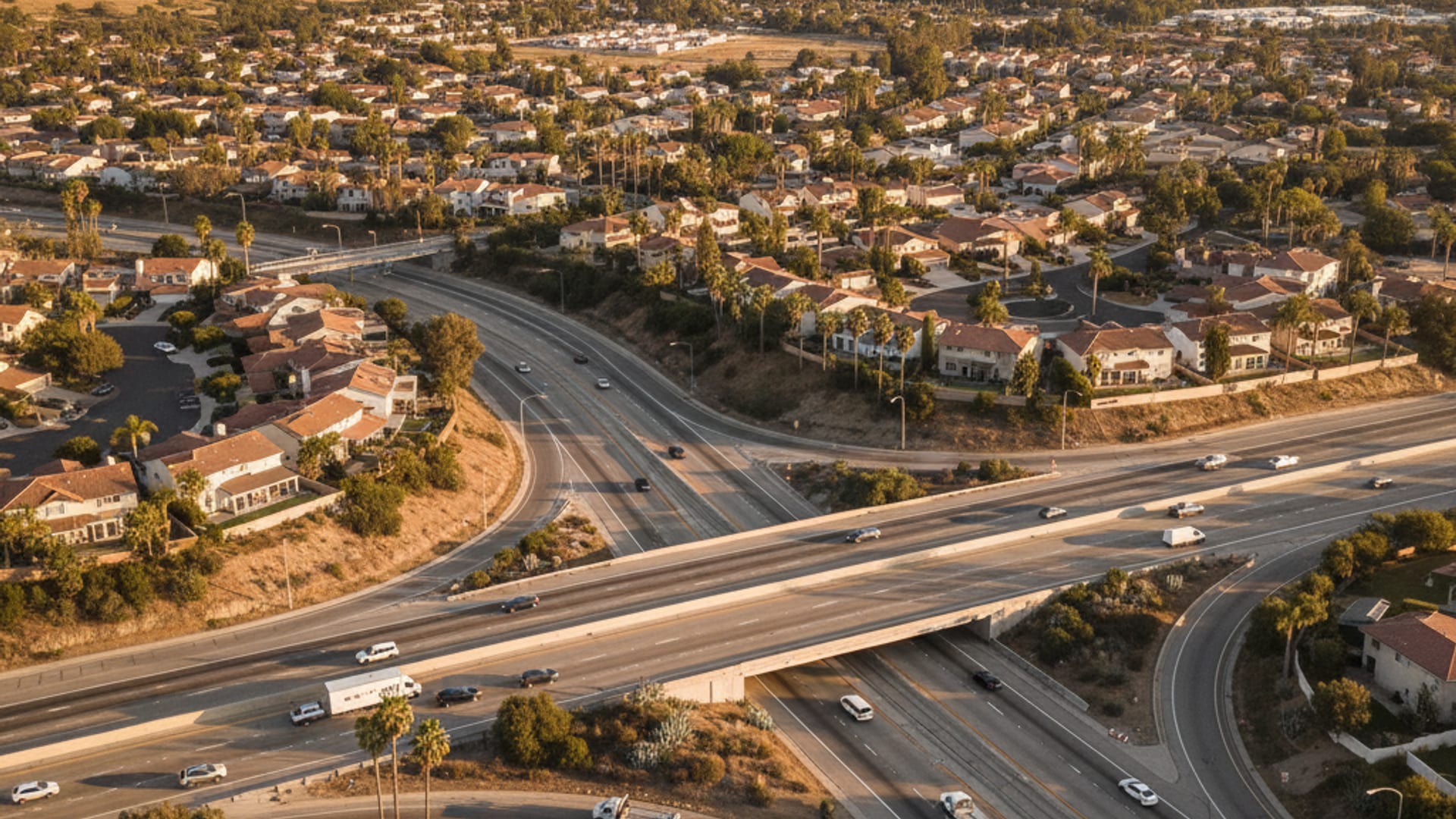
Call (915) 615-2224 immediately. Loop 375, also called the Cesar Chavez Border Highway, is a limited-access freeway with narrow shoulders, fast-moving traffic, and no easy pull-off in most sections. If your car broke down here, you’re not in a safe spot to wait long. Get off the road as far as possible, turn on your hazards, and call for a tow right away.
What makes Loop 375 different from other El Paso roads
Most drivers think of the Border Highway as just another stretch of road along the Rio Grande. It’s not. Loop 375 is a 49-mile limited-access freeway that circles the entire city, and the southern segment, the Cesar Chavez Border Highway, runs right along the U.S.-Mexico border from downtown to the Lower Valley.
That means no traffic lights, no driveways to pull into, and almost no breakdown lanes worth the name. Traffic moves at freeway speeds, often above 60 mph. If you’re on the shoulder, you’re close to live lanes. And because this corridor connects all four of El Paso’s major international bridges, commercial truck traffic is constant.
The section has seen repeated serious crashes. That’s not meant to scare you. It’s meant to explain why getting a tow truck on scene fast matters more here than on a typical city street.
The segments of Loop 375 / Border Highway you need to know
Loop 375 has five named sections. The ones most relevant to breakdowns along the border corridor:
Cesar Chavez Border Highway runs through downtown and Segundo Barrio, staying close to the Rio Grande. This is the stretch most people mean when they say “the Border Highway.” The Bridge of the Americas (BOTA) feeds directly onto this segment, which means bridge-queue traffic, cars that just sat in 100°F heat for 45 to 90 minutes, merges onto a freeway here. Overheating and battery deaths are common in this zone.
The Zaragoza stretch connects Loop 375 to the Ysleta-Zaragoza International Bridge further east, at around I-10 Exit 32. The Zaragoza interchange has an active braided ramp construction project, which tightens shoulder access and creates more hazard areas. Truck queues backing up from the Zaragoza commercial crossing affect traffic patterns on this segment.
Joe Battle Boulevard is the eastern residential section of Loop 375, serving the Eastside neighborhoods and connecting to the Lower Valley. Breakdowns on Joe Battle tend to be less immediately dangerous than on the river-adjacent sections, but it’s still a limited-access freeway: no driveways, no street parking, no quick escape route.
Border West Expressway is the elevated southwest section that opened in October 2019. It runs above railroad tracks between downtown and the Upper Valley corridor. The elevated structure means zero pull-off options. A breakdown here requires a tow. There’s nowhere else to go.
Where you can actually pull over
Your options are limited. Here’s the honest guide:
On the Cesar Chavez segment between downtown and Zaragoza: the shoulder is narrow but present in most stretches. Get as far right as you can. If there’s an on-ramp or off-ramp nearby, pulling into the ramp gore area (the triangular section where lanes split) is safer than the main shoulder. Do not get out of your car on the main travel lanes.
Near the Zaragoza interchange: the construction zone has changed shoulder access repeatedly. When in doubt, limp to the nearest exit before stopping: Zaragoza Road to the east, or loop back toward downtown.
On Joe Battle: shoulders are wider and traffic is somewhat lighter. Bridge overpasses and intersections at street level give you more exit options.
On the Border West Expressway elevated section: there is essentially no safe pull-off. If you’re losing power, the exit ramps at each end are your only option. Don’t stop on the elevated span.
Near any of the international bridge approach roads: if you’re in a bridge queue that’s feeding onto Loop 375, you’re in a mix of slow-moving vehicles and merging freeway traffic. If the car dies in the queue, turn on hazards and call. The bridge plaza CBP officers can help direct traffic around you while you wait.
What to do, in order
- Turn on your hazard lights immediately.
- Steer to the right shoulder as far as you can go, even if it means a slow roll on a flat tire. A damaged wheel is far cheaper than getting hit from behind.
- If you can exit the freeway, do it. An off-ramp exit is safer than the shoulder.
- Once stopped, stay in your vehicle with your seatbelt on if traffic is close. Get out on the passenger side if you need to exit.
- Call (915) 615-2224. Tell the dispatcher which section of Loop 375 you’re on and the nearest visible exit sign or bridge.
- Turn on your interior dome light if it’s dark or visibility is low.
- If you have road flares or reflective triangles, place them behind the vehicle, but only if you can do it without stepping into live traffic.
Do not attempt to push the car or make repairs on the main shoulder if trucks are passing close. The risk isn’t worth it.
The bridge-congestion factor
Thousands of vehicles cross between El Paso and Juárez every day. The Bridge of the Americas alone handles more than half of all northbound vehicle traffic. Most of those vehicles funnel directly onto Loop 375’s Cesar Chavez segment.
That bridge queue in June, July, and August? Temperatures inside a car sitting in slow-moving traffic can exceed 130°F. Cooling systems that were already marginal give out. Batteries that were weak don’t recover. By the time a car merges onto the freeway, it’s already been stressed to the limit.
If your car overheated in a bridge queue and then broke down on Loop 375, you’re not alone. It’s one of the more common breakdown patterns on this corridor. The combination of sustained idling heat, the freeway merge, and summer temperatures creates a predictable failure point.
That’s also why response time matters. A tow truck familiar with the Loop 375 corridor, and with the bridge-approach access points, will reach you faster than one trying to navigate an unfamiliar route.
See our post on what to do after a car accident on I-10 in El Paso for how breakdown and accident procedures differ on El Paso freeways. For towing costs, see how much a tow costs in El Paso.
If you’re in the Lower Valley near Ysleta or Zaragoza, we cover that area directly. See our Lower Valley towing page or our emergency towing service.
Frequently asked questions
Who do I call when my car breaks down on the Border Highway in El Paso?
Call (915) 615-2224. Quick Tow El Paso covers the full Loop 375 corridor including the Cesar Chavez Border Highway, the Zaragoza segment, Joe Battle Boulevard, and the Border West Expressway. Tell the dispatcher which section you’re on and the nearest exit or bridge landmark. That helps get a truck to you faster on a limited-access road where exact location is harder to pinpoint.
Is Loop 375 the same as the Border Highway?
Loop 375 is the full 49-mile freeway loop around El Paso. The “Border Highway” refers specifically to the southern section of Loop 375, officially named the Cesar Chavez Border Highway, which runs along the Rio Grande near the U.S.-Mexico border. This is the segment between downtown El Paso and the Ysleta-Zaragoza Bridge area. When people say “the Border Highway,” they mean this section.
Where can you pull over on Loop 375 if you break down?
The shoulder is narrow on most of the Cesar Chavez segment. Your safest options are: the gore area near an on-ramp or off-ramp, the nearest freeway exit ramp, or the widest section of shoulder you can reach. On the elevated Border West Expressway section, there’s essentially no safe pull-off, so get to an exit ramp if at all possible. On Joe Battle in the east, shoulders are wider. Never stop in a live travel lane.
How fast can a tow truck reach me on Loop 375?
Response time depends on where you are on the corridor and current traffic. The Loop 375 / Border Highway area sees regular service calls, so dispatchers know the access points. Bridge-related congestion near BOTA or Zaragoza can affect approach routes. Calling immediately, rather than waiting to see if the car might start again, is the move that gets you off the road faster.
How much does a tow from the Border Highway cost in El Paso?
Most tows on the Cesar Chavez or Zaragoza sections of Loop 375 start with a $95 hookup, plus a per-mile rate, for a standard passenger vehicle, depending on where you’re going. Longer hauls to a shop further from the corridor cost more. For a full breakdown of tow pricing in El Paso, see how much a tow costs in El Paso.
Does the Border Highway connect to the international bridges?
Yes. The Cesar Chavez Border Highway connects directly to the Bridge of the Americas (via I-110, also called the Border Highway connector) and provides access to the Ysleta-Zaragoza International Bridge on the eastern stretch. The entire corridor was built largely to move traffic between the four El Paso ports of entry. That’s also why truck volume is high and traffic moves fast: this road serves commercial and passenger border traffic, not just local commuters.