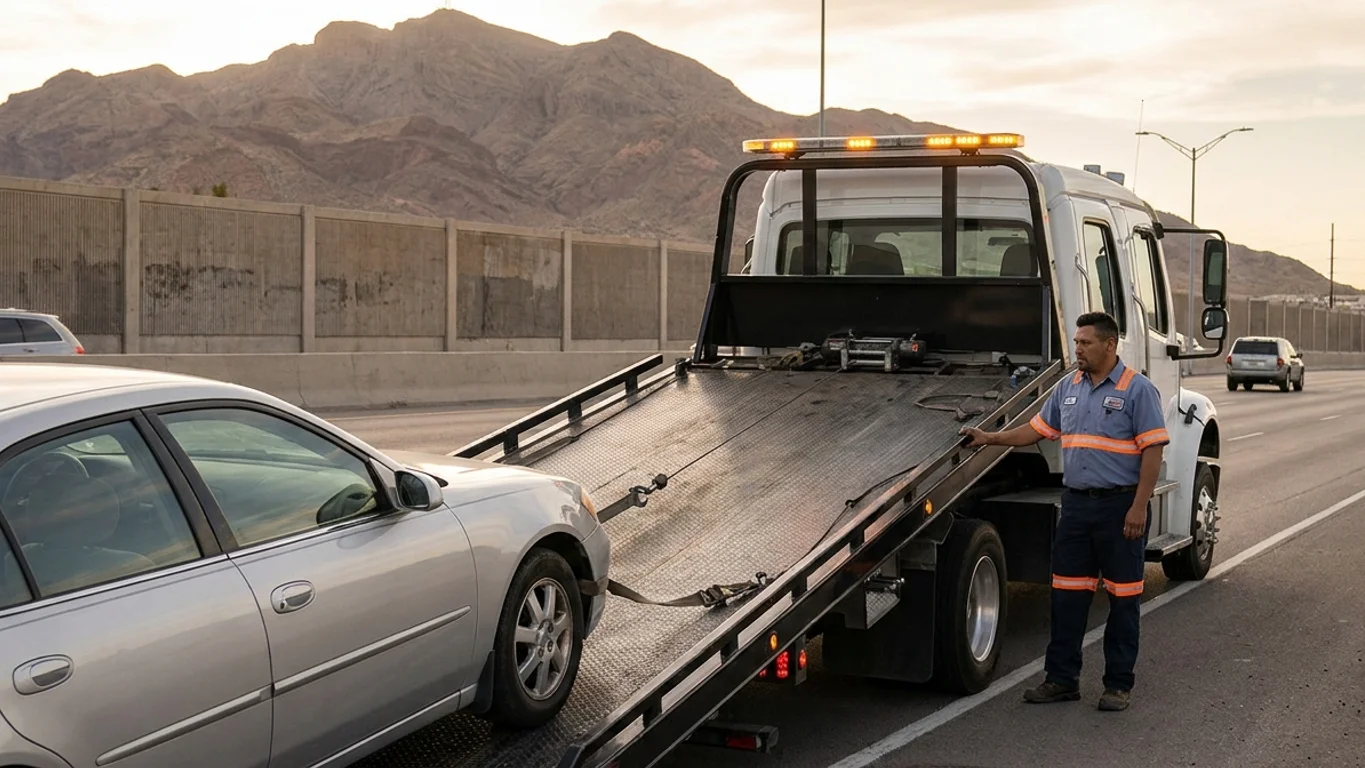
Call (915) 615-2224 right away. US-54, the Patriot Freeway, is a limited-access freeway with tight shoulders, fast traffic, and few safe places to stop between exits. A breakdown here isn’t like stalling on a city street with driveways and parking lanes nearby. Get off the travel lane, put your hazards on, and call for a tow before you try anything else.
What makes US-54 (the Patriot Freeway) different from other El Paso roads
Most people driving through northeast El Paso know US-54 as the fast way to Fort Bliss or the route north toward New Mexico. It’s officially the Patriot Freeway, renamed in 1993 after the Gulf War, and it runs as a limited-access freeway for roughly 20 miles connecting I-10 with Fort Bliss, northeast El Paso, and Chaparral, New Mexico. Limited access means no driveways and no quick pull-off like you’d find on a regular boulevard. Your real exit options are the interchange ramps themselves.
At the south end, US-54 runs into the three-level interchange locals call the Spaghetti Bowl, where it meets I-10 and briefly joins I-110 before splitting off toward the Bridge of the Americas. That interchange has been under active reconstruction, with TxDOT adding direct-connector ramps and rebuilding sections of it. Construction shifts lane patterns and narrows shoulders without much warning, so a spot with room to pull over last month might not have any this month.
The freeway also carries a heavy stream of military traffic tied to Fort Bliss, one of the Army’s largest installations, mixed in with commercial trucks. That mix of commuter volume and heavier vehicles is different from a typical surface street, and it’s exactly the kind of situation emergency towing service is built for.
Where can you actually pull over on US-54?
Options are thinner than you’d expect for a freeway this size. Near the Spaghetti Bowl at the south end, active construction zones mean the shoulder you expect might be blocked by barriers or narrowed to almost nothing. If you’re losing power near that interchange, limp to the nearest ramp rather than stopping on the main shoulder.
Further north, toward Fort Bliss and northeast El Paso, shoulders open up some, but they’re still freeway shoulders, not city curb lanes. There’s no driveway to coast into and no side street to duck onto. Exits are spaced out, so if trouble comes on, a rough idle, a shudder, a climbing temperature gauge, aim for the next exit sign instead of waiting for the engine to quit.
Near the north end, where US-54 connects toward Transmountain Road and Loop 375 into New Mexico, you’re getting further from central El Paso. A breakdown up near the state line can mean a longer haul to a shop, which is where long-distance towing comes in. Tell the dispatcher how far north you are so the right operator gets routed to you, not just the one closest to downtown.
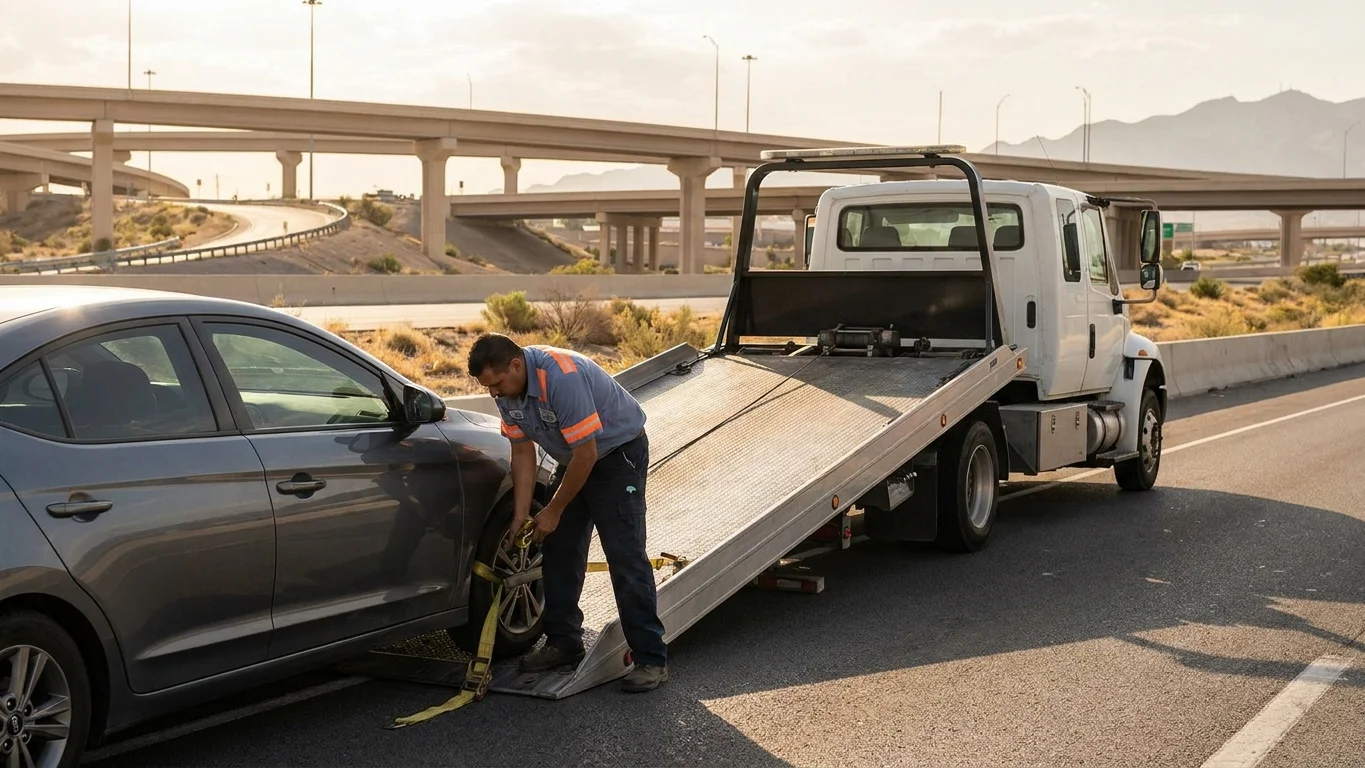
What to do, in order
- Turn on your hazard lights the moment something feels wrong.
- Ease toward the shoulder or the nearest exit ramp, whichever gets you off the main lanes fastest.
- If you can make it to an exit, take it. A surface street off-ramp beats sitting on a freeway shoulder.
- Once stopped, stay belted inside the vehicle if traffic is close, and exit on the passenger side away from live lanes.
- Call (915) 615-2224 and tell the dispatcher which mile marker, exit, or landmark you’re closest to.
- Turn on your interior light if it’s dark so approaching drivers see you sooner.
- If you have flares or reflective triangles, place them only if you can do it without stepping into a live lane.
Skip the roadside repair if trucks are still passing close. Getting off the freeway matters more than saving the tow.
How do the Spaghetti Bowl and Fort Bliss traffic factor in?
The Spaghetti Bowl isn’t just a nickname, it’s the reason a lot of US-54 breakdowns turn urgent fast. Three stacked levels of ramps, ongoing construction, and traffic merging in from I-10 and I-110 mean a stalled car near that interchange sits in one of the more complicated stretches of road in El Paso. See our post on breaking down on I-10 in El Paso for how that connecting freeway handles its own breakdowns.
North of the interchange, Fort Bliss shift changes push a steady wave of commuter and commercial traffic onto US-54 at predictable times of day. A tow operator who knows the corridor and its exits reaches you faster than one guessing at unfamiliar ramps. That’s why we treat northeast El Paso and Fort Bliss as their own coverage areas, not a generic citywide dispatch. Larger military and commercial vehicles sometimes need heavy-duty towing equipment a standard flatbed can’t handle.
How much does a tow from US-54 cost in El Paso?
Most light-duty tows in El Paso run on a flat rate based on distance, quoted on the phone before anyone gets sent out, with no added charge for nights or weekends. Exact cost depends on where your car sits on the corridor and where it needs to go, so for a full breakdown of El Paso tow pricing, see how much a tow costs in El Paso.
Frequently asked questions
Who do I call when I break down on US-54 in El Paso?
Call (915) 615-2224. Quick Tow El Paso covers the full US-54 corridor from the Spaghetti Bowl interchange with I-10 up through Fort Bliss, northeast El Paso, and the stretch toward Transmountain Road. Tell the dispatcher your exit or mile marker so a truck finds you faster on a road with no street addresses.
Is US-54 the same as the Patriot Freeway?
Yes. US-54 was officially renamed the Patriot Freeway in 1993, after the Gulf War. Locals use both names for the same limited-access freeway, which runs about 20 miles from the I-10 interchange downtown through Fort Bliss and northeast El Paso toward Chaparral, New Mexico.
Where can I safely pull over on US-54 if my car breaks down?
Get as far right as you can, and near the Spaghetti Bowl construction zone, treat the nearest exit ramp as your target instead of the shoulder. Shoulders widen somewhat past the interchange near Fort Bliss, but this freeway has no driveways or side streets, so an exit ramp is always the safer stop.
How fast can a tow truck reach me on US-54?
It depends on where you are on the corridor and current traffic, including any Spaghetti Bowl construction delays. Calling right away, rather than waiting to see if the car restarts, is what gets a truck moving toward you sooner.
How much does a tow from US-54 cost?
Pricing is a flat rate based on distance, quoted over the phone before dispatch, with no extra charge for nights or weekends. For the full pricing picture, see how much a tow costs in El Paso.